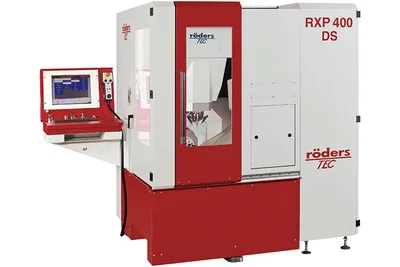
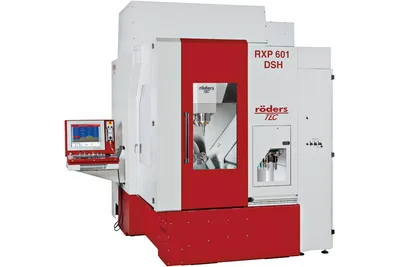
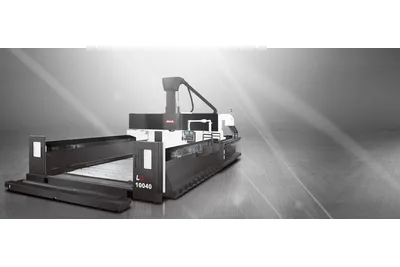
Röders RXP601 DS
This model was not found in Röders's current lineup when we checked on 2026-10-03 . It may be a superseded or older model; the specifications below are as we last recorded them.
Key Specifications
X Travel
Y Travel
Z Travel
Max Spindle
Spindle Taper
Weight
How much does the Röders RXP601 DS cost?
Estimated price range
Our best estimate for a 5-axis machining center in this class — not a quote from Röders. Configuration moves it a long way.
Overview
Two independent spindles are what set the Röders RXP601 DS apart. Each is listed at 17 kW (22.8 hp) and 24,000 RPM, and each has 600 mm (23.6 in) of X travel to itself, with 500 mm (19.7 in) of Y and 350 mm (13.8 in) of Z. The RXP601 DS is not shown in the current Röders lineup. These notes follow the listed figures, and a buyer should verify them on the machine.
Because the X travel is given per spindle, the machine can be thought of as two work zones side by side on one base. The spindles are described as independent, so the two can cut separate parts in parallel. What the listed figures do not show is how the Y and Z axes are shared between them, and that decides whether two different programs can run at once or only two copies of one. It is the key question to put to the seller.
Speed options of 42,000 and 60,000 RPM are listed, with CT 40 as the only taper. Neither the tool interface of the faster spindles nor whether both spindles must carry the same option is stated. With two spindles to tool up, the holder inventory doubles, so settle this early.
The machine sits on a Granitan mineral cast composite base, has linear motors on all axes, rapids at 60 m/min (2,362 ipm) and is listed at < 0.003 mm (< 3 µm) positioning accuracy. Weight is given as ~12,000 kg (26,455 lb). There are no rotary axis rows, no table size and no table load among the listed figures, so the 5-axis configuration and the payload both need confirming.
Full Specifications
| Parameter | Value |
|---|---|
| X-Axis Travel | 600 mm (23.6 in) per spindle |
| Y-Axis Travel | 500 mm (19.7 in) |
| Z-Axis Travel | 350 mm (13.8 in) |
| Spindle Count | 2 (independent dual spindle) |
| Max Spindle Speed | 24,000 RPM (42,000 / 60,000 RPM optional) |
| Spindle Taper | CT 40 |
| Spindle Motor Power | 17 kW (22.8 hp) per spindle |
| Rapid Traverse Rate | 60 m/min (2,362 ipm) |
| Positioning Accuracy | < 0.003 mm (< 3 µm) |
| Machine Base | Granitan mineral cast composite |
| Drives | Linear motors (all axes) |
| CNC Control | Röders RMS6 (Siemens Sinumerik optional) |
| Machine Weight | ~12,000 kg (26,455 lb) |
Specifications compiled from manufacturer literature and industry references. Not independently verified against a published spec sheet — confirm with the manufacturer or an authorised dealer before making a purchasing decision.
Strengths & Limitations
Strengths
- Two independent spindles, each listed at 17 kW (22.8 hp)
- 600 mm (23.6 in) of X travel per spindle, with 500 mm (19.7 in) of Y and 350 mm (13.8 in) of Z
- 24,000 RPM listed, with 42,000 and 60,000 RPM spindle options
- Linear motors on all axes, 60 m/min (2,362 ipm) rapids and < 0.003 mm (< 3 µm) listed positioning accuracy
Limitations
- No rotary axis, table size or table load rows are listed
- Nothing in the listed figures says how Y and Z are shared between the two spindles
- The weight of ~12,000 kg (26,455 lb) is approximate; the foundation and lift plan need the exact figure
- CT 40 is the only taper listed, and the interface of the 42,000 and 60,000 RPM options is not stated
Best For
Frequently Asked Questions
01
Two. The spindle count row reads 2, independent dual spindle, and spindle power is 17 kW (22.8 hp) per spindle. X travel is given as 600 mm (23.6 in) per spindle, so each spindle has its own working zone along X.
02
X travel is 600 mm (23.6 in) per spindle, Y is 500 mm (19.7 in) and Z is 350 mm (13.8 in). The Y and Z rows are not marked per spindle, so whether those axes move together or separately for the two spindles has to be confirmed.
03
Maximum spindle speed is 24,000 RPM, with 42,000 and 60,000 RPM as options. The taper row reads CT 40. The table does not give a different interface for the optional spindles, so check what is fitted to each spindle before buying holders.
04
Weight is listed as ~12,000 kg (26,455 lb), marked approximate. The base is Granitan mineral cast composite. No footprint or power requirement is listed, so the installation drawing is needed before the floor and the electrical supply are prepared.
Videos

The Equipment Hub

Tezmaksan Makina