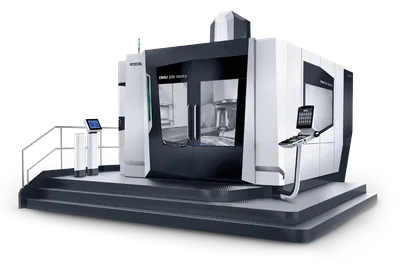
Roeders RP500
This model was not found in Roeders's current lineup when we checked on 2026-10-03 . It may be a superseded or older model; the specifications below are as we last recorded them.
Key Specifications
X Travel
Y Travel
Z Travel
Max Spindle
Spindle Taper
Tool Capacity
How much does the Roeders RP500 cost?
Estimated price range
Our best estimate for a 5-axis machining center in this class — not a quote from Roeders. Configuration moves it a long way.
Overview
The Roeders RP500 is a compact 5-axis high-speed machining center: 500 x 450 x 350 mm of travel (19.7 x 17.7 x 13.8 in), a 42,000 RPM spindle and a swivel table carrying up to 100 kg (220 lb). The current Roeders lineup does not include an RP500, so this page works from the listed figures, which an inspection of the actual machine should confirm.
Both rotary axes are in the table. B is a swivel table with a range of ±115 degrees and C rotates continuously without limit, so the part is tilted and turned under the spindle. The working envelope is stated directly: 500 mm (19.7 in) maximum workpiece diameter on the table and 300 mm (11.8 in) maximum height. With only 100 kg (220 lb) allowed, the part, the fixture and any pallet or chuck all count against the limit.
The spindle is listed at 22 kW (29.5 hp), with HSK-E32 as standard and HSK-A63 as an option. Those are very different tool interfaces, and the one fitted sets the practical range of cutter sizes, so it is the first thing to establish. Tools come from a 24-station magazine, or a 60-station magazine where that option was bought, with a 1.5 sec tool-to-tool time.
X, Y and Z run on linear drives at 60,000 mm/min (2,362 ipm) with 0.5 g of acceleration. Listed positioning accuracy is ±0.002 mm (±0.00008 in) and repeatability ±0.001 mm (±0.00004 in), on a Granitan mineral casting base. The machine weighs 5,500 kg (12,125 lb), occupies approximately 2.2 m x 2.8 m and is listed for a 400 VAC 3-phase 50 Hz supply, which matters if it is going to a site with a different mains standard.
Full Specifications
| Parameter | Value |
|---|---|
| X-Axis Travel | 500 mm (19.7 in) |
| Y-Axis Travel | 450 mm (17.7 in) |
| Z-Axis Travel | 350 mm (13.8 in) |
| B Axis Range | ±115 degrees (swivel table) |
| C Axis Rotation | Unlimited continuous |
| Max Workpiece Diameter on Table | 500 mm (19.7 in) |
| Max Workpiece Height | 300 mm (11.8 in) |
| Max Table Load | 100 kg (220 lb) |
| Max Spindle Speed | 42,000 RPM |
| Spindle Motor Power | 22 kW (29.5 hp) |
| Spindle Taper | HSK-E32 (standard); HSK-A63 (option) |
| Drive Type | Linear drives on X, Y, Z axes |
| Acceleration Max | 0.5 g (all axes) |
| Rapid Traverse Rate | 60,000 mm/min (2,362 ipm) X/Y/Z |
| Positioning Accuracy | ±0.002 mm (±0.00008 in) |
| Repeatability | ±0.001 mm (±0.00004 in) |
| Machine Base | Granitan mineral casting |
| Tool Capacity | 24-station magazine (standard); 60-station optional |
| Tool Change (tool-to-tool) | 1.5 sec |
| Machine Weight | 5,500 kg (12,125 lb) |
| CNC Control | Roeders RMS6 (Fanuc-based high-speed contouring) |
| Floor Space Required | approximately 2.2 m x 2.8 m |
| Electrical | 400 VAC 3-phase 50 Hz |
Specifications compiled from manufacturer literature and industry references. Not independently verified against a published spec sheet — confirm with the manufacturer or an authorised dealer before making a purchasing decision.
Strengths & Limitations
Strengths
- 42,000 RPM spindle rated at 22 kW (29.5 hp)
- Linear drives on X, Y and Z with 60,000 mm/min (2,362 ipm) rapids and 0.5 g acceleration
- Listed positioning accuracy of ±0.002 mm (±0.00008 in) and repeatability of ±0.001 mm (±0.00004 in)
- ±115 degrees of B swivel combined with unlimited continuous C rotation
- 1.5 sec tool-to-tool change from a 24-station magazine, with a 60-station magazine optional
- Footprint of approximately 2.2 m x 2.8 m for a machine weighing 5,500 kg (12,125 lb)
Limitations
- Table load is limited to 100 kg (220 lb), fixture included
- Workpieces cannot exceed 500 mm (19.7 in) in diameter or 300 mm (11.8 in) in height
- HSK-A63 is an option; the standard HSK-E32 interface restricts shank and cutter size
- The standard magazine has 24 stations and the 60-station magazine is an option
- The electrical supply is listed as 400 VAC 3-phase 50 Hz, so a site on a different voltage or frequency has to plan for that
Best For
Frequently Asked Questions
01
The listed maximum workpiece diameter on the table is 500 mm (19.7 in) and the maximum height is 300 mm (11.8 in). Maximum table load is 100 kg (220 lb). Axis travel is 500 mm (19.7 in) in X, 450 mm (17.7 in) in Y and 350 mm (13.8 in) in Z.
02
The spindle is listed at 42,000 RPM and 22 kW (29.5 hp). HSK-E32 is the standard taper and HSK-A63 is an option. Holders for the two do not interchange, so confirm which interface is on the machine before pricing tooling.
03
A 24-station magazine is standard and a 60-station magazine is listed as an option. Tool-to-tool change time is 1.5 sec. The table gives no maximum tool diameter, length or weight, so take those limits from the machine's documents.
04
Positioning accuracy is listed at ±0.002 mm (±0.00008 in) and repeatability at ±0.001 mm (±0.00004 in). The axes X, Y and Z use linear drives and the base is Granitan mineral casting. On a machine in service, ask for a current calibration report to see what it holds now.
05
The machine weighs 5,500 kg (12,125 lb) and has a footprint of approximately 2.2 m x 2.8 m. The electrical row reads 400 VAC 3-phase 50 Hz. No connected load, air supply or coolant figures are listed, so those need to come from the installation documents.
More from Roeders
Other 5-Axis Machining Centers
Starrag Bumotec s181
Hartford Aero-836G
Fidia ARIAL 50L
AWEA LG-4030