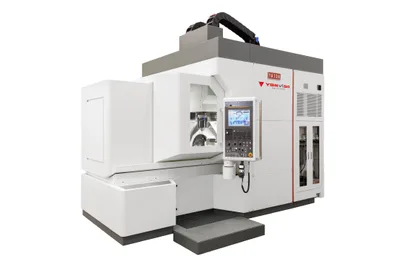
Zayer ARES
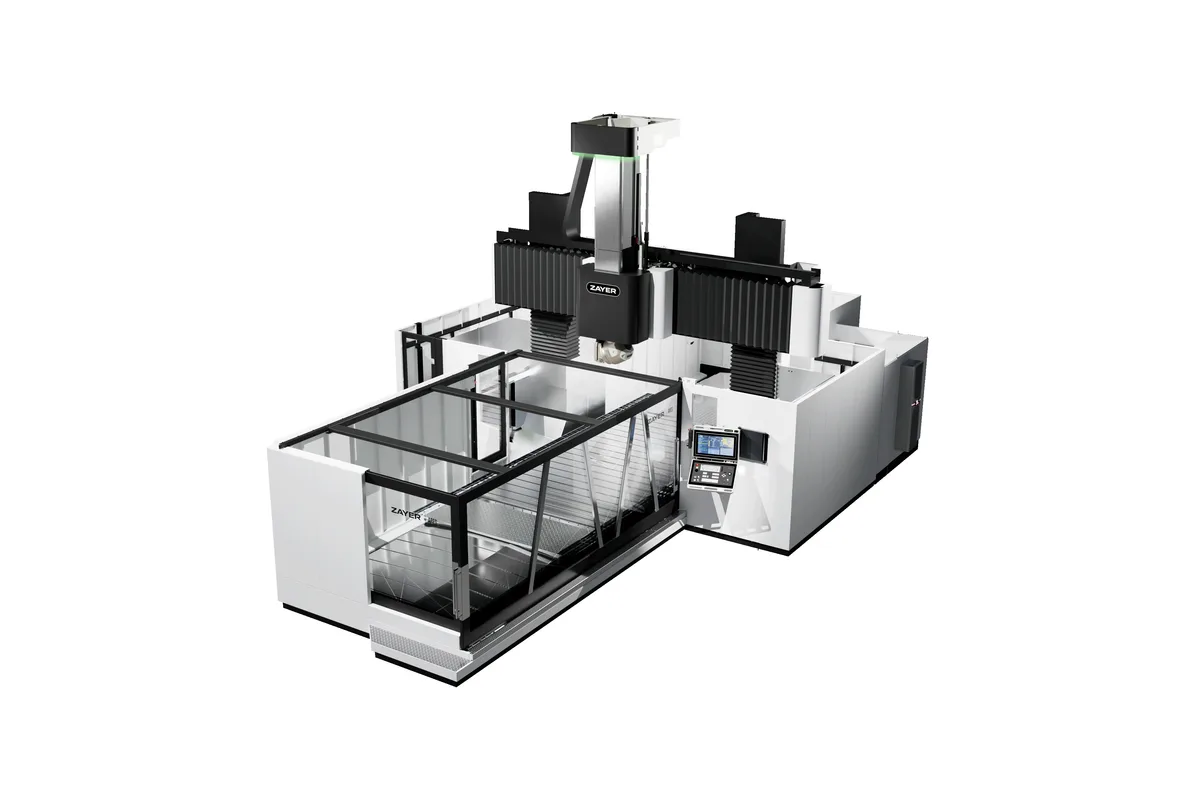
Image: zayer.com, Zayer
Key Specifications
Tool Capacity
Rapid Traverse
Accuracy
Repeatability
table length
table width
How much does the Zayer ARES cost?
Price estimate
We do not have a price for the Zayer ARES that we can stand behind, so we show no number. Configuration, options and installation move the final price a long way: a quote is the reliable figure.
Overview
The Zayer ARES is a bridge type milling machine with a moving table and a moving cross beam. The cross beam is the point of the design: it travels 900 mm (35.4 in) as a programmable W axis, so the ram can stay short on low parts and the bridge can be raised for tall ones. Zayer's own summary is maximum machine rigidity regardless of the height of the part.
X travel and table length are 4,000, 5,000 or 6,000 mm (157.5, 196.9 or 236.2 in). Y travel is 3,350 mm (131.9 in), with 3,850 mm (151.6 in) optional, between columns 2,750 mm (108.3 in) apart, or 3,250 mm (128.0 in). Z is 1,200 mm (47.2 in), or 1,500 mm (59.1 in) as an option. The table is 2,000 mm (78.7 in) wide, optionally 2,500 mm (98.4 in), and carries 20,000 kg (44,092 lb).
As on the ARION, the buyer chooses between high torque and high speed heads, and the choice runs through the whole table. High torque means 6,000 rpm and 30 kW (40.2 hp), 43 kW (57.7 hp) optional, with rapid feed up to 35,000 mm/min (1,378 ipm). High speed means 18,000 rpm and 33 kW (44.3 hp), with rapid feed listed at 40,000 mm/min (1,575 ipm). The longitudinal axis is a rack with a double motor and pinion; cross and vertical are ball screws.
Zayer says the W axis can be used as a positioning axis or as a machining axis. That distinction matters: on the ALTEA W the maker describes the same 900 mm (35.4 in) beam only as a positioning axis. The magazine holds 30 tools, with 40, 60 or 80 optional, and automatic change of heads is an option. The enclosure is open on top as standard, with a roof available.
Full Specifications
| Parameter | Value |
|---|---|
| Table Length | 4,000 - 5,000 - 6,000 mm (157.5 - 196.9 - 236.2 in) |
| Table Width | 2,000 mm (78.7 in); 2,500 mm (98.4 in) optional |
| Distance Between Columns | 2,750 mm (108.3 in); 3,250 mm (128.0 in) optional |
| X Axis Travel | 4,000 - 5,000 - 6,000 mm (157.5 - 196.9 - 236.2 in) |
| Y Axis Travel | 3,350 mm (131.9 in); 3,850 mm (151.6 in) optional |
| Z Axis Travel | 1,200 mm (47.2 in); 1,500 mm (59.1 in) optional |
| W Axis Travel | 900 mm (35.4 in) |
| Max Distance Table to Spindle Nose | 1,440 mm (56.7 in); 1,740 - 2,040 mm (68.5 - 80.3 in) optional (high torque) / 1,240 mm (48.8 in); 1,540 - 1,840 mm (60.6 - 72.4 in) optional (high speed) |
| Rapid Traverse Rate | up to 35,000 mm/min (1,378 ipm) (high torque) / 40,000 mm/min (1,575 ipm) (high speed) |
| Cutting Feed Rate | up to 30,000 mm/min (1,181 ipm) (high torque) / 35,000 mm/min (1,378 ipm) (high speed) |
| Longitudinal Axis Drive | Rack and double motor and pinion |
| Cross Axis Drive | ball screw |
| Vertical Axis Drive | ball screw |
| Power | 30 kW (40.2 hp); 43 kW (57.7 hp) optional (high torque) / 33 kW (44.3 hp) (high speed) |
| Spindle Speed | 6,000 rpm (high torque) / 18,000 rpm (high speed) |
| Positioning Accuracy | 0.008/4,000 mm |
| Repeatability | 0.005/4,000 mm |
| Max Table Load | 20,000 kg (44,092 lb) |
| Tool Capacity | 30; 40 - 60 - 80 optional |
Specifications sourced from zayer.com — verified 2026-10-04
Strengths & Limitations
Strengths
- Moving cross beam with 900 mm (35.4 in) of travel, programmable as a positioning or a machining axis
- Three lengths: 4,000, 5,000 or 6,000 mm (157.5, 196.9 or 236.2 in) of X travel
- 20,000 kg (44,092 lb) table load
- High speed version with 18,000 rpm and rapid feed of 40,000 mm/min (1,575 ipm)
- Automatic change of heads is available as an option
Limitations
- Power in the high torque version is 30 kW (40.2 hp) unless the 43 kW (57.7 hp) option is taken; the TEBAS starts at 43 kW (57.7 hp)
- High torque spindle speed is 6,000 rpm with no faster option listed
- The largest optional magazine holds 80 tools
- No machine weight is published for the ARES
Best For
Frequently Asked Questions
01
It adds a W axis with 900 mm (35.4 in) of displacement. Zayer describes it as programmable and usable either as a positioning axis or as a machining axis. Raising or lowering the beam changes the clearance under the bridge without extending the ram, which is how the machine keeps its rigidity on both low and tall parts.
02
Three: 4,000, 5,000 or 6,000 mm (157.5, 196.9 or 236.2 in) of X travel, with a table of the same length. Standard Y is 3,350 mm (131.9 in) and standard Z is 1,200 mm (47.2 in). Options are 3,850 mm (151.6 in) of Y and 1,500 mm (59.1 in) of Z.
03
Zayer gives the maximum distance from table to spindle nose as 1,440 mm (56.7 in) with a high torque head, with 1,740 or 2,040 mm (68.5 or 80.3 in) as options. With a high speed head the figures are 1,240 mm (48.8 in), and 1,540 or 1,840 mm (60.6 or 72.4 in) optional.
04
In the high torque family a 45º head is standard, with a continuous-rotation 45º head, a 30º head and a direct outlet head optional. In the high speed family a 30º head with electrospindle is standard and a 40º head with a 42 kW, 15,000 rpm electrospindle is optional.
05
The ARES has the moving cross beam; the plain TEBAS does not. The TEBAS is the heavier roughing machine, with 43 kW (57.7 hp) as standard, 3,750 mm (147.6 in) of Y travel and rapid feed up to 50,000 mm/min (1,969 ipm). Both carry 20,000 kg (44,092 lb) and share the 4,000 to 6,000 mm range of X travel.
More from Zayer
Other 5-Axis Machining Centers
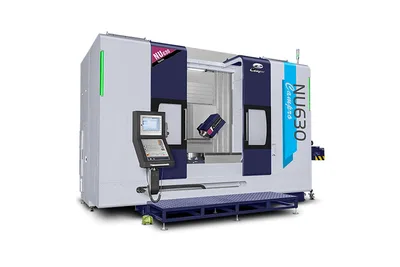
Campro NU 630
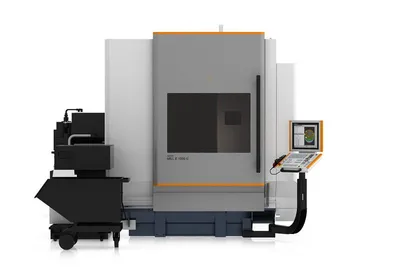
GF Machining Mikron MILL E 1400 U ST
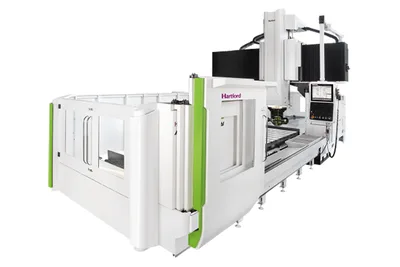
Hartford HSA-636EAY
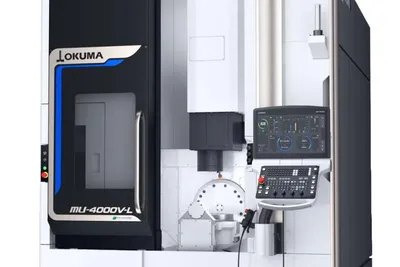
Okuma MU-4000V
Yasda YBM Vi50