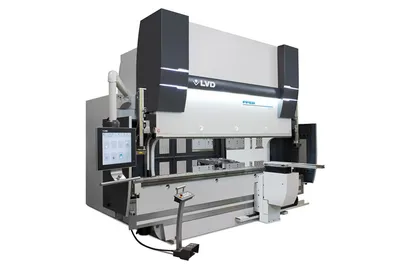
Durma AD-EB 2580
Key Specifications
bending force
bending length
distance between columns
stroke
daylight
working height
How much does the Durma AD-EB 2580 cost?
Price estimate
We do not have a price for the Durma AD-EB 2580 that we can stand behind, so we show no number. Configuration, options and installation move the final price a long way: a quote is the reliable figure.
Overview
The Durma AD-EB 2580 is an electric press brake that moves its beam with belts and pulleys instead of cylinders or ball screws. It is rated at 80 ton over a 2,550 mm (100.4 in) bending length. Durma lists a coupled motor and reducer and a belt and pulley tackle system as the press group, and no hydraulic oil is used.
One figure in the table is unusual. The distance between columns, 2,840 mm (111.8 in), is larger than the bending length. On a conventional machine the side frames stand inside the bed length and limit how deep a full-length part can go. Here a 2,550 mm part passes between the columns, so the back gauge depth and not the frame decides how deep a long panel can be bent. The table gives no throat depth for that reason.
Open height is generous: 320 mm (12.6 in) of stroke and 500 mm (19.7 in) of daylight. The beam approaches and returns at 105 mm/s. Bending speed is listed as 10-20 mm/s, with a note that under the CE norm it should be a maximum of 10 mm/sec except for robot-aided use.
Standard equipment is a DA-66S control with four axes, Y1, Y2, X and R. The aluminium back gauge travels 650 mm (25.6 in) in X and 250 mm (9.8 in) in R; an X axis of 1000 mm with light barrier back protection is optional. Durma says the body is bolted, not welded. It weighs 6,400 kg (14,109 lb) and measures 3,700 mm (145.7 in) by 2,200 mm (86.6 in) on the floor.
Full Specifications
| Parameter | Value |
|---|---|
| Bending Force | 80 ton |
| Bending Length | 2,550 mm (100.4 in) |
| Distance Between Columns | 2,840 mm (111.8 in) |
| Stroke | 320 mm (12.6 in) |
| Daylight | 500 mm (19.7 in) |
| Working Height | 1,085 mm (42.7 in) |
| Approaching Speed | 105 mm/s |
| Bending Speed | 10-20 mm/s |
| Return Speed | 105 mm/s |
| Back Gauge X Axis Travel | 650 mm (25.6 in) |
| Back Gauge R Axis Travel | 250 mm (9.8 in) |
| Machine Length | 3,700 mm (145.7 in) |
| Machine Width | 2,200 mm (86.6 in) |
| Machine Height | 2,550 mm (100.4 in) |
| Machine Weight | 6,400 kg (14,109 lb) |
Specifications sourced from durmazlar.com.tr — verified 2026-10-05
Strengths & Limitations
Strengths
- 2,840 mm (111.8 in) between columns, wider than the 2,550 mm (100.4 in) bending length
- Belt and pulley electric drive with no hydraulic oil
- 320 mm (12.6 in) stroke and 500 mm (19.7 in) daylight
- 105 mm/s approaching and return speed
- DA-66S control and a 4-axis setup (Y1, Y2, X, R) as standard
Limitations
- 80 ton is the smaller of the two ratings in the series
- Bending speed above 10 mm/sec is reserved for robot-aided use under the CE norm
- At 2,200 mm (86.6 in) wide it takes more depth on the floor than its length suggests
- Motorized Z1 and Z2 axes and the DA-69S control are options
Best For
Frequently Asked Questions
01
Electrically, through belts. Durma lists a motor coupled to a reducer and a belt system with pulley tackle as the press group, and calls it a hydraulic oil-free drive system. The body is bolted and machined, according to the brochure.
02
80 ton of bending force over 2,550 mm (100.4 in). The distance between columns is 2,840 mm (111.8 in), stroke 320 mm (12.6 in), daylight 500 mm (19.7 in) and working height 1,085 mm (42.7 in).
03
Approaching speed and return speed are both 105 mm/s. Bending speed is given as 10-20 mm/s. Durma's footnote says that according to the CE norm the bending speed should be a maximum of 10 mm/sec, except for robot-aided use.
04
The AD-EB 30135 is the larger machine: 135 ton over 3,050 mm (120.1 in), at 7,300 kg (16,093 lb). Stroke, daylight and back gauge travel are the same on both. The AD-EB 2580 is slightly quicker in approach and return, 105 mm/s against 100 mm/s on the AD-EB 30135, and weighs 6,400 kg (14,109 lb).
Videos

Durma International

DIMAKIN Soluções Industriais

The Engineering Technology Group Limited

Minsen MC
More from Durma
Other CNC Press Brakes
Ermak Power-Bend Falcon 2600-100
Trumpf TruBend 7036
LVD Easy-Form 170/30
Salvagnini P2