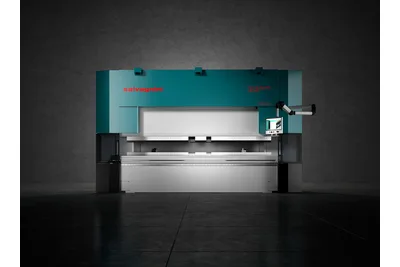
Salvagnini P2
Key Specifications
max bending length
max bend height
material thickness mild steel
control
maximum length of incoming sheet
maximum width of incoming sheet
How much does the Salvagnini P2 cost?
Estimated price range
Our best estimate for a cnc press brake in this class — not a quote from Salvagnini. Configuration moves it a long way.
Overview
The Salvagnini P2 is a panel bender for mild steel from 0.4 to 3.2 mm (0.016-0.126 in) thick, with a maximum bend height of 203 mm (8 in) and Salvagnini's MAC 3.0 control. Those rows carry units. The rest of the technical data is printed as plain numbers.
Sheet size is set by three of those rows: incoming sheet up to 1995 long and 1414 wide, and a maximum diagonal that can be rotated of 2000. The diagonal is the one that catches people out. A blank has to turn on the table so each edge can be presented for bending, and a blank at both the full length and the full width has a longer diagonal than 2000. The two maxima cannot be used on the same part, so check the corner-to-corner dimension of your largest panel as well as its sides.
Bending length needs a question to the supplier. One row gives a maximum bending length of 2,500 mm (98.4 in). Another, in the technical-data block, reads 400-1000 for maximum bending length, and the incoming sheet is capped at 1995. These rows do not agree, and the table does not link them to named variants, so have the figure confirmed for the exact machine on the quotation.
Maximum bending force is 240 and maximum clamping force 380. Average absorbed power is listed at 3.0 and noise level at 68, again without units. No thickness range appears for stainless or aluminum.
Full Specifications
| Parameter | Value |
|---|---|
| Max Bending Length | 2,500 mm (98.4 in) |
| Max Bend Height | 203 mm (8 in) |
| Material Thickness Mild Steel | 0.4-3.2 mm (0.016-0.126 in) |
| CNC Control | MAC 3.0 |
| Maximum Length of Incoming Sheet | 1995 |
| Maximum Width of Incoming Sheet | 1414 |
| Maximum Diagonal That Can Be Rotated | 2000 |
| Maximum Bending Force | 240 |
| Maximum Clamping Force | 380 |
| Maximum Bending Length | 400-1000 |
| Maximum Bending Height | 203 |
| Minimum Thickness | 0.4 |
| Average Absorbed Power | 3.0 |
| Noise Level | 68 |
Specifications sourced from salvagninigroup.com — verified 2026-10-03
Strengths & Limitations
Strengths
- Bends mild steel from 0.4 to 3.2 mm (0.016-0.126 in)
- Maximum bend height of 203 mm (8 in)
- MAC 3.0 control listed for the machine
- Incoming sheet up to 1995 long and 1414 wide, with a rotatable diagonal of 2000
- Maximum clamping force of 380 holding the sheet against a maximum bending force of 240
Limitations
- The two bending-length rows disagree: 2,500 mm (98.4 in) in one, 400-1000 in the other
- The rotatable diagonal of 2000 is shorter than the diagonal of a full 1995 by 1414 blank, so both maxima cannot be used on one part
- Mild steel thickness ends at 3.2 mm (0.126 in)
- No thickness range is listed for stainless or aluminum
- Sheet-size, force, power and noise rows are printed without units
Best For
Frequently Asked Questions
01
Mild steel from 0.4 to 3.2 mm (0.016-0.126 in). The minimum thickness row repeats the 0.4 figure. Salvagnini's table gives no range for stainless or aluminum, so ask for those limits if the work is not mild steel.
02
Incoming sheet can be up to 1995 long and 1414 wide, and the maximum diagonal that can be rotated is 2000. A blank at both the full length and the full width has a longer diagonal than that, so in practice the diagonal is the limit for large panels.
03
The table is not consistent on this. One row gives 2,500 mm (98.4 in). A second row for maximum bending length reads 400-1000, and the incoming sheet length is limited to 1995. Have the bending length confirmed for the exact variant being quoted.
04
Maximum bend height is 203 mm (8 in). The technical-data block repeats the same 203 for maximum bending height, so on this figure the two parts of the table agree.
05
Average absorbed power is listed at 3.0 and noise level at 68. Neither row prints a unit, and no supply voltage is given, so the electrical connection has to be specified from the supplier's installation data.