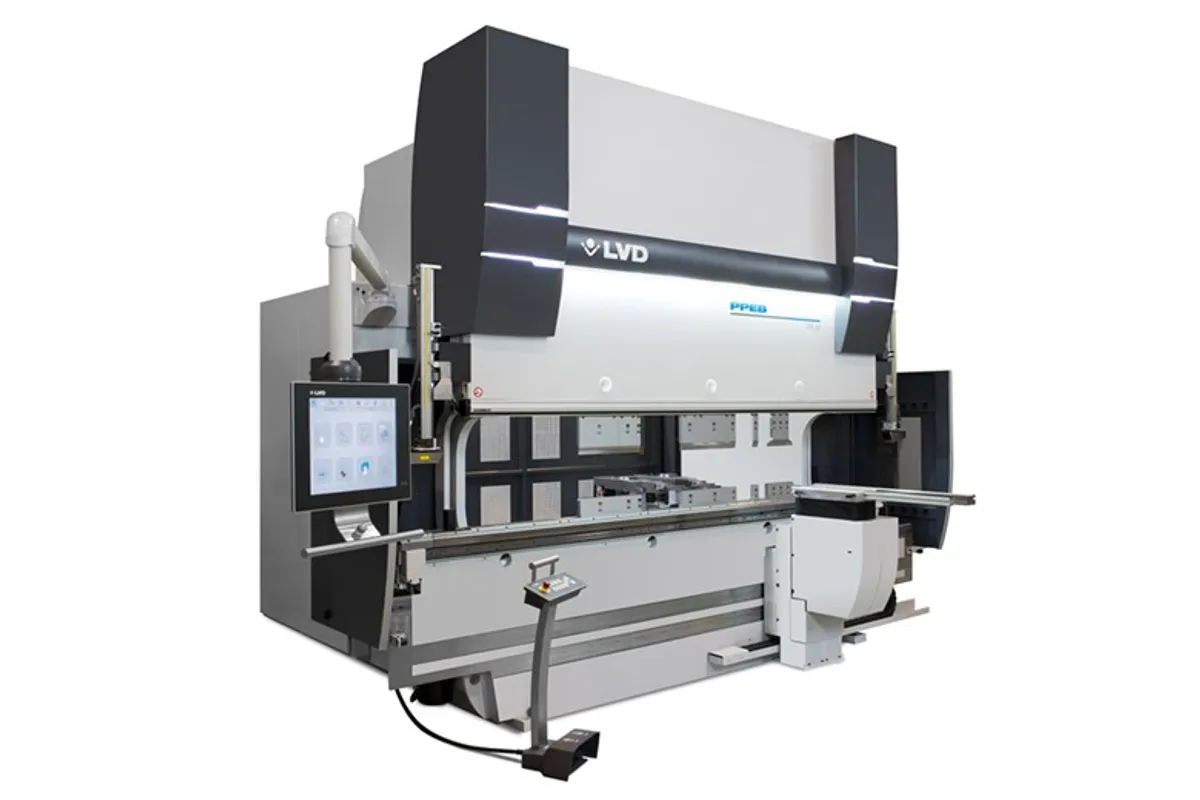
LVD PPEB 320/40
Key Specifications
bending length
distance between columns
table width
throat depth
approach speed
working speed
How much does the LVD PPEB 320/40 cost?
Estimated price range
Our best estimate for a cnc press brake in this class — not a quote from LVD. Configuration moves it a long way.
Overview
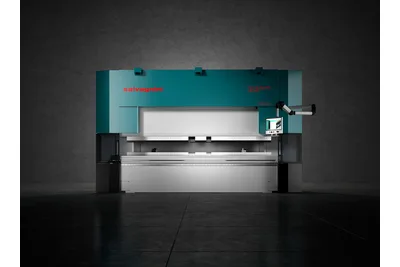
The LVD PPEB 320/40 is a press brake with a 4,000 mm (157 in) bending length and a tall working envelope: 300 mm (11.8 in) of ram stroke under a 570 mm (22.4 in) open height. LVD lists a 37 kW motor and a machine weight of 23,000 kg (50,706 lb).
Stroke and open height are the figures that matter for deep work. Tall punches, deep dies and parts with high return flanges all eat into the opening, and 570 mm leaves room for them with clearance left to withdraw the formed part. The same bed carries a table 200 mm (7.87 in) wide at a working height of 1,000 mm (39.4 in).
There are 3,150 mm (124 in) between the columns, and the throat is 400 mm (15.7 in) deep. A part up to 3,150 mm long can go to any depth. From there up to the full 4,000 mm it must stay within the throat.
The ram approaches at 120 mm/s, works at 14 mm/sec (0.55 in/sec) and returns at 130 mm/s. The backgauge is offered with up to 6 axes (X, R, Z1, Z2, X2, R2). The wording means the axis count depends on the configuration ordered, so confirm which axes are on the quotation. The table gives no bending force. For scale, the Easy-Form 3100/135 has a 3,050 mm (120 in) bending length and weighs 9,500 kg (20,944 lb).
Full Specifications
| Parameter | Value |
|---|---|
| Bending Length | 4,000 mm (157 in) |
| Distance Between Columns | 3,150 mm (124 in) |
| Table Width | 200 mm (7.87 in) |
| Throat Depth | 400 mm (15.7 in) |
| Approach Speed | 120 mm/s |
| Working Speed | 14 mm/sec (0.55 in/sec) |
| Return Speed | 130 mm/s |
| Backgauge Axes | Up to 6 axes (X, R, Z1, Z2, X2, R2) |
| Width Between Columns | 3,150 mm (124 in) |
| Ram Stroke | 300 mm (11.8 in) |
| Open Height | 570 mm (22.4 in) |
| Working Height | 1,000 mm (39.4 in) |
| Bending Speed | 14 mm/s |
| Motor Power | 37 kW |
| Machine Weight | 23,000 kg (50,706 lb) |
Specifications sourced from lvdgroup.com — verified 2026-10-03
Strengths & Limitations
Strengths
- 300 mm (11.8 in) ram stroke and 570 mm (22.4 in) open height for deep parts and tall tooling
- 4,000 mm (157 in) bending length with 3,150 mm (124 in) between the columns
- Backgauge available with up to 6 axes (X, R, Z1, Z2, X2, R2)
- 37 kW motor, with a 120 mm/s approach and a 130 mm/s return
- Table width of 200 mm (7.87 in)
Limitations
- Working speed is 14 mm/sec (0.55 in/sec)
- Weighs 23,000 kg (50,706 lb), more than twice the 9,500 kg (20,944 lb) of the Easy-Form 3100/135
- Six backgauge axes is the upper limit of the offer, not what every machine has
- Parts longer than 3,150 mm (124 in) must fit within the 400 mm (15.7 in) throat
Best For
Frequently Asked Questions
01
Ram stroke is 300 mm (11.8 in) and open height is 570 mm (22.4 in). Working height is 1,000 mm (39.4 in) and the table is 200 mm (7.87 in) wide.
02
Bending length is 4,000 mm (157 in). The distance between the columns is 3,150 mm (124 in), so a part up to that length passes between the side frames. A longer part has to sit within the throat, which is 400 mm (15.7 in) deep.
03
LVD lists up to 6 axes: X, R, Z1, Z2, X2 and R2. That is the maximum, and a given machine may have fewer, so check the axes named on the quotation or fitted to the machine.
04
Approach speed is 120 mm/s, working speed is 14 mm/sec (0.55 in/sec) and return speed is 130 mm/s. Motor power is 37 kW. Machine weight is 23,000 kg (50,706 lb).
Videos

Heinz Sanders GmbH
Comparisons
More from LVD
Other CNC Press Brakes
Yawei PBA-300/4100
Durma PBF 40160
Yawei PBH(A)-800/8200
Durma AD-S 30320
Salvagnini B3 AU-TO 170/4250