Breton Matrix E1 800 K20
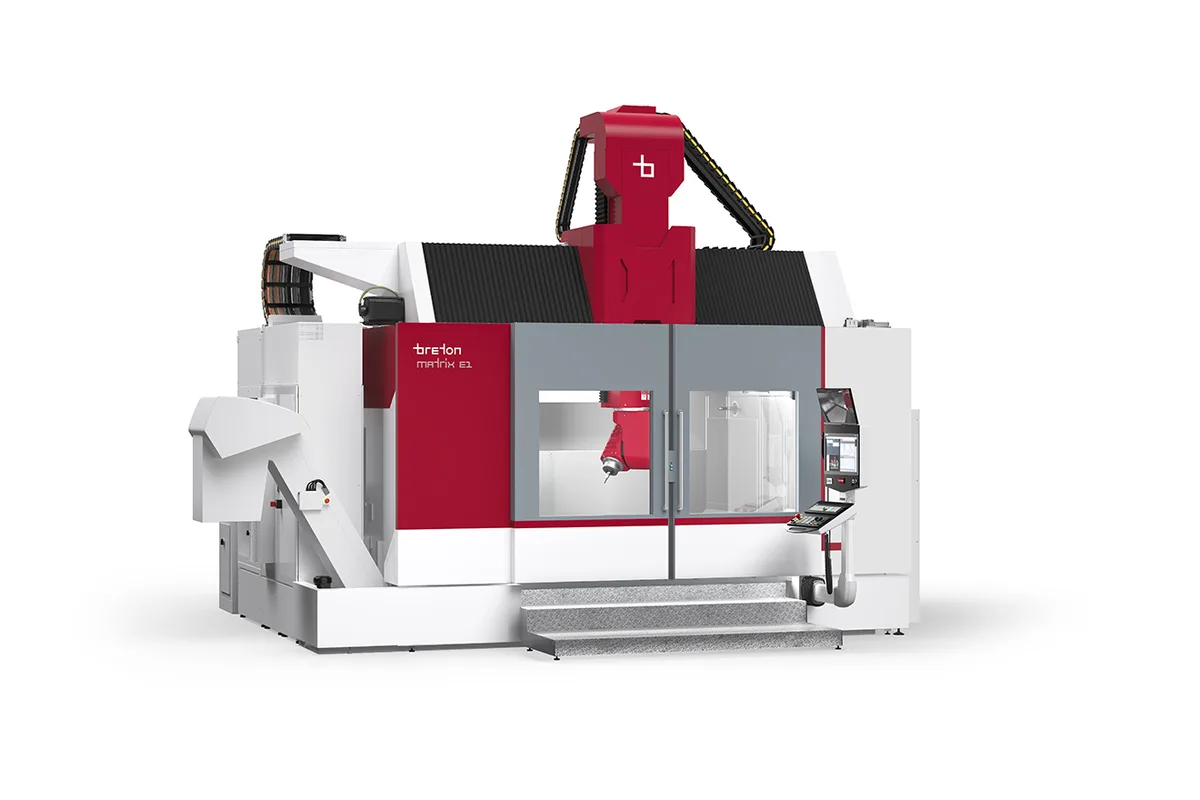
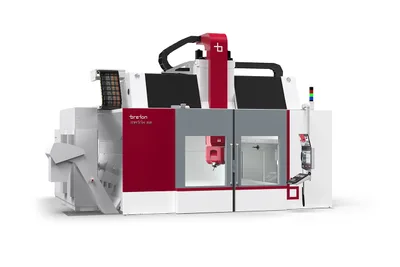
Image: breton.it, Breton
Key Specifications
Spindle Taper
x axis travel
y axis travel
z axis travel
rapid traverse x
rapid traverse y
How much does the Breton Matrix E1 800 K20 cost?
Price estimate
We do not have a price for the Breton Matrix E1 800 K20 that we can stand behind, so we show no number. Configuration, options and installation move the final price a long way: a quote is the reliable figure.
Overview
The Breton Matrix E1 800 K20 is the lowest of three Z heights of the Matrix E1, a monobloc 5-axis gantry machining centre for steel, lightweight alloys and special composites. Travels are 2,000 mm (78.7 in) in X, 2,500 mm (98.4 in) in Y and 800 mm (31.5 in) in Z. Breton positions the E1 for hi-feed roughing, semi-finishing and finishing of medium-size workpieces, with moulds and dies named first among the applications.
Note which axis is the long one. The cross travel is greater than the longitudinal travel, which keeps the machine shallow from front to back and puts the work close to the operator. The workbench is listed as 2,000 mm (78.7 in) long and 1,000 mm (39.4 in) wide, shorter than on the two taller versions: the Breton Matrix E1 1000 K20 lists a length of 2,500 mm (98.4 in).
An 800 mm (31.5 in) vertical stroke suits plate-like and shallow work, such as die inserts, mould halves of moderate depth and aerostructure parts cut from slab. Once the tool is tilted, part of that stroke goes to head clearance, so deep cavities belong on a taller sibling.
All three linear axes use direct motors, which Breton says removes the backlash and vibration that drive belts cause. Rapids are 50 m/min (1,969 ipm) in X and Y and 40 m/min (1,575 ipm) in Z. C covers -305° to 305°, and this is the only E1 column that prints a rapid speed for A, at 30 rpm.
The version table gives no spindle power, torque or speed. The taper is HSK-A63, and the control is Siemens Sinumerik One or Heidenhain 640.
Full Specifications
| Parameter | Value |
|---|---|
| X Axis Travel | 2,000 mm (78.7 in) |
| Y Axis Travel | 2,500 mm (98.4 in) |
| Z Axis Travel | 800 mm (31.5 in) |
| Rapid Traverse X | 50 m/min (1,969 ipm) |
| Rapid Traverse Y | 50 m/min (1,969 ipm) |
| Rapid Traverse Z | 40 m/min (1,575 ipm) |
| A Axis Rapid Speed | 30 rpm |
| C Axis Range | -305° to 305° |
| C Axis Rapid Speed | 30 rpm |
| Spindle Taper | HSK-A63 |
| Table Length | 2,000 mm (78.7 in) |
| Table Width | 1,000 mm (39.4 in) |
| CNC Control | Siemens Sinumerik One / Heidenhain 640 |
Specifications sourced from breton.it — verified 2026-10-05
Strengths & Limitations
Strengths
- Rigid monobloc structure in arc welded steel, with no mating surfaces between columns and work table
- Direct motors on the X, Y and Z axes, with rapids of 50 m/min (1,969 ipm) in X and Y
- 2,500 mm (98.4 in) of Y travel on a machine with 2,000 mm (78.7 in) of X
- Arrives already assembled and can be installed on flat foundations
- Choice of Siemens Sinumerik One or Heidenhain 640 control
Limitations
- Z travel of 800 mm (31.5 in) is the shortest of the E1 versions
- The workbench is 2,000 mm (78.7 in) long, against 2,500 mm (98.4 in) on the Breton Matrix E1 1000 K20
- No spindle power, torque or speed appears in the version table
- The A axis range is not printed, only its 30 rpm rapid speed
Best For
Frequently Asked Questions
01
The version table lists 2,000 mm (78.7 in) in X, 2,500 mm (98.4 in) in Y and 800 mm (31.5 in) in Z. The C axis of the head covers -305° to 305° with a rapid speed of 30 rpm.
02
In Z travel and workbench length. This version has 800 mm (31.5 in) of Z and a workbench 2,000 mm (78.7 in) long. The Breton Matrix E1 1000 K20 has 1,000 mm (39.4 in) of Z and a 2,500 mm (98.4 in) workbench. X, Y, the rapids and the taper are the same.
03
Breton lists direct motors on the X, Y and Z axes and a direct drive head. The maker says the direct motors eliminate the backlash and vibration caused by drive belts. Rapid feed rates are 50 m/min (1,969 ipm) in X and Y and 40 m/min (1,575 ipm) in Z.
04
Yes, according to the maker, which names steel, lightweight alloy and special composites. For composite work, the chip evacuation augers built into the structure can be replaced with dust suction systems.
More from Breton
Other 5-Axis Machining Centers
Hedelius TILTENTA 7-3600 NEO
DMG Mori NMV 5000 DCG
HNK HPM-40M (40x100)
Vision Wide GSF-3032
Chevalier UNi5X-400