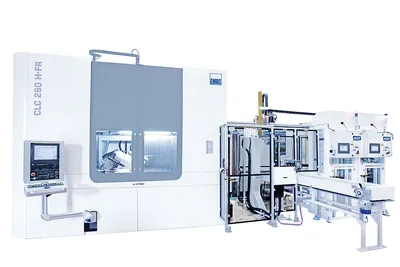
HNK HGG-4000
Key Specifications
gear outside diameter
profile height
module range
helix angle
vertical working range
grinding wheel diameter
How much does the HNK HGG-4000 cost?
Price estimate
We do not have a price for the HNK HGG-4000 that we can stand behind, so we show no number. Configuration, options and installation move the final price a long way: a quote is the reliable figure.
Overview
The HNK HGG-4000 is where the HGG gear grinders change wheel. For gears up to Ø4,000 mm (157.5 in) outside diameter, the module range widens to M1-M50, the maximum wheel diameter rises to 450 mm (17.7 in) and the maximum wheel thickness to 130 mm (5.1 in).
A thicker wheel is what makes the coarser modules possible in profile grinding, because the wheel has to span the whole tooth space. The price is speed. Maximum wheel speed falls to 3,500 rpm, from 4,000 rpm on the HGG-2000. Profile height goes up to a maximum of 100, printed without a unit, and the vertical working range to 1,500 mm (59.1 in).
Gears of four metres belong to cement and ore mills, large marine reduction gears, wind-turbine gearbox ring gears and mining drives. They are case-hardened or through-hardened and distort in heat treatment by amounts that grinding has to remove tooth by tooth. That is the setting in which HNK's listed aids are used: the tooth calibration devices the maker mentions, the AE sensor for locating flanks, automatic balancing for the larger wheel and a double dressing system to shorten dressing.
The grinding spindle drive is 24 kW (32.2 hp), with 37 kW (49.6 hp) in braces, the same as on the smaller machines. With a wheel half as thick again, the braced rating deserves a question. Helix angle range is ±45° and the control Siemens 840D.
Full Specifications
| Parameter | Value |
|---|---|
| Gear Outside Diameter | Ø4,000 mm (157.5 in) |
| Profile Height | Max. 100 |
| Module Range | M1-M50 |
| Helix Angle | ±45° |
| Vertical Working Range | 1,500 mm (59.1 in) |
| Grinding Wheel Diameter | Max. 450 mm (17.7 in) |
| Grinding Wheel Diameter Shoulder | Min. 206 mm (8.1 in) |
| Grinding Wheel Thickness | Max. 130 mm (5.1 in) |
| Grinding Spindle Power | 24 kW (32.2 hp) {37 kW (49.6 hp)} |
| Wheel Speed Max | Max. 3,500 rpm |
| CNC Control | Siemens 840D |
Specifications sourced from en.hnkkorea.com — verified 2026-10-04
Strengths & Limitations
Strengths
- Module range M1-M50 on gears up to Ø4,000 mm (157.5 in)
- Wheel up to 450 mm (17.7 in) in diameter and 130 mm (5.1 in) thick
- 1,500 mm (59.1 in) vertical working range
- Tooth calibration devices and AE sensor listed by HNK
Limitations
- Wheel speed limited to 3,500 rpm
- Base spindle power of 24 kW (32.2 hp) is unchanged from the HGG-1000
- No table load figure for workpieces of this size
Best For
Frequently Asked Questions
01
The HGG-4000 grinds M1-M50 with a wheel up to 450 mm (17.7 in) in diameter and 130 mm (5.1 in) thick at up to 3,500 rpm, and has 1,500 mm (59.1 in) of vertical range. The HGG-2000 grinds M1-M35 with a 400 mm (15.7 in) by 90 mm (3.5 in) wheel at up to 4,000 rpm.
02
The vertical working range is 1,500 mm (59.1 in). Face width plus wheel overrun at both ends has to fit within it. HNK publishes no separate maximum face width.
03
HNK lists 24 kW (32.2 hp) for the grinding spindle drive and prints 37 kW (49.6 hp) in braces. The page does not relate power to module, so ask which rating the maker proposes for the coarsest teeth you grind.
04
±45°, the same as every HGG model. That covers spur gears and the usual single- and double-helical gears in heavy drives.
More from HNK
Other CNC Gear Cutting Machines
KAPP NILES KX 300 P
Klingelnberg P 40
Reishauer RZ 260
Liebherr LGP 2000