Klingelnberg P 40
Key Specifications
Max Workpiece ⌀
module range
horizontal measuring interval x
max moment of inertia
max workpiece weight
vertical measuring interval z
How much does the Klingelnberg P 40 cost?
Estimated price range
Our best estimate for a cnc gear cutting machine in this class — not a quote from Klingelnberg. Configuration moves it a long way.
Overview
The Klingelnberg P 40 sits between the P 26 and the P 65 in the P range of gear measuring centers, sized for workpieces up to 400 mm in diameter, 300 kg in weight and 5 kgm² in moment of inertia. It measures gears with modules of 0.30 – 20 mm; 0.10 mm is shown in brackets.
Its place is easiest to see from its neighbours. The P 26 below it stops at a 260 mm testing diameter, approx. 80 kg and 1 kgm², and weighs approx. 1,700 kg. The P 65 Precision Measuring Center above it reaches 650 mm, 500 kg and 100 kgm², at 4,050 kg net. The P 40 itself weighs 2,200 kg net with standard equipment, so it carries nearly four times the workpiece weight of the P 26 in a machine that is only moderately heavier.
Shaft-type parts are limited by two rows. The distance between centers is 50 – 800 mm, with 1,000 mm in brackets, and the vertical measuring interval on Z is 550 mm, with 700 mm in brackets. Machine height follows the same pattern, 2,200 mm or 2,400 mm in brackets, on a footprint of 2,015 x 2,505 mm. Ask which column version a quotation covers, because the table does not label the bracketed figures. The horizontal measuring interval on X is ±115 mm.
It asks little of the building: 0.7 kVA including the printer and 6 bar of compressed air at 1 l/min. Accuracy is classed Group A for gear measurement, with a length measuring error of 1.8 µm + L/450 mm between 18 and 22 Celsius and 1.8 µm + L/250 mm between 15 and 35 Celsius.
Full Specifications
| Parameter | Value |
|---|---|
| Module Range | (0.10), 0.30 – 20 mm |
| Horizontal Measuring Interval X | ±115 mm |
| Max Workpiece Diameter | 400 mm (clamping/testing diameter of cylindrical gears between centers) |
| Max Moment of Inertia | 5 kgm² |
| Max Workpiece Weight | 300 kg |
| Vertical Measuring Interval Z | 550 (700) mm |
| Distance Between Centers | 50 – 800 (1,000) mm |
| Machine Accuracy Gear Measurement | Group A (VDI/VDE 2612 sheet 6) |
| Mpe E0 at 18 22 C | 1.8 µm + L/450 mm (ISO 10360-2:2010) |
| Roundness at 18 22 C | 0.3 µm (Ø 100/L, VDI/VDE 2617 sheet 8) |
| Total Axial Runout at 18 22 C | 1.5 µm (VDI/VDE 2617 sheet 8) |
| Mpe E0 at 15 35 C | 1.8 µm + L/250 mm (ISO 10360-2:2010) |
| Roundness at 15 35 C | 0.5 µm (Ø 100/L, VDI/VDE 2617 sheet 8) |
| Total Axial Runout at 15 35 C | 1.8 µm (VDI/VDE 2617 sheet 8) |
| Rated Power | 0.7 kVA (including printer) |
| Compressed Air Connection | 6 bar / 1 l/min |
| Machine Weight | 2,200 kg (net, incl. standard equipment, approx.) |
| Machine Dimensions | 2,015 x 2,505 x 2,200 (2,400) mm (L x W x H, approx.) |
Specifications sourced from klingelnberg.com — verified 2026-10-03
Strengths & Limitations
Strengths
- Takes workpieces up to 300 kg, against approx. 80 kg on the P 26
- 400 mm diameter capacity with a 5 kgm² moment of inertia limit
- One machine spans modules of 0.30 – 20 mm
- Footprint of 2,015 x 2,505 mm and a net weight of 2,200 kg with standard equipment
- Draws 0.7 kVA including the printer
Limitations
- Gears over 400 mm in diameter need the P 65 Precision Measuring Center, which reaches 650 mm
- Module range ends at 20 mm, so coarser gearing is out of scope
- The table does not label its bracketed figures (700 mm on Z, 1,000 mm between centers, 2,400 mm height)
- Module 0.10 mm is shown only in brackets
Best For
Frequently Asked Questions
01
The P 26 has a maximum testing diameter of 260 mm, a workpiece weight of approx. 80 kg and a moment of inertia limit of 1 kgm². The P 40 raises those to 400 mm, 300 kg and 5 kgm². Machine weight goes from approx. 1,700 kg on the P 26 to 2,200 kg net.
02
When the part is over 400 mm in diameter, over 300 kg or over 5 kgm². The P 65 Precision Measuring Center takes 650 mm, 500 kg and 100 kgm², and its module range runs to 35 mm where the P 40 ends at 20 mm.
03
Klingelnberg lists approximate dimensions of 2,015 x 2,505 x 2,200 mm (L x W x H), with 2,400 mm in brackets for the height. Net weight with standard equipment is approx. 2,200 kg. Services are 0.7 kVA including the printer and compressed air at 6 bar / 1 l/min.
04
The distance between centers is 50 – 800 mm, with 1,000 mm given in brackets. The vertical measuring interval on Z is 550 mm, with 700 mm in brackets, so the measurable length is shorter than the clamping length in either version.
Videos
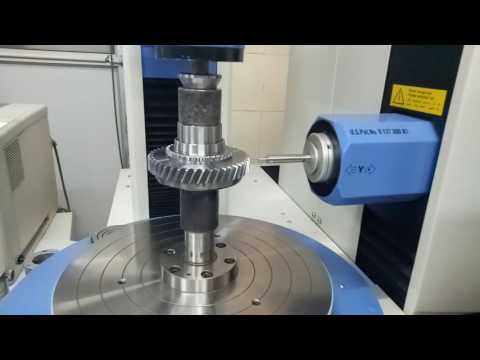
Sandeep saroha

Super Hobs & Broaches Pvt. Ltd.
More from Klingelnberg
Klingelnberg G 27
Klingelnberg P 40 Precision Measuring Center
Klingelnberg G 60 Bevel Gear Grinding Machine
Klingelnberg P 40
Klingelnberg P 65
Klingelnberg P 26
Other CNC Gear Cutting Machines
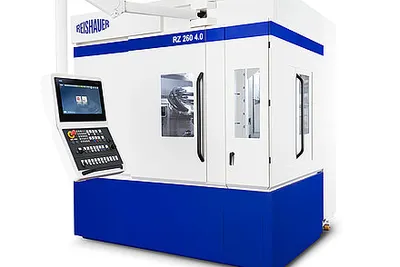
Reishauer RZ 260
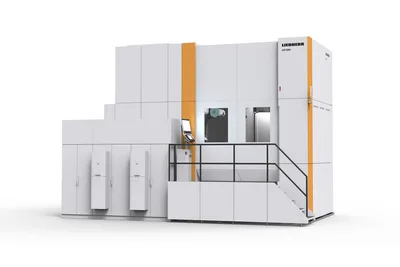
Liebherr LGP 2000