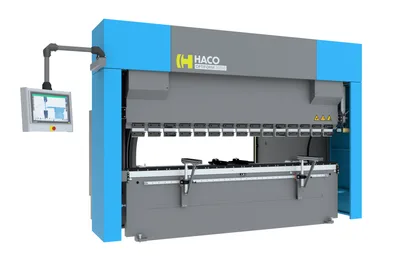
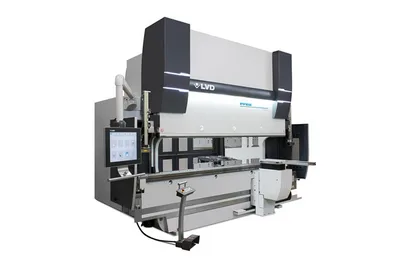
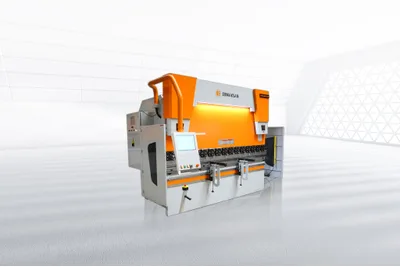
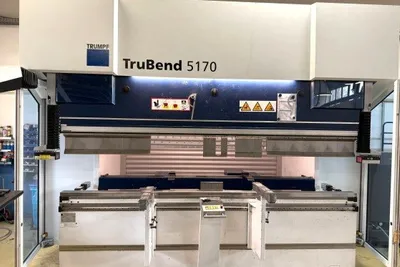
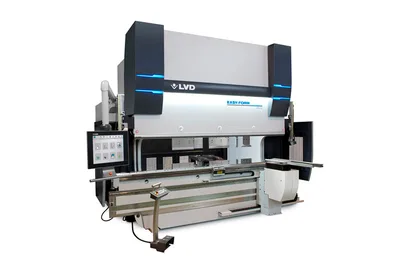
Haco ERMS CNC Press Brake
Key Specifications
bending length
ram drive
position feedback
crowning
backgauge
control
How much does the Haco ERMS CNC Press Brake cost?
Estimated price range
Our best estimate for a cnc press brake in this class — not a quote from Haco. Configuration moves it a long way.
Overview
The Haco ERMS CNC Press Brake is a hydraulic press brake family with listed bending lengths of 1600 – 6000 mm and a ram driven by two synchronized cylinders. The listed figures are unconfirmed, so treat them as a starting point and check them against the quotation or the data plate of a specific machine.
The ram drive is listed as hydraulic with a synchronized dual cylinder arrangement, and position feedback comes from a closed-loop optical encoder on both sides. Each end of the ram is therefore measured and corrected separately, which is what holds the angle constant along the bend when the load sits off centre. An automatic hydraulic crowning beam is listed as well, so bed deflection on long parts is compensated without shimming the dies.
Gauging is listed as a 5-axis backgauge with X, R, Z1, Z2 and X1 as standard and a 6th axis as an option. The control row reads Delem DA-69T with 2D/3D simulation, so a bend sequence can be looked over on screen before the first part is formed.
Ram speeds are listed at 180 mm/s on approach and 190 mm/s on return, with a stroke length of 177.8 mm and a shut height of 304.8 mm. Those are single values set against a whole range of bending lengths, so ask which size they belong to. The capacity, open height and daylight rows need the same confirmation before tooling is chosen.
Full Specifications
| Parameter | Value |
|---|---|
| Bending Length | 1600 – 6000 mm |
| Ram Drive | Hydraulic, synchronized dual cylinder (ERMS system) |
| Position Feedback | Closed-loop optical encoder on both sides |
| Crowning | Automatic hydraulic crowning beam |
| Backgauge | 5-axis (X, R, Z1, Z2, X1 standard; 6th axis optional) |
| CNC Control | Delem DA-69T with 2D/3D simulation |
| Open Height | 470 – 600 mm (model dependent) |
| Approach Speed | 180 mm/s |
| Return Speed | 190 mm/s |
| Capacity | 100,000 kg |
| Shut Height | 304.8 mm |
| Stroke Length | 177.8 mm |
| Daylight | 457.2 mm |
Specifications compiled from manufacturer literature and industry references. Not independently verified against a published spec sheet — confirm with the manufacturer or an authorised dealer before making a purchasing decision.
Strengths & Limitations
Strengths
- Synchronized dual cylinder hydraulic ram with a closed-loop optical encoder on both sides, so each end of the ram is positioned on its own feedback
- An automatic hydraulic crowning beam is in the listed figures, which matters most toward the 6000 mm end of the bending length range
- 5-axis backgauge with X, R, Z1, Z2 and X1 listed as standard
- Delem DA-69T control with 2D/3D simulation for checking a bend sequence before it runs
- Listed ram speeds of 180 mm/s on approach and 190 mm/s on return
Limitations
- The listed figures are unconfirmed, so every row needs checking against the quotation or the machine itself
- Stroke length (177.8 mm) and shut height (304.8 mm) are single values for a family that spans 1600 – 6000 mm of bending length
- The 6th backgauge axis is an option and not part of the standard 5-axis backgauge
- No working speed, throat depth or machine weight appears in the listed figures, so cycle time and floor loading cannot be judged from this table
Best For
Frequently Asked Questions
01
The listed figures give a bending length range of 1600 – 6000 mm. Most other rows are single values, including a stroke length of 177.8 mm and a shut height of 304.8 mm, so ask which length those apply to before comparing a specific machine with this table.
02
The backgauge is listed as 5-axis, with X, R, Z1, Z2 and X1 as standard. A 6th axis is listed as an option. In the usual press brake naming, X and X1 set finger depth, R sets finger height, and Z1 and Z2 move the fingers along the bed.
03
The control row reads Delem DA-69T with 2D/3D simulation. Simulation lets the operator look over the bend order before the first bend is made. Offline software and other control functions are not in the listed figures, so confirm them separately.
04
The listed figures give an approach speed of 180 mm/s and a return speed of 190 mm/s. No working speed is listed, and that is the speed that decides how long each bend takes under load, so ask for it if cycle time matters.
Community Discussions
Troubleshooting and problem-solving
Links to community discussions. Summaries are editorial — visit the original thread for full context.