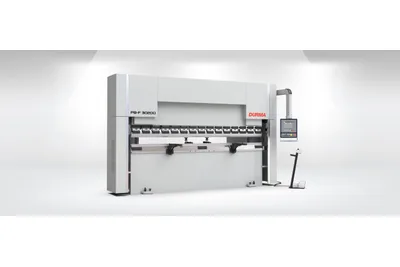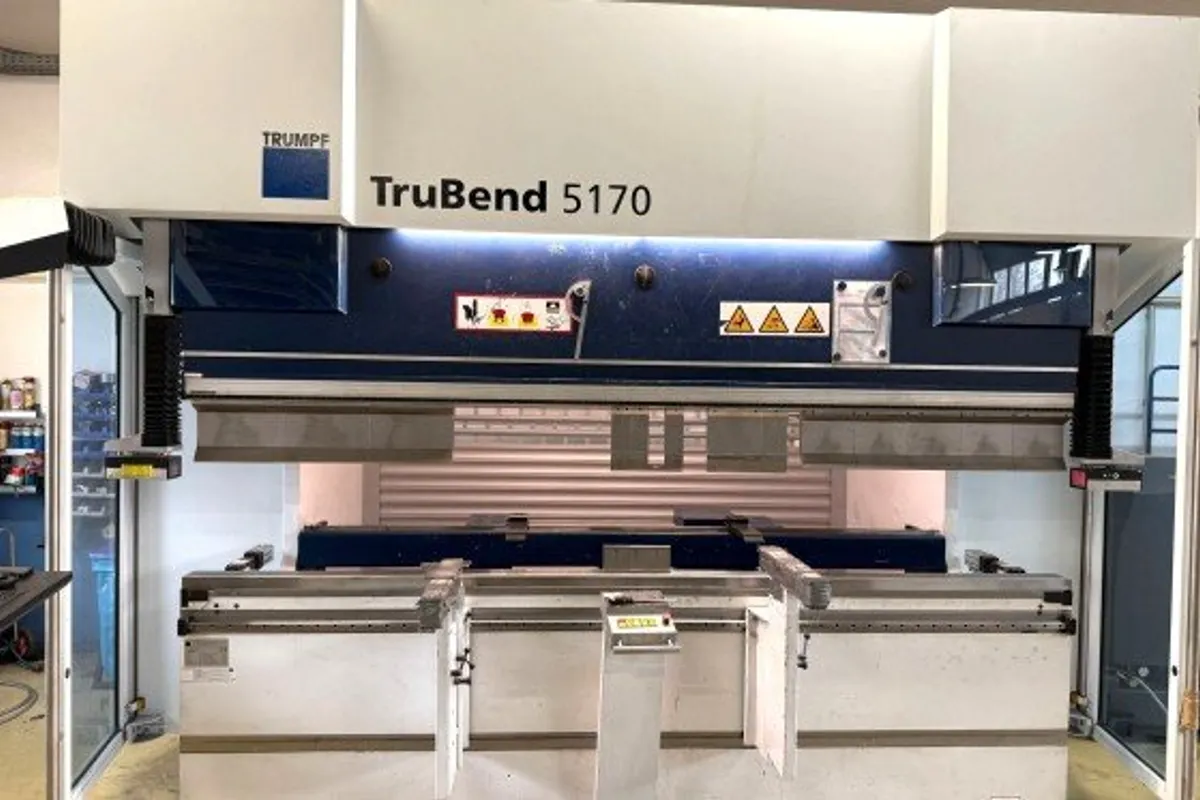
Trumpf TruBend 5170
Key Specifications
press force
bending length
distance between columns
usable open height
throat depth
stroke
Overview
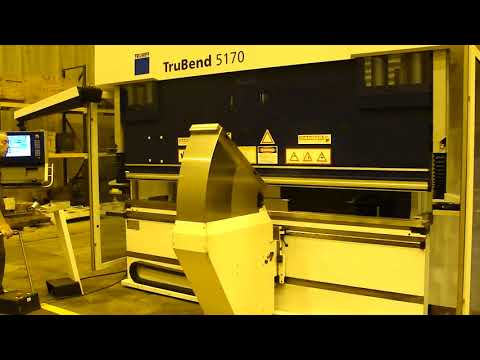
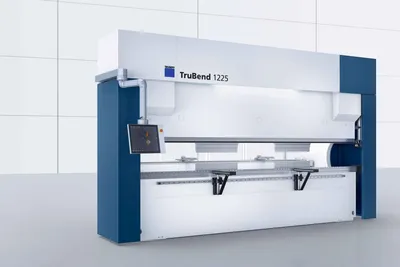
The Trumpf TruBend 5170 is the 170-metric-ton model in Trumpf's Series 5000 press brake lineup, which is the company's best-selling bending platform worldwide. With 1,700 kN (187 US tons) of press force and a 4,250 mm (167.3 in) bending length, it handles mid-to-heavy gauge sheet metal work that's common in contract fabrication, structural components, and enclosure manufacturing. If your shop regularly bends 10-gauge and thicker mild steel or stainless across four-meter-plus lengths, this is the tonnage class where Trumpf really earns its keep.
The headline technology on the 5170 is Trumpf's On-Demand Servo Drive. Unlike conventional hydraulic press brakes that keep the pump running continuously, the servo drive only activates during the actual bending stroke. That translates to lower energy consumption, significantly reduced noise, and less heat generation in the hydraulic system. Rapid approach speed hits 220 mm/s (8.7 in/s) with a maximum bending speed of 25 mm/s (1.0 in/s), which keeps cycle times competitive even on thick material.
The 6-axis back gauge system is one of the TruBend 5170's strongest selling points. Six programmable axes give you the flexibility to handle complex bend sequences, offset flanges, and multi-step parts without manual repositioning. Combined with CNC-controlled crowning, the machine compensates for deflection across the full bending length automatically -- you won't need to shim or manually adjust for consistent angles on long parts.
Angle accuracy is where Trumpf separates itself from most competitors. The ACB (Automatically Controlled Bending) system is available in two flavors: ACB Wireless uses sensor disks integrated into the upper tooling that communicate wirelessly with the control, while ACB Laser uses a non-contact optical measurement. Either way, the first bend comes out right, even on new material batches with unpredictable springback. Trumpf claims up to 35% cycle time savings with ACB Speed software, which applies springback data from the first part to all subsequent bends.
The TASC 6000 control (now branded as Touchpoint TruBend on newer machines) runs on a 15-inch touchscreen with an interface that feels more like a tablet than a traditional CNC. Programming is straightforward for experienced operators, and it integrates with Trumpf's TruTops Bend offline programming software for complex jobs. The control handles 2D bend simulation, tool setup optimization, and collision checking before you ever touch metal.
The machine frame is an all-steel welded construction, stress-relief annealed, with a spherical ram suspension and ram tilt for precise alignment. The electro-hydraulic drive uses 4-cylinder technology for even force distribution across the full bending length. Machine weight runs approximately 12,000 kg (26,455 lb) depending on configuration.
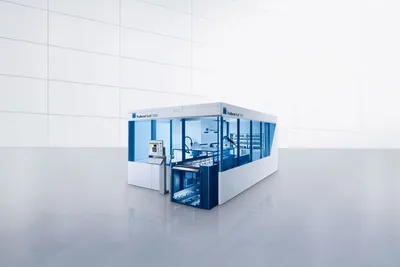
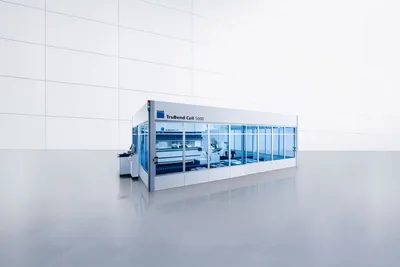
Automation-ready shops can pair the 5170 with Trumpf's BendMaster robot for automated part handling, and the ToolMaster automatic tool changer for lights-out bending cell operation. The TruBend Cell 5000 configuration turns the standalone brake into a full automated bending cell capable of producing up to four different parts per work cycle.
New TruBend 5170 machines typically run $250,000-$400,000 depending on options, back gauge configuration, and angle measurement systems. Used models from 2007-2018 trade between $80,000 and $200,000 depending on hours, condition, and control generation. Trumpf machines hold their value well on the secondary market thanks to build quality and the company's strong service network. Specs sourced from Trumpf published technical data, dealer listings, and equipment resale platforms.
Full Specifications
| Parameter | Value |
|---|---|
| Press Force | 1,700 kN / 170 metric tons (187 US tons) |
| Bending Length | 4,250 mm (167.3 in) |
| Distance Between Columns | 3,680 mm (144.9 in) |
| Usable Open Height | 615 mm (24.2 in) |
| Throat Depth | 420 mm (16.5 in) |
| Stroke | 445 mm (17.5 in) |
| Rapid Speed | 220 mm/s (8.7 in/s) |
| Max Bending Speed | 25 mm/s (1.0 in/s) |
| Back Gauge | 6-axis programmable |
| CNC Control | TASC 6000 / Touchpoint TruBend (15" touchscreen) |
| Drive System | Electro-hydraulic, 4-cylinder, On-Demand Servo |
| Crowning | CNC-controlled |
| Motor Power | 28 kW |
| Machine Weight | ~12,000 kg (26,455 lb) |
| Machine Dimensions | ~3,980 x 1,740 x 2,840 mm (156.7 x 68.5 x 111.8 in) |
| Arno Bayer Head Of Industrial Engineering Joining At Ekpo | We particularly appreciate the TruFiber's combination of outstanding beam quality and process reliability. |
| Gerhard Steinhuber Samps Steinhuber Gmbh | For us, the Flex Cell is an ideal solution in terms of cost-benefit ratio. |
| Bjrn Mller Head Of Production Factory 2 Gedia Gmbh | It was a really good collaborative project. Together, we searched for solutions that perfectly met our individual requirements. |
| Joseph Gampp Division Manager Of Product Management Feinwerktechnik Hago | The technology fits perfectly into our strategic alignment. |
Specifications sourced from trumpf.com — verified 2026-03-28
Strengths & Limitations
Strengths
- On-Demand Servo Drive cuts energy consumption and noise significantly compared to conventional hydraulic press brakes -- the pump only runs during bending
- 6-axis back gauge handles complex bend sequences, offset flanges, and multi-step parts without manual repositioning between bends
- ACB angle measurement (Wireless or Laser) nails the first bend on every material batch, eliminating test bends and scrap from springback guessing
- CNC-controlled crowning compensates for beam deflection automatically across the full 4,250 mm bending length
- Touchpoint TruBend control feels intuitive and modern, with offline programming via TruTops Bend for complex multi-bend parts
- Automation-ready platform supports BendMaster robot and ToolMaster automatic tool changer for lights-out bending cell operation
- Trumpf's global service network and parts availability keep uptime high -- resale values are among the strongest in the press brake market
Limitations
- New machine pricing starts north of $250K and climbs fast with ACB, automation, and tooling packages -- significantly pricier than Amada or Cincinnati equivalents
- Trumpf's proprietary tooling and control ecosystem locks you in -- switching to third-party tooling or programming software isn't straightforward
- Older TASC 6000 controls run on Windows XP, which creates IT security concerns and limits connectivity in modern shop networks
- Service and parts costs carry a premium compared to domestic or Asian-brand alternatives
- 12,000 kg machine weight requires substantial floor preparation and limits repositioning flexibility
Best For
Frequently Asked Questions
01
New TruBend 5170 machines typically run $250,000-$400,000 depending on options. Base machines with a 4-axis back gauge come in at the lower end, while fully loaded configurations with ACB Laser angle measurement, 6-axis back gauge, CNC crowning, and BendGuard safety systems push toward the upper range. Adding automation (BendMaster, ToolMaster) can take the total cell past $600,000. Used models from 2007-2018 trade between $80,000 and $200,000.
02
The number after 51 indicates the tonnage class: the 5085 delivers 850 kN (85 metric tons), the 5130 delivers 1,300 kN, the 5170 delivers 1,700 kN, and the 5320 tops the range at 3,200 kN. All share the same control platform, On-Demand Servo Drive, and back gauge options. The main differences are press force, bending length, and machine footprint. The 5170 is the sweet spot for shops that need serious tonnage without stepping up to the 5230 or 5320's size and cost.
03
ACB Wireless uses sensor disks built into the upper tooling that measure the actual bend angle in real time and communicate wirelessly with the control. The system detects springback on the first bend and automatically corrects subsequent strokes. ACB Laser uses a non-contact optical sensor to measure angles without touching the part. Both systems eliminate test bends and scrap, with ACB Speed software applying the first part's springback data to all following parts for up to 35% faster cycle times.
04
Yes. Trumpf offers the BendMaster robot (available in 60 kg and 150 kg payload versions) for automated part loading, bending, and unloading. The ToolMaster automatic tool changer swaps upper and lower tooling without operator intervention. Combined as a TruBend Cell 5000, the system produces up to four different components per work cycle with consistent quality. The BendMaster even includes image recognition for part identification.
05
The TruBend 5170 uses Trumpf's proprietary Trumpf-style tooling with self-centering clamping. Upper tools use the 'New Standard Clamping' system, and lower tools feature hydraulic clamping. Wila-compatible tooling adapters are available but add cost. The lower tool displacement feature allows programmable pneumatic shifting of bottom dies to two positions, which reduces manual setup time between different V-die openings.
06
Both are premium European and Japanese press brake platforms. The TruBend 5170's advantages are the On-Demand Servo Drive (lower energy, quieter), the ACB angle measurement family, and tighter integration with Trumpf's laser and automation ecosystem. Amada typically offers competitive pricing, strong tooling options, and a well-regarded control system. Trumpf tends to dominate in Eastern US and European markets, while Amada is stronger in Western US and Asia. Service network proximity should heavily influence your decision.
Videos
Precision Tube Laser
PrestigeEquipment
Metal Concepts
TRUMPF Inc.
BTS Facades and Fabrications
Community Discussions
Community discussion — Press brake talk Trumpf, Amada etc. - Practical Machinist
Pricing and buying discussion — Fabrication: CNC Laser, Waterjet, Plasma, Welding | Trumpf ...
Troubleshooting and problem-solving — Fabrication: CNC Laser, Waterjet, Plasma, Welding | Trumpf ...
Community discussion — Crashed Trumpf Dies
Troubleshooting and problem-solving — Trumpf press brake protective beam - CNCzone
Troubleshooting and problem-solving — Need Help! Trumpf laser error codes? - cnczone.com
Troubleshooting and problem-solving — Need Help! Trumpf Laser Cutting Troubleshooting.... - CNCzone
Community discussion — need help trumpf laser - CNCzone
Links to community discussions. Summaries are editorial — visit the original thread for full context.