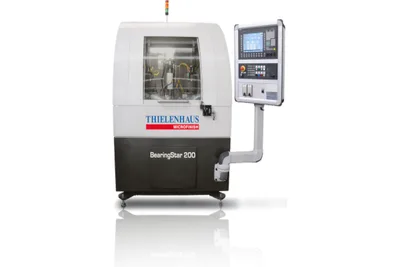
Thielenhaus BearingStar mini
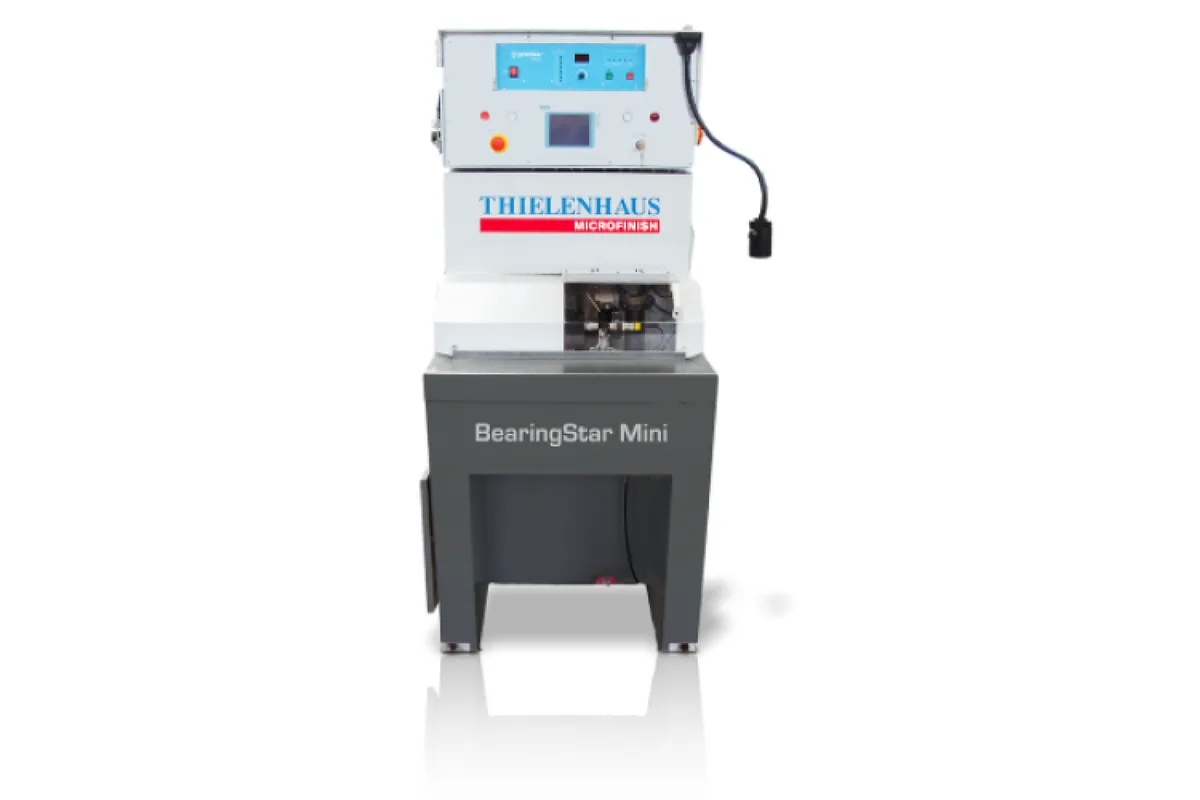
Image: thielenhaus.com, Thielenhaus Technologies
Key Specifications
machining stations
workpiece diameter
workpiece width
workpiece spindle speed
oscillation frequency
radial oscillation angle
How much does the Thielenhaus BearingStar mini cost?
Price estimate
We do not have a price for the Thielenhaus BearingStar mini that we can stand behind, so we show no number. Configuration, options and installation move the final price a long way: a quote is the reliable figure.
Overview
The Thielenhaus BearingStar mini is the smallest machine in the BearingStar range: a fully automatic Microfinish machine for the raceways of miniature ball and roller bearing rings. It takes workpieces of 5 – 19 mm (0.20 – 0.75 in) in diameter and 2.5 – 15 mm (0.10 – 0.59 in) in width on a single machining station, and it works by the 1-step method.
Small rings need surface speed, and the workpiece spindle supplies it with a range of 0 – 36,000 rpm. The stone side is scaled down in the same way. Contact pressure is adjustable from 0 – 10 N, the linear oscillation stroke from 0 – 2 mm (0 – 0.08 in), and the radial oscillation angle is ±0 – 15°, at up to 1,200 double strokes per minute.
With one station and one stone type there is no separate roughing and finishing stone. Thielenhaus instead describes pre- and final machining within the cycle by changing the cutting speed, the stone contact pressure and the oscillation. That keeps the machine simple. It also means one stone specification has to serve both stages.
The listed ring types are deep groove ball bearings (DGBB), angular contact ball bearings (ACBB), cylindrical roller bearings (CRB) and special bearings, as inner and outer rings. The table gives no footprint, weight or connection data, so those have to come from Thielenhaus directly. Above 19 mm the next machine is the BearingStar 90, whose outer rings start at 26 mm; rings between those two limits fall outside both tables.
Full Specifications
| Parameter | Value |
|---|---|
| Machining Stations | 1 |
| Workpiece Diameter | 5 – 19 mm (0.20 – 0.75 in) |
| Workpiece Width | 2.5 – 15 mm (0.10 – 0.59 in) |
| Workpiece Spindle Speed | 0 – 36,000 rpm |
| Oscillation Frequency | 0 – 1,200 double strokes/min |
| Radial Oscillation Angle | ±0 – 15° |
| Linear Oscillation Stroke | 0 – 2 mm (0 – 0.08 in) |
| Stone Contact Pressure | 0 – 10 N |
Specifications sourced from thielenhaus.com — verified 2026-10-05
Strengths & Limitations
Strengths
- Workpiece spindle range of 0 – 36,000 rpm, sized for miniature rings
- Stone contact pressure adjustable from 0 – 10 N for delicate miniature raceways
- Both a radial oscillation angle (±0 – 15°) and a linear oscillation stroke (0 – 2 mm) are listed
- Pre- and final machining on one station by changing cutting speed, stone contact pressure and oscillation
- Fully automatic machine for inner and outer rings
Limitations
- One machining station only; a 2-station layout as on the BearingStar 90 is not listed at this size
- Workpiece diameter ends at 19 mm (0.75 in)
- 1-step machining with one stone type, so there is no second stone grade for a separate finishing step
- The technical data give no weight, footprint, power or air requirement
Best For
Frequently Asked Questions
01
Workpiece diameter is 5 – 19 mm (0.20 – 0.75 in) and workpiece width 2.5 – 15 mm (0.10 – 0.59 in). Thielenhaus lists the machine for miniature ball and roller bearing inner and outer rings, which places it below every other ring machine in the BearingStar range.
02
The workpiece spindle speed range is 0 – 36,000 rpm. A ring only a few millimetres across needs that top speed to reach a useful surface speed under the stone. Oscillation frequency runs from 0 – 1,200 double strokes/min alongside it.
03
The table lists both: a radial oscillation angle of ±0 – 15° and a linear oscillation stroke of 0 – 2 mm (0 – 0.08 in). A radial movement follows a ball groove and a linear stroke follows a roller raceway, which matches the ball and roller ring types Thielenhaus names for the machine.
04
One. Thielenhaus describes 1-step machining with a stone type, with pre- and final machining done by changing the cutting speed, stone contact pressure and oscillation during the cycle. Stone contact pressure is adjustable from 0 – 10 N.