Palmary PCB-6060
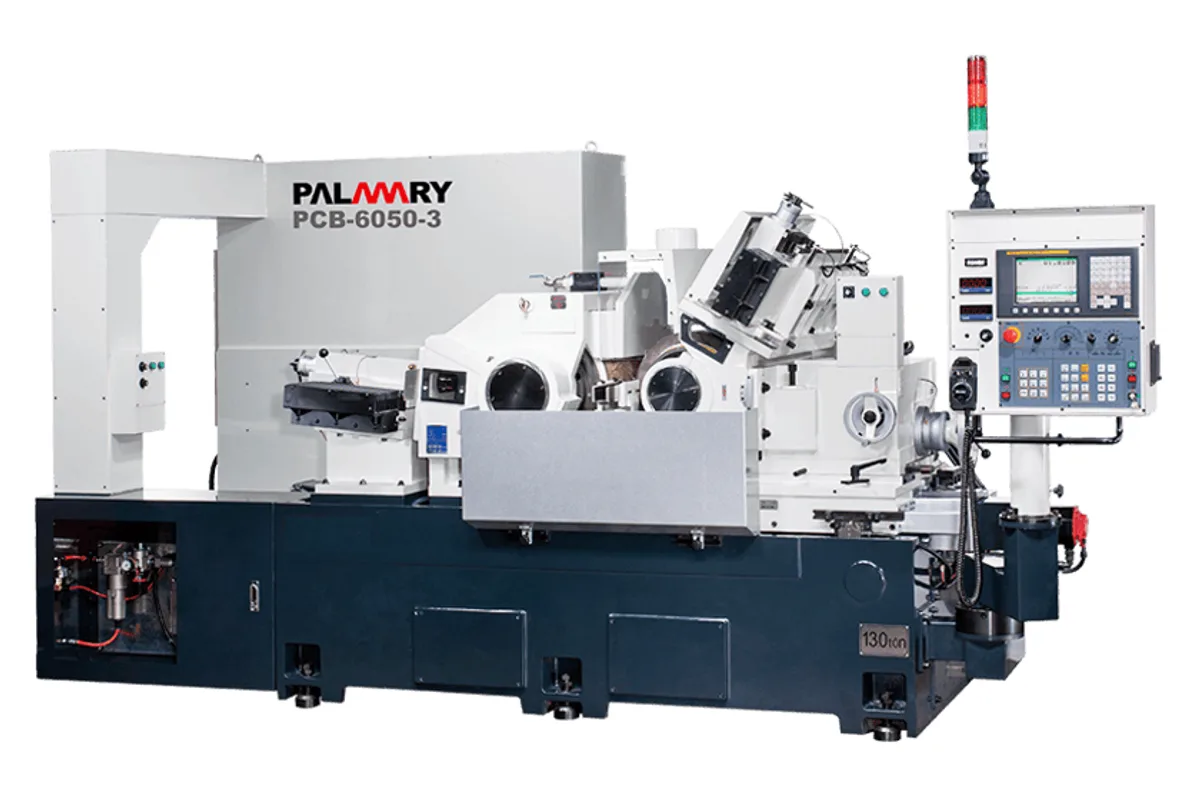
Image: palmary.com, Palmary
Key Specifications
grinding diameter range
wheel size
wheel peripheral speed
grinding wheel dressing device
regulating wheel size
regulating wheel speed
How much does the Palmary PCB-6060 cost?
Price estimate
We do not have a price for the Palmary PCB-6060 that we can stand behind, so we show no number. Configuration, options and installation move the final price a long way: a quote is the reliable figure.
Overview
The Palmary PCB-6060 has the widest wheel in Palmary's centerless range: Ø610 mm in diameter and 610 mm across. It is a CNC centerless grinder for Ø1 to Ø150 mm work, with a regulating wheel of Ø405 mm by 610 mm.
A wheel as wide as it is tall is bought for one of two reasons. Either the parts are long and must be infeed ground in a single plunge, as with rollers, long sleeves or printer shafts, or the through-feed rate has to be as high as it can be. In both cases the grinding wheel motor is the constraint to check, because the table gives the PCB-6060 the same 50 HP (37 kW) as the 510 mm PCB-6050.
To keep a wheel of that width cutting straight, Palmary supports the grinding wheel spindle at both ends, so that grinding force is even across the contact face and the part does not come out tapered. The feeding slide is one V and one flat, hand scraped, and the regulating wheel worm shaft is adjustable to remove play.
Standard wheel speed is 40 m/s, with 45 m/s (8,858 ft/min) optional. The regulating wheel runs 10 to 200 rpm on a 5 kW (6.7 hp) servo and tilts ±5°. The table lists automatic lubricators for both spindles of this model. Weight is printed as 13,000 kg (28,660 lb), the same as the PCB-6050, and control is by FANUC CNC.
Full Specifications
| Parameter | Value |
|---|---|
| Grinding Diameter Range | Ø1~Ø150 mm |
| Wheel Size | Ø610 x 610 x Ø355.6 mm (24.0 x 24.0 x 14.0 in) |
| Wheel Peripheral Speed | 40 m/s (opt. 45 m/s) |
| Grinding Wheel Dressing Device | Single-point dressing device / (opt.) Diamond roller dressing device |
| Regulating Wheel Size | Ø405 x 610 x Ø254 mm (15.9 x 24.0 x 10.0 in) |
| Regulating Wheel Speed | 10-200 rpm (variable speed) |
| Regulating Wheel Tilt Angle | ±5° |
| Regulating Wheel Swivel Angle | ±2° |
| Regulating Wheel Dresser Swivel Angle | ±5° |
| Grinding Wheel Motor | 50 HP x 4P (37 kW) |
| Regulating Wheel Motor | 5 kW (6.7 hp) servo motor |
| Coolant Pump Motor | 1 HP x 2P (0.75 kW) |
| Grinding Wheel Spindle Lubrication | Auto. lubricator |
| Regulating Wheel Spindle Lubrication | Auto. lubricator |
| Slide Lubrication | Auto lubricator (LUBE) |
| CNC Control | FANUC |
| Coolant Tank | 140 L (37.0 gal) |
| Slide Lubrication Tank | 4 L (1.1 gal) |
| Machine Weight | 13,000 kg (28,660 lb) |
Specifications sourced from palmary.com — verified 2026-10-05
Strengths & Limitations
Strengths
- 610 mm wide grinding and regulating wheels
- Double support spindle for even grinding force across the wheel face
- 50 HP (37 kW) grinding wheel motor
- Hand scraped V and flat feeding slide
Limitations
- Motor is no larger than on the 510 mm PCB-6050
- Standard wheel speed of 40 m/s
- Listed weight is identical to the PCB-6050, so confirm it
- Dressing a 610 mm face by single point is slow; the diamond roller device is optional
Best For
Frequently Asked Questions
01
610 mm, on the PCB-6060. Its grinding wheel is Ø610 x 610 mm on a 355.6 mm bore and its regulating wheel Ø405 x 610 mm on a 254 mm bore. The standard grinding range is Ø1 to Ø150 mm.
02
The grinding wheel motor is 50 HP (37 kW), 4-pole, and the regulating wheel motor a 5 kW (6.7 hp) servo. The coolant motor is 1 HP (0.75 kW). These are the same ratings the table gives for the PCB-6050.
03
Palmary points to the double support bearing type spindle, which it says gives even grinding force on the contact surface and equal stress at both ends of the spindle, avoiding taper shaped workpieces. The regulating wheel swivels ±2° for correction.
04
A grinding wheel exchanger and a jib crane for grinding wheel changes are listed as optional accessories. The standard list notes that the grinding and regulating flanges are formed in one piece with their spindles, and includes a vibration meter for manual balancing.
More from Palmary
Other CNC Grinding Machines
Amada TECHSTER 104
Danobat DANUNI-4100
Star SU TRU TECH T93XM-A
EMAG HG 208 DW