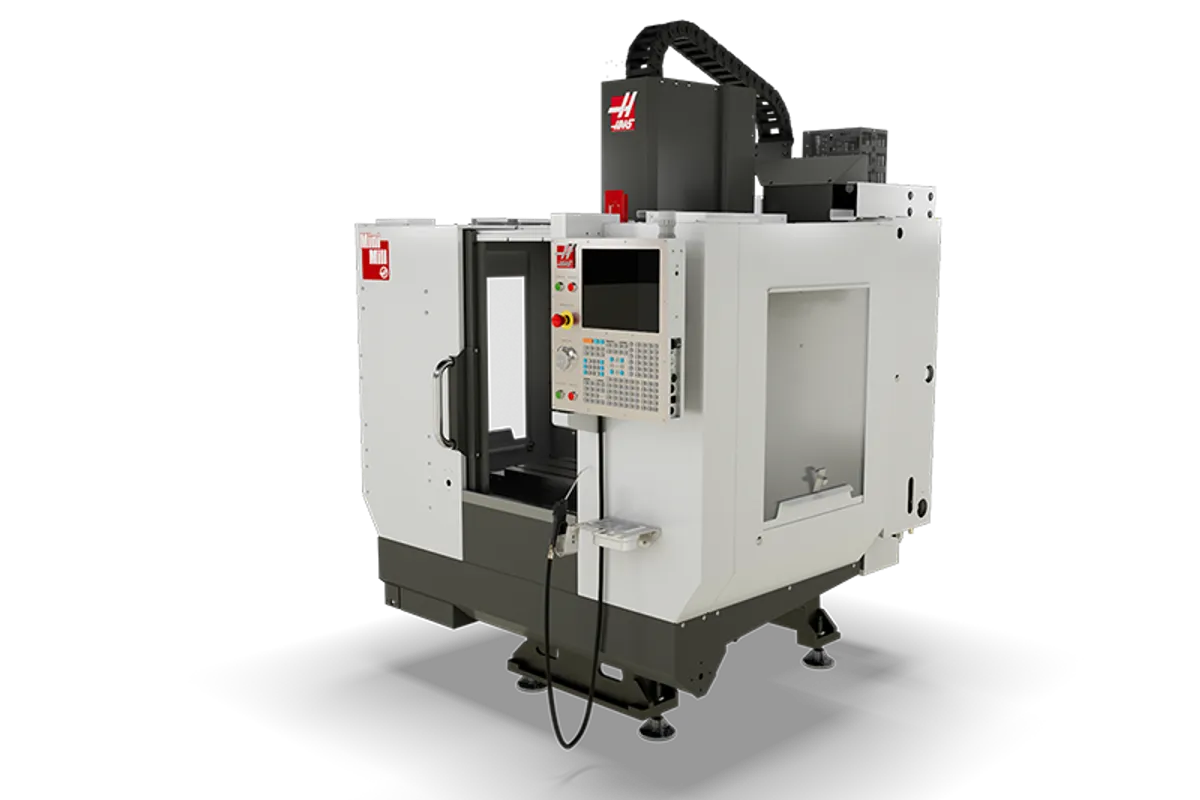
Haas Mini Mill-EDU
Key Specifications
X Travel
Y Travel
Z Travel
Max Spindle
Spindle Taper
Tool Capacity
How much does the Haas Mini Mill-EDU cost?
Manufacturer list price
As published by Haas Automation, verified 2026-10-02. Options, tooling, freight and installation are extra.
Overview
The Haas Mini Mill-EDU is the reduced-speed version of the Mini Mill: the same 16 × 14 × 15 in (406 × 356 × 381 mm) travels and 36 × 12 in (914 × 305 mm) table, with a 6,000 rpm spindle and axis speeds held to 400 ipm (10.2 m/min). Haas lists a starting price of US$40,995.
Three figures separate it from the standard machine. The Mini Mill spindle runs to 8,000 rpm, against 6,000 rpm here. Mini Mill rapids are 800 ipm (20.3 m/min) and its cutting feed 650 ipm, where the EDU uses 400 ipm (10.2 m/min) for both. And the Mini Mill is listed with a carousel of 10 or 20 tools, while the tool capacity row for the EDU reads 10 (opt.).
So do not assume a tool changer. The carousel is an option; where it is fitted, changes take 4.2 s tool-to-tool and 5 s chip-to-chip, and tools can be up to 3.5 in (89 mm) in diameter, 12 in (305 mm) long and 12 lb (5.4 kg).
Slower axes and a lower top speed do not make it a light machine. Power is 10 hp (7.5 kW) through a belt drive into a CT or BT 40 taper, and thrust is 2,000 lbf (8,896 N) on each axis, so it cuts with full-size 40-taper tooling. What it gives up is cycle time and surface speed on small tools. Haas's table carries no spindle torque figure for this model.
The supply rows include single-phase power, 220 VAC at 40 A, as well as three-phase at 220 VAC and 25 A or 440 VAC and 13 A. Table load is 500 lb (227 kg) and the machine ships at 4,450 lb (2,018.5 kg).
Full Specifications
| Parameter | Value |
|---|---|
| X-Axis Travel | 16 in (406 mm) |
| Y-Axis Travel | 14 in (356 mm) |
| Z-Axis Travel | 15 in (381 mm) |
| Spindle Nose to Table (max) | 19 in (483 mm) |
| Spindle Nose to Table (min) | 4 in (102 mm) |
| Spindle Motor Power | 10 hp (7.5 kW) |
| Max Spindle Speed | 6,000 rpm |
| Spindle Drive | Direct Speed, Belt Drive |
| Spindle Taper | CT or BT 40 |
| Table Size | 36 × 12 in (914 × 305 mm) |
| T-Slot Width | 0.626 in to 0.63 in (15.9 mm to 16 mm) |
| T-Slot Center Distance | 4.33 in (110 mm) |
| T-Slots | 3 |
| Max Table Load | 500 lb (227 kg) |
| Max Cutting Feedrate | 400 ipm (10.2 m/min) |
| Rapid Traverse Rate | 400 ipm (10.2 m/min) |
| Max Thrust X | 2,000 lbf (8,896 N) |
| Max Thrust Y | 2,000 lbf (8,896 N) |
| Max Thrust Z | 2,000 lbf (8,896 N) |
| Tool Changer Type | Carousel |
| Tool Capacity | 10 (opt.) |
| Max Tool Diameter (full magazine) | 3.5 in (89 mm) |
| Max Tool Length | 12 in (305 mm) |
| Max Tool Weight | 12 lb (5.4 kg) |
| Tool Change (tool-to-tool) | 4.2 s |
| Tool Change (chip-to-chip) | 5 s |
| Coolant Capacity | 45 gal (170 L) |
| Air Required | 4 scfm @ 100 psi (113 L/min @ 6.9 bar) |
| Electrical Single Phase | 220 VAC 1-phase, 40 A |
| Electrical Service (low voltage) | 220 VAC 3-phase, 25 A |
| Electrical Service (high voltage) | 440 VAC 3-phase, 13 A |
| Shipping Domestic Pallet | 90 × 80 × 92 in (229 × 203 × 234 cm) |
| Shipping Export Pallet | 90 × 80 × 92 in (229 × 203 × 234 cm) |
| Machine Weight | 4,450 lb (2,018.5 kg) |
Specifications sourced from haascnc.com — verified 2026-10-02
Strengths & Limitations
Strengths
- Runs on single-phase 220 VAC at 40 A as well as three-phase 220 VAC at 25 A or 440 VAC at 13 A
- Full Mini Mill envelope: 16 × 14 × 15 in (406 × 356 × 381 mm) travels on a 36 × 12 in (914 × 305 mm) table
- 10 hp (7.5 kW) CT or BT 40 spindle, the same power rating as the Mini Mill
- 2,000 lbf (8,896 N) of thrust on X, Y and Z
- 500 lb (227 kg) table load on a table with three T-slots at 4.33 in (110 mm) centers
Limitations
- Spindle tops out at 6,000 rpm, against 8,000 rpm on the Mini Mill
- Rapids and cutting feed are both limited to 400 ipm (10.2 m/min); the Mini Mill rapids at 800 ipm (20.3 m/min)
- The 10-tool carousel is listed as optional, so a base machine should not be assumed to have a tool changer
- Haas's table gives no spindle torque figure for this model
Best For
Frequently Asked Questions
01
Speed and tool changer. The Mini Mill-EDU spindle runs to 6,000 rpm and its rapids and cutting feed are both 400 ipm (10.2 m/min), with a 10-tool carousel listed as optional. The Mini Mill runs to 8,000 rpm, rapids at 800 ipm (20.3 m/min), cuts at up to 650 ipm and is listed with a carousel of 10 or 20 tools. Travels, table size, table load and the 10 hp (7.5 kW) rating are the same.
02
Not necessarily. The tool capacity row in Haas's table reads 10 (opt.), which marks the 10-tool carousel as an option. With it, a tool change takes 4.2 s tool-to-tool and 5 s chip-to-chip, and tools are limited to 3.5 in (89 mm) in diameter, 12 in (305 mm) in length and 12 lb (5.4 kg).
03
Haas lists three choices: 220 VAC single-phase at 40 A, 220 VAC three-phase at 25 A, or 440 VAC three-phase at 13 A. Air consumption is 4 scfm at 100 psi (113 L/min at 6.9 bar).
04
The TM-0 has more X travel, 20 in (508 mm), but 12 in (305 mm) of Y, a 7.5 hp (5.6 kW) 4,000 rpm spindle and 200 ipm (5.1 m/min) for rapids and cutting feed. The Mini Mill-EDU has 16 in (406 mm) of X and 14 in (356 mm) of Y, with 10 hp (7.5 kW), 6,000 rpm and 400 ipm (10.2 m/min). Table load is 350 lb (159 kg) on the TM-0 and 500 lb (227 kg) here.
More from Haas Automation
Other Vertical Machining Centers (VMC)
Litz VH-800A
GF Mikron MILL S 500
Vision Wide MSE-1612
Northwood Iron Horse XL 3