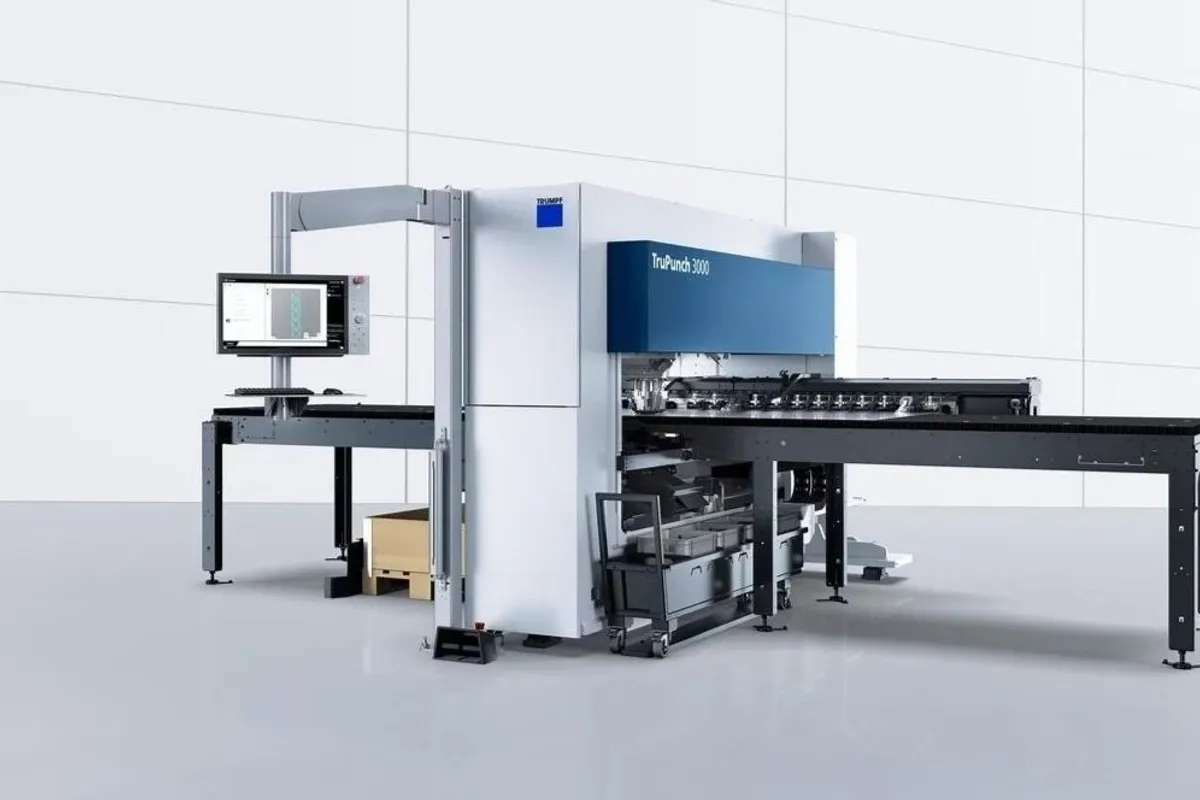
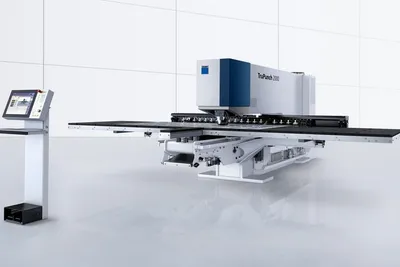
TRUMPF TruPunch 3000
Key Specifications
X Travel
Y Travel
Tool Capacity
punching force
max sheet thickness stainless
max punch diameter
How much does the TRUMPF TruPunch 3000 cost?
Estimated price range
Our best estimate for a cnc punch presse in this class — not a quote from TRUMPF. Configuration moves it a long way.
Overview
The TRUMPF TruPunch 3000 is a punching machine with 2,500 mm (98.4 in) of X travel and 1,250 mm (49.2 in) of Y travel. It takes sheet up to 6.4 mm (0.25 in) thick and workpieces up to 150 kg (331 lb), and it changes tools in 0.5 s.
Two rows of Trumpf's table carry a pair of values instead of one. Punching force is given as 165 | 180 kN and maximum stroke rate as 600 | 800 per minute. The table does not label the pairs. When a quotation arrives, ask which force and which stroke rate belong to the machine on offer, and do not assume the higher of each.
The 6.4 mm (0.25 in) thickness limit does not hold for every material: stainless is limited to 4 mm. Punch diameter is 76.2 mm (3 in) as standard, so a cut-out wider than that is made with several hits instead of one.
The quick tool change is the clearest difference from the TruPunch 2000, which shares the travels and the 150 kg (331 lb) workpiece limit but lists 2.4 s per change. Tool capacity is listed as 18 pieces / 2 pieces, against 17 pieces / 3 pieces on the TruPunch 2000. The next size up is the TruPunch 5000, with 3,050 mm (120 in) by 1,550 mm (61.0 in) of travel and sheet to 8 mm (0.31 in).
Full Specifications
| Parameter | Value |
|---|---|
| Punching Force | 165 | 180 kN |
| Max Sheet Thickness Stainless | 4 mm |
| Max Punch Diameter | 76.2 mm (3 in) standard |
| Max Stroke Rate | 600 | 800 1/min |
| X-Axis Travel | 2,500 mm (98.4 in) |
| Y-Axis Travel | 1,250 mm (49.2 in) |
| Max Sheet Thickness | 6.4 mm (0.25 in) |
| Max Workpiece Weight | 150 kg (331 lb) |
| Tool Change Time | 0.5 s |
| Tool Capacity | 18 pieces / 2 pieces |
Specifications sourced from trumpf.com — verified 2026-10-03
Strengths & Limitations
Strengths
- Tool change time of 0.5 s, against 2.4 s on the TruPunch 2000
- 2,500 mm (98.4 in) of X travel and 1,250 mm (49.2 in) of Y travel
- Punching force of up to 180 kN and a stroke rate of up to 800 per minute, taking the higher value of each listed pair
- Workpieces up to 150 kg (331 lb) and sheet up to 6.4 mm (0.25 in)
- 76.2 mm (3 in) punch diameter as standard
Limitations
- Stainless steel is limited to 4 mm
- Force and stroke rate are listed as unlabelled pairs, 165 | 180 kN and 600 | 800 per minute, so the lower values may apply to a given machine
- Sheet thickness stops at 6.4 mm (0.25 in), where the TruPunch 5000 lists 8 mm (0.31 in)
- Y travel of 1,250 mm (49.2 in) falls short of the 1,550 mm (61.0 in) on the TruPunch 5000, so wider sheets do not fit
Best For
Frequently Asked Questions
01
Trumpf lists it as 165 | 180 kN, two values without a label saying which version of the machine each belongs to. The maximum stroke rate is listed the same way, as 600 | 800 per minute. Confirm both figures for the specific machine being quoted.
02
Maximum sheet thickness is 6.4 mm (0.25 in). For stainless the limit is 4 mm. The standard punch diameter is 76.2 mm (3 in), so the largest single-hit hole is set by that figure and by the force available in the material being punched.
03
The travels, 2,500 mm (98.4 in) by 1,250 mm (49.2 in), the 6.4 mm (0.25 in) sheet thickness and the 150 kg (331 lb) workpiece limit are the same on both. The TruPunch 3000 changes tools in 0.5 s where the TruPunch 2000 takes 2.4 s. Tool capacity is listed as 18 pieces / 2 pieces against 17 pieces / 3 pieces.
04
When the sheet or the part outgrows the TruPunch 3000. The TruPunch 5000 lists 3,050 mm (120 in) by 1,550 mm (61.0 in) of travel, 8 mm (0.31 in) sheet and 280 kg (617 lb) workpieces, against 2,500 mm (98.4 in) by 1,250 mm (49.2 in), 6.4 mm (0.25 in) and 150 kg (331 lb) here.
Videos

TRUMPFtube

Verdi Makina

Vanto Machines

Surplex
Community Discussions
Troubleshooting and problem-solving
Troubleshooting and problem-solving
Links to community discussions. Summaries are editorial — visit the original thread for full context.
Comparisons
More from TRUMPF
Other CNC Punch Presses
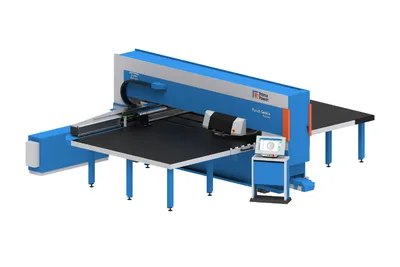
Prima Power Punch Genius 1540
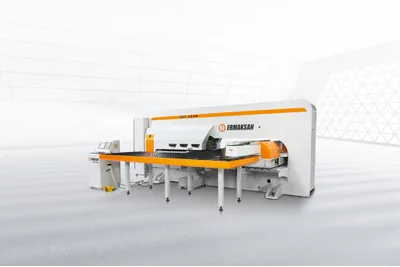
Ermak ETP 1500x2500
Bystronic ByTower
Amada AC 2510 NT
Yawei HPC-2048