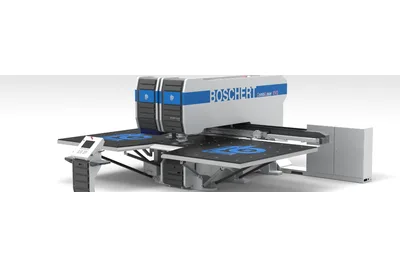
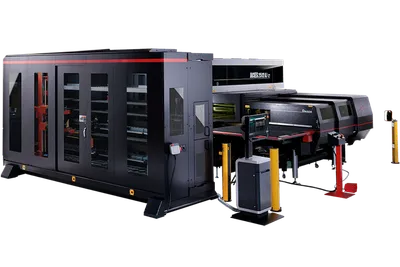
TRUMPF TruMatic 2000R
Key Specifications
sheet capacity
punching force
turret stations
punch drive
laser type
laser power
Overview
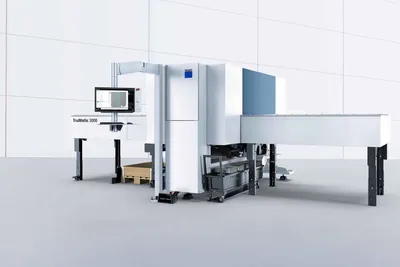
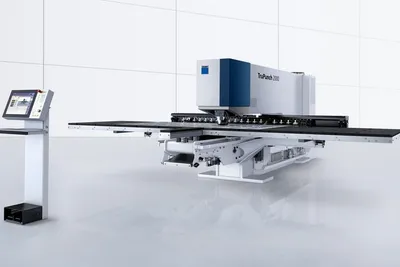
The TRUMPF TruMatic 2000R is a CNC combination punching and laser cutting machine from TRUMPF GmbH + Co. KG, headquartered in Ditzingen, Germany. TRUMPF's TruMatic series represents combination machines that integrate a turret punch press with a laser cutting head, enabling both punching operations (forming, embossing, special shapes) and laser cutting in a single machine without re-fixturing.
The TruMatic 2000R handles sheet metal up to 1,500 x 2,500 mm in the combination punch-laser configuration. The punch section provides 180 kN (18 tons) punching force with a 20-station turret, while the laser section uses a CO2 or fiber laser (model-dependent) for contour cutting, complex outlines, and small feature cutting. Programming runs in TRUMPF TruTops Punch/Laser combined software that assigns operations to punch or laser based on feature type and processing efficiency.
The combination approach provides practical advantages: punched features (holes, forms, louvres) that are faster and cheaper with the punch continue to use punch tooling; complex contours and small internal cutouts where laser quality is superior use the laser; all in a single setup on one sheet without machine transfer. For shops with mixed production of standard and complex parts, a combination machine consolidates two machines into one.
The TruMatic 2000R competes with the Amada Pulsar 2512, the Prima Power Combi Genius, and the Salvagnini combination systems in the punch-laser combination market. TRUMPF differentiators are TruTops software quality for operation assignment, TRUMPF's brand leadership in both laser and punch technology, and the established service network for combination machine support. Pricing typically runs $400,000-$800,000.
Full Specifications
| Parameter | Value |
|---|---|
| Sheet Capacity | 1,500 x 2,500 mm (59 x 98 in) |
| Punching Force | 180 kN (18 tons) |
| Turret Stations | 20 stations |
| Punch Drive | Hydraulic (standard model) |
| Laser Type | CO2 or fiber laser (model variant dependent) |
| Laser Power | 2.2-3.2 kW CO2 or 2-3 kW fiber |
| Sheet Thickness Mild Steel Punch | 0.5-6.0 mm |
| Sheet Thickness Mild Steel Laser | 0.5-12 mm (CO2) or 0.5-20 mm (fiber) |
| CNC Control | TRUMPF TruTops Punch/Laser combination programming |
| Machine Weight | 12,000 kg (26,455 lb) |
| Electrical | 400 VAC 3-phase 50 Hz |
| Arno Bayer Head Of Industrial Engineering Joining At Ekpo | We particularly appreciate the TruFiber's combination of outstanding beam quality and process reliability. |
| Gerhard Steinhuber Samps Steinhuber Gmbh | For us, the Flex Cell is an ideal solution in terms of cost-benefit ratio. |
| Bjrn Mller Head Of Production Factory 2 Gedia Gmbh | It was a really good collaborative project. Together, we searched for solutions that perfectly met our individual requirements. |
| Joseph Gampp Division Manager Of Product Management Feinwerktechnik Hago | The technology fits perfectly into our strategic alignment. |
Specifications sourced from trumpf.com — verified 2026-03-28
Strengths & Limitations
Strengths
- Combination punch + laser in one machine eliminates material transfer between separate punch press and laser cutter for mixed-operation parts
- TruTops software intelligently assigns operations to punch or laser based on feature type, processing efficiency, and cost optimization
- TRUMPF brand leadership in both laser cutting and punch press technology provides validated quality in both processes from one vendor
- 20-station turret provides adequate tooling for forming tools (louvres, embosses) and special punch shapes alongside standard round/rectangular punches
- Single setup for complex parts with punched forms + laser contours eliminates fixturing cost and alignment between operations
Limitations
- Higher capital cost than separate punch press + laser system for shops that don't need combination capability for most parts
- CO2 laser version loses competitiveness against modern fiber laser punch combinations for reflective materials (aluminum, stainless)
- 20-station turret is smaller than standalone 36-station punch presses, limiting tooling variety for punch-intensive production
Best For
Frequently Asked Questions
01
TruTops Punch/Laser uses a rules-based assignment system with user-adjustable parameters: (1) Feature type - round and rectangular holes within the punch tool library are assigned to punch by default; complex contours not available in the turret are assigned to laser; (2) Size threshold - features smaller than the laser's minimum pierce diameter are assigned to punch; large cutouts where laser speed is competitive with multiple punch strokes may be assigned to laser; (3) Material - stainless and aluminum assigned to laser for edge quality; mild steel uses punch for standard holes; (4) User override - the programmer can manually reassign any feature to either process. The software estimates machine time for each assignment option and can suggest the faster option. For production programming, the assignment logic is fine-tuned in setup sessions to match the shop's preferred process allocation.
02
CO2 laser (2.2-3.2 kW): operates at 10.6 µm wavelength, well-absorbed by organic materials and steel. Advantages: better beam quality for thick stainless and mild steel cutting; wider available power range. Disadvantages: requires more complex gas laser technology with gas consumption and tube replacement costs; slower on thin material compared to fiber. Fiber laser (2-3 kW): operates at 1.07 µm wavelength, better absorbed by metals including copper and aluminum that CO2 cannot cut efficiently. Advantages: faster cutting on thin material (1-6 mm); cuts reflective materials (aluminum, copper, brass) safely; lower operating cost; no gas tube replacement. Disadvantages: higher initial cost. For new installations, TRUMPF recommends fiber laser for most applications due to the broader material capability and lower operating cost. CO2 TruMatic 2000R machines are legacy installations.
03
The TruMatic 2000R punch section (18 tons, 20-station turret) supports the same forming tool catalog as standalone TRUMPF TruPunch machines: louvres (single and double), lances (for ventilation grilles), dimples, bridge extrusions, card guides, tab-and-slot features, and countersinking. For the combination machine application, formed features are particularly valuable because the laser cannot perform 3D forming - louvres and embosses must be punched. The combination machine workflow: (1) Punch all holes and formed features first; (2) Laser cut the part outline and complex internal contours. This sequence ensures the sheet is structurally intact during forming. Forming tool stroke height limits must be managed: the Z-axis must accommodate the largest forming tool in the 20-station turret.
04
For a part requiring 30 punched holes, 5 louvres, and a laser-cut complex outline: separate machine workflow: punch on punch press (2.5 minutes) + manual transfer to laser (5-10 minutes) + laser cut (1.5 minutes) = 9-14 minutes total per part. Combination machine workflow: all operations on one machine (3.5-5 minutes) without transfer = 3.5-5 minutes. Time saving: 50-70% for this part type. The combination machine advantage is maximized for complex parts requiring both processes. For parts requiring only punching or only laser cutting, the combination machine provides no throughput advantage and the dual-system investment is over-allocated. The business case for combination machines depends on the fraction of the product mix that genuinely requires both processes.
05
The TruMatic 2000R handles sheet sizes from approximately 300 x 300 mm minimum to 1,500 x 2,500 mm maximum. Standard sheet use: 1,250 x 2,500 mm (3 x 8 ft equivalent) and 1,500 x 2,500 mm (close to 5 x 8 ft) are the most common commercial formats compatible with this machine. Full 4 x 8 ft (1,219 x 2,438 mm): yes, this fits within the 1,500 x 2,500 mm envelope. Full 4 x 10 ft (1,219 x 3,048 mm): exceeds the 2,500 mm Y capacity - shops requiring 10 ft sheet handling need the TruMatic 5000 or 7000. Skeleton removal: the combination machine processes the full sheet including skeleton - the laser can cut the skeleton into smaller pieces for removal without manual handling.
Videos
mteg GmbH
Андрій Заболотний
GINDUMAC GmbH
Elite Machinery Inc.
GINDUMAC GmbH
Community Discussions
Community discussion — Press brake talk Trumpf, Amada etc. - Practical Machinist
Troubleshooting and problem-solving — simumerik system 3 ( trumpf trumatic 225 ...
Pricing and buying discussion — Fabrication: CNC Laser, Waterjet, Plasma, Welding | Trumpf ...
Troubleshooting and problem-solving — Fabrication: CNC Laser, Waterjet, Plasma, Welding | Trumpf ...
Community discussion — Trumph TRUMATIC 200r - cnczone.com
Community discussion — Need Help! Trumpf 200R - cnczone.com
Troubleshooting and problem-solving — Need Help! Trumpf Laser Cutting Troubleshooting.... - CNCzone
Community discussion — Search Results - CNCzone.com- Largest Forums for CNC ...
Troubleshooting and problem-solving — Anyone familiar with this problem? : r/Machinists - Reddit
Community discussion — Prototrak machines? : r/Machinists - Reddit
Community discussion — Tips on knurling? : r/Machinists - Reddit
Maintenance and service — Drill Taps : r/Machinists - Reddit
Links to community discussions. Summaries are editorial — visit the original thread for full context.