Salvagnini S1.40
Key Specifications
max sheet size
min sheet size
punching technology
laser cutting technology
laser source power
laser assist gas
How much does the Salvagnini S1.40 cost?
Price estimate
We do not have a price for the Salvagnini S1.40 that we can stand behind, so we show no number. Configuration, options and installation move the final price a long way: a quote is the reliable figure.
Overview
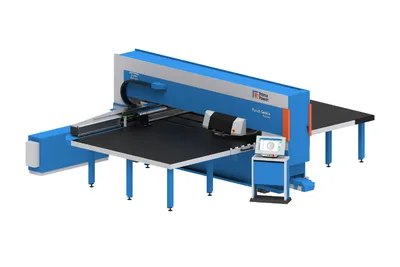
Four-metre sheet is the reason to pick the Salvagnini S1.40 over its shorter sibling. Its maximum sheet is 4,064 x 1,524 mm (160.0 x 60.0 in); the S1.30 stops at 3,048 x 1,524 mm. The rest of the table does not change between the two.
Long sheet changes how a punch-laser combi earns its keep. More parts fit in a nest before the machine has to stop for a new blank, and long parts such as cabinet sides or door skins come off in one piece. Salvagnini lists three production strategies for the automated cell: single parts; multiple parts and nests, microjointed or separated, with the scrap preserved and the skeleton unloaded; and separated nests with the skeleton destroyed. On a sheet this long the choice affects what unloading device is needed, so decide it before the layout is drawn.
The tooling concept is a multi-press head with a die structure for up to 59 tools, individually actuated. The thick turret tools are designed and produced by Matrix, a company in the Salvagnini Group. A fiber laser of 3000-4000 W, cutting with nitrogen or compressed air, separates the parts and handles irregular contours.
Capacity is deliberately narrow. Aluminum, steel and stainless steel are all listed at 5.0 mm (0.20 in) maximum for both punching and laser cutting, with a 0.5 mm (0.02 in) minimum. The smallest sheet the manipulator accepts is 670 x 400 mm (26.4 x 15.7 in). The drive that moves the tools uses a controlled descent, which Salvagnini says reduces cycle times and improves punching quality.
Full Specifications
| Parameter | Value |
|---|---|
| Max Sheet Size | 4,064 x 1,524 mm (160.0 x 60.0 in) |
| Min Sheet Size | 670 x 400 mm (26.4 x 15.7 in) |
| Punching Technology | Multi-press head |
| Laser Cutting Technology | Fiber laser |
| Laser Source Power | 3000-4000 W |
| Laser Assist Gas | Nitrogen, compressed air |
| Max Thickness Aluminum Punching | 5.0 mm (0.20 in), UTS 265 N/mm2 |
| Max Thickness Aluminum Laser Cutting | 5.0 mm (0.20 in), UTS 265 N/mm2 |
| Max Thickness Steel Punching | 5.0 mm (0.20 in), UTS 410 N/mm2 |
| Max Thickness Steel Laser Cutting | 5.0 mm (0.20 in), UTS 410 N/mm2 |
| Max Thickness Stainless Steel Punching | 5.0 mm (0.20 in), UTS 660 N/mm2 |
| Max Thickness Stainless Steel Laser Cutting | 5.0 mm (0.20 in), UTS 660 N/mm2 |
| Min Material Thickness | 0.5 mm (0.02 in) |
Specifications sourced from salvagninigroup.com — verified 2026-10-05
Strengths & Limitations
Strengths
- Maximum sheet of 4,064 x 1,524 mm (160.0 x 60.0 in) for long parts and larger nests
- Up to 59 tools in the multi-press head, with no in-cycle set-ups
- Fiber laser of 3000-4000 W for separation and irregular contours
- Two-carriage manipulator changes its dynamics with the dimensions and weight of the sheet
- Thermal expansion of the manipulator axes is checked and compensated automatically
Limitations
- Thickness is capped at 5.0 mm (0.20 in) in aluminum, steel and stainless steel
- Sheet width is limited to 1,524 mm
- Sheets smaller than 670 x 400 mm (26.4 x 15.7 in) cannot be processed
- Unloading a sheet of this length needs one of the UC, TM or TML devices to run unattended
Best For
Frequently Asked Questions
01
The maximum sheet dimensions are 4,064 x 1,524 mm (160.0 x 60.0 in). The minimum is 670 x 400 mm (26.4 x 15.7 in). The S1.30 is the shorter model, with a maximum of 3,048 x 1,524 mm.
02
The table lists a maximum of 5.0 mm (0.20 in) in aluminum, steel and stainless steel, for punching and for laser cutting alike, and a minimum of 0.5 mm (0.02 in). The figures are tied to stated tensile strengths, for example UTS 410 N/mm2 for steel.
03
No. The multi-press head carries up to 59 tools in its die structure and each one is actuated individually, so every tool is available at any point of the program. Salvagnini says this eliminates in-cycle set-ups and the related waiting times.
04
That depends on the strategy chosen. Parts can be produced microjointed or separated with the scrap preserved and the skeleton unloaded, or as separated nests with the skeleton destroyed. The TM and TML manipulators pick up and stack parts without destroying the skeleton.
More from Salvagnini
Other CNC Punch Presses
Yawei HPE-3057
TRUMPF TruPunch 3000
TRUMPF TruMatic 2000R
Prima Power Punch Genius 1540