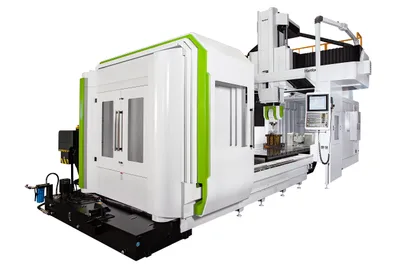
GF Machining Liechti Turbomill 800g Twin
Key Specifications
Max Spindle
Spindle Taper
Tool Capacity
Weight
Rapid Traverse
Spindle Power
How much does the GF Machining Liechti Turbomill 800g Twin cost?
Estimated price range
Our best estimate for a 5-axis machining center in this class — not a quote from GF Machining Solutions. Configuration moves it a long way.
Overview
The Liechti Turbomill 800g Twin is listed as a dual-spindle 5-axis simultaneous machine: two independent HSK-A63 spindles, each rated 50 kW (67 hp) and 150 Nm at up to 20,000 rpm, working over an 800 mm work zone on parts up to 300 mm in diameter. The magazine carries 60 tools, split 30 per spindle. These are listed figures that nobody has yet confirmed against a current Liechti or GF Machining Solutions specification.
The twin layout is what defines it. Two spindles mean two parts in progress at once, which is how a shop doubles output on a repeat part without doubling floor space for two separate machines. The price of that is envelope. The single-spindle Liechti Turbomill 800g is listed for parts up to 450 mm in diameter; here the limit is 300 mm, and the table does not say why.
Tool count also needs a careful look. Each spindle draws on 30 tools, which is fewer than the 40 of the single-spindle Turbomill 800g. A part whose programme needs more than 30 tools will not run twin without compromise.
The listed weight is 28,000 kg (61,729 lb), against 20,000 kg for the single-spindle Liechti Turbomill 800g. Rapids are 30 m/min and positioning 0.004 mm. Coolant runs through the spindles at 80 bar, under a Siemens Sinumerik 840D sl control with Liechti Turbosoft+ CAM.
Full Specifications
| Parameter | Value |
|---|---|
| Workzone Length | 800 mm |
| Max Part Diameter | 300 mm (11.8 in) |
| Number of Axes | 5-axis simultaneous (dual spindle) |
| Max Spindle Speed | 20,000 RPM |
| Spindle Taper | HSK-A63 |
| Spindle Motor Power | 50 kW (67 hp) per spindle |
| Spindle Torque | 150 Nm |
| Spindle Configuration | Dual independent spindles |
| Tool Capacity | 60 (30 per spindle) |
| Rapid Traverse Rate | 30 m/min (1,181 ipm) |
| Positioning Accuracy | 0.004 mm (4 µm) |
| CAM Software | Liechti Turbosoft+ |
| CNC Control | Siemens Sinumerik 840D sl |
| Coolant System | High-pressure through-spindle (80 bar) |
| Machine Weight | 28,000 kg (61,729 lb) |
Specifications compiled from manufacturer literature and industry references. Not independently verified against a published spec sheet — confirm with the manufacturer or an authorised dealer before making a purchasing decision.
Strengths & Limitations
Strengths
- Two independent 20,000 rpm HSK-A63 spindles, each listed at 50 kW and 150 Nm
- Machines two parts at once over an 800 mm work zone
- 60 tools in total, 30 per spindle
- Through-spindle coolant at 80 bar
Limitations
- Part diameter limited to 300 mm, against 450 mm on the single-spindle Liechti Turbomill 800g
- Each spindle has 30 tools, fewer than the 40 of the single-spindle machine
- 28,000 kg (61,729 lb) is a heavy installation
- The listed table has not been confirmed against a current manufacturer specification
Best For
Frequently Asked Questions
01
A second independent spindle. The Turbomill 800g Twin has two 50 kW, 150 Nm spindles with 30 tools each; the Liechti Turbomill 800g has one spindle and 40 tools. The trade is part size and weight: 300 mm and 28,000 kg on the twin, against 450 mm and 20,000 kg on the Liechti Turbomill 800g.
02
The listed maximum part diameter is 300 mm (11.8 in) and the work zone length is 800 mm. Both spindles work within those limits. Larger-diameter parts need the single-spindle Liechti Turbomill 800g, which is listed for 450 mm.
03
The listed spindle configuration is dual independent spindles, each rated 50 kW (67 hp) and 150 Nm at up to 20,000 rpm. Ask the supplier how independent motion is handled in the control and CAM, since the table does not describe it.
04
The listed weight is 28,000 kg (61,729 lb). That needs a foundation assessment and suitable rigging. Electrical, air and footprint data are not in the listed table and must come from the supplier's installation drawing.
More from GF Machining Solutions
GF Mikron MILL E 700 U
GF Machining MIKRON MILL P 800 U S
GF Machining Liechti g-Mill 1350
GF Machining Liechti Turbomill 2000gx Twin
GF Machining Mikron MILL E 1400 U ST
GF Machining MIKRON MILL S 400 U
Other 5-Axis Machining Centers
Starrag NB Series
Hartford HSA-536EAY
AWEA LP-4025YF
Hartford 5BC-429