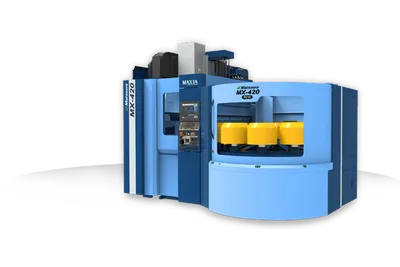
GF Machining Liechti Turbomill 2000gx Twin
Key Specifications
blade length max incl fixture
blade swing diameter max
spindle
tool changer
quality inspection
cam software
How much does the GF Machining Liechti Turbomill 2000gx Twin cost?
Estimated price range
Our best estimate for a 5-axis machining center in this class — not a quote from GF Machining Solutions. Configuration moves it a long way.
Overview
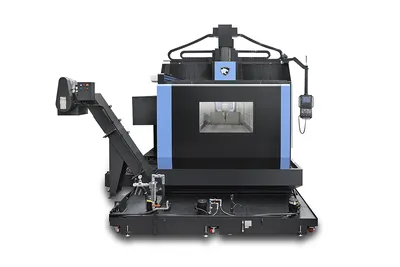
The Liechti Turbomill 2000gx Twin is a twin-spindle blade machining center. Liechti lists a maximum blade length of 2000 mm including the fixture and a maximum blade swing diameter of 2 x 395 mm, worked by two HSK-A63 spindles of 20,000 rpm, 120 Nm and 25 kW each.
The twin layout means two blades are machined at the same time, one per spindle, within the 395 mm swing each. That is the configuration for series production of one blade design, where output per machine counts. The 2000 mm length figure includes the fixture, so the usable blade length is shorter by whatever the clamping at the root and tip takes up.
The tool changer is offered with 60 or 90 positions, also on HSK-A63, and the choice is worth making with the full tool list of the blade family in hand. Liechti lists work and tool measuring for quality inspection, and programming runs through Liechti Turbosoft plus, its own CAM software.
The Liechti table does not give axis travels, rapids, accuracy, control or machine weight, so those have to come from the quotation.
Full Specifications
| Parameter | Value |
|---|---|
| Blade Length Max Incl Fixture | 2000 mm |
| Blade Swing Diameter Max | 2 x 395 mm |
| Spindle | 2 x 20,000 rpm, 120 Nm, 25 kW, HSK-A63 |
| Tool Changer | 60 or 90 positions, HSK-A63 |
| Quality Inspection | Work & tool measuring |
| CAM Software | Liechti Turbosoft plus |
Specifications sourced from liechti.com — verified 2026-08-10
Strengths & Limitations
Strengths
- Two HSK-A63 spindles at 20,000 rpm, 120 Nm and 25 kW each machine two blades at once
- Blades up to 2000 mm long including the fixture
- Tool changer offered with 60 or 90 positions
- Work and tool measuring for in-machine quality inspection
Limitations
- Blade swing diameter is limited to 395 mm at each of the two stations
- Liechti's table gives no travels, accuracy, control or weight, so these must be obtained from the supplier
Best For
Frequently Asked Questions
01
Liechti lists a maximum blade length of 2000 mm including the fixture and a maximum blade swing diameter of 2 x 395 mm, one for each spindle. Subtract the fixture at both ends from the 2000 mm to find the longest blade.
02
Two spindles, each listed at 20,000 rpm, 120 Nm and 25 kW with an HSK-A63 interface. The tool changer is also HSK-A63, with 60 or 90 positions to choose from.
03
Liechti lists work and tool measuring under quality inspection, and Liechti Turbosoft plus as the CAM software. Ask the supplier which measuring hardware and which software modules are included in the quotation.
More from GF Machining Solutions
Other 5-Axis Machining Centers
Hyundai WIA KF7300/5A
Fooke ENDURA 7000LINEAR
DN Solutions DBM 2550 U