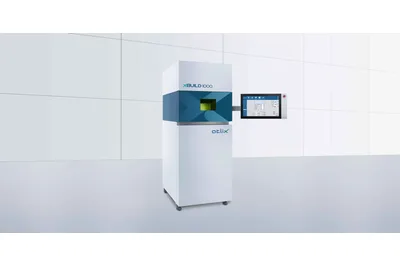
EOS M 100
Key Specifications
build volume
laser type
laser power
number of lasers
focus diameter
layer thickness
How much does the EOS M 100 cost?
Estimated price range
Our best estimate for a metal additive manufacturing in this class — not a quote from EOS. Configuration moves it a long way.
Overview
The EOS M 100 is a small Direct Metal Laser Sintering (DMLS) machine with a cylindrical build volume of Ø 100 x 95 mm (Ø 3.94 x 3.74 in) and a single 200 W Yb-fiber laser. The listed figures all point toward small, detailed parts: a focus diameter of ~40 µm and layers of 20 - 50 µm, depending on material.
The material row names Cobalt Chrome, Titanium, Stainless Steel and precious metals, and the inert gas is nitrogen. Taken with a round build plate of 100 mm diameter, that fits work such as dental frameworks, jewellery and small medical or mechanical components, and it excludes anything structural in size.
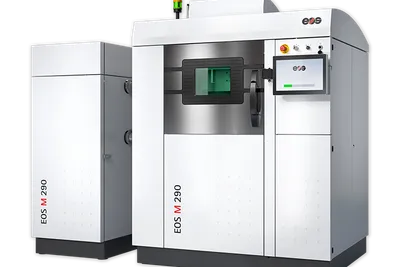
The machine is light on services. It runs from a single-phase 230 V supply with a maximum power consumption of 2.4 kW and measures 800 x 950 x 2,250 mm (31.5 x 37.4 x 88.6 in), so it can stand in a laboratory or a small workshop that has no three-phase feed. The larger M 290 lists 250 x 250 x 325 mm (9.8 x 9.8 x 12.8 in) and 400 W.
Scan speed is listed as up to 7.0 m/s. Software is EOSPRINT, with EOSTATE monitoring as an option, and the control is EOS's own.
Full Specifications
| Parameter | Value |
|---|---|
| Build Volume | Ø 100 x 95 mm (Ø 3.94 x 3.74 in) |
| Laser Type | Yb-fiber laser |
| Laser Power | 200 W |
| Number of Lasers | 1 |
| Focus Diameter | ~40 µm |
| Layer Thickness | 20 - 50 µm (material dependent) |
| Scan Speed | Up to 7.0 m/s |
| Technology | Direct Metal Laser Sintering (DMLS) |
| Materials | Cobalt Chrome, Titanium, Stainless Steel, Precious metals |
| Inert Gas | Nitrogen |
| Power Supply | Single-phase, 230V |
| Power Consumption Max | 2.4 kW |
| Machine Dimensions | 800 x 950 x 2,250 mm (31.5 x 37.4 x 88.6 in) |
| Software | EOSPRINT, EOSTATE monitoring (optional) |
| CNC Control | EOS proprietary |
Specifications compiled from manufacturer literature and industry references. Not independently verified against a published spec sheet — confirm with the manufacturer or an authorised dealer before making a purchasing decision.
Strengths & Limitations
Strengths
- ~40 µm focus diameter and 20 - 50 µm layers for fine detail
- Single-phase 230 V supply and a maximum power consumption of 2.4 kW
- Footprint of 800 x 950 mm (31.5 x 37.4 in) at a height of 2,250 mm (88.6 in)
- Listed for Cobalt Chrome, Titanium, Stainless Steel and precious metals
Limitations
- Build volume is only Ø 100 x 95 mm (Ø 3.94 x 3.74 in), against 250 x 250 x 325 mm on the M 290
- One 200 W laser, half the 400 W of the M 290
- EOSTATE monitoring is listed as optional, so it is not part of the base machine
- Nitrogen is the only inert gas the listed figures name, so confirm the gas needed for the alloy you plan to run
Best For
Frequently Asked Questions
01
The listed build volume is Ø 100 x 95 mm (Ø 3.94 x 3.74 in), a cylinder and not a box. A part has to fit inside a 100 mm circle in plan and within 95 mm of height, including whatever supports it needs underneath.
02
The material row gives Cobalt Chrome, Titanium, Stainless Steel and precious metals. Layer thickness is 20 - 50 µm and is material dependent, so the usable layer for one alloy may not be available for another. The listed inert gas is nitrogen.
03
The listed figures give a single-phase 230 V supply and a maximum power consumption of 2.4 kW. The machine measures 800 x 950 x 2,250 mm (31.5 x 37.4 x 88.6 in), so check ceiling height where it will stand.
04
Focus diameter is listed as ~40 µm, with layers of 20 - 50 µm and a scan speed of up to 7.0 m/s from a 200 W Yb-fiber laser. For comparison, the M 290 lists a focus diameter of approx. 85 µm (0.00335 in) with a 400 W laser.
Videos

Tech Through The Lens
Progearnews
Community Discussions
Options and configuration advice
Links to community discussions. Summaries are editorial — visit the original thread for full context.
More from EOS
Other Metal Additive Manufacturing
Desktop Metal Shop System
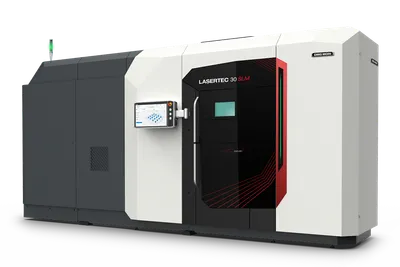
DMG Mori LASERTEC 30 SLM 3rd Generation
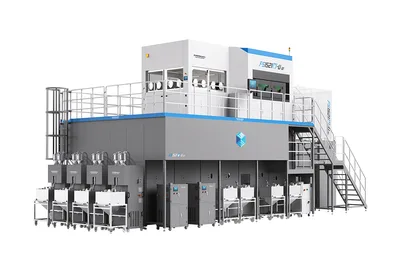
Farsoon FS1521M