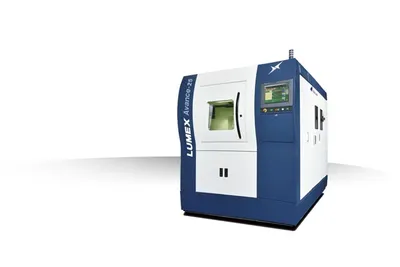
EOS M 300-1
Key Specifications
build volume
laser type
laser power
number of lasers
scan speed
focus diameter
How much does the EOS M 300-1 cost?
Estimated price range
Our best estimate for a metal additive manufacturing in this class — not a quote from EOS. Configuration moves it a long way.
Overview
The EOS M 300-1 is a metal additive manufacturing system built around the 300 x 300 x 435 mm (11.8 x 11.8 x 17.1 in) build volume of the M 300 series. Height is the figure to notice: 435 mm (17.1 in) of Z over a 300 x 300 mm plate makes this a machine for tall, slender parts as much as for wide ones.
Set against the M 290, the difference is easy to read. The M 290 lists 250 x 250 x 325 mm (9.8 x 9.8 x 12.8 in) and weighs approx. 1350 kg (2976 lbs). The M 300-1 gives more room on every axis, but it weighs approx. 5500 kg (12125 lbs) and stands 5221 x 2680 x 2340 mm (205.6 x 105.5 x 92.1 in), so it is a much larger installation for a moderately larger part.
Within the series, the M 300-4 shares the same build volume and the same approx. 5500 kg (12125 lbs), and is listed with 4 x 400 W of laser power. A buyer choosing between the two should have the laser configuration of each written into the quotation, because that is where the machines differ. The chamber and the frame figures do not.
The table gives a scan speed of up to 7.0 m/s (23.0 ft/s) and a focus diameter of approx. 100 µm (0.00394 in). Software is listed as EOSPRINT 2 together with EOSTATE MPM + ExposureOT. On the services side the machine wants 3 x 63 A, with consumption of max. 19.6 kW and typical 16.0 kW, and compressed air at 7 bar and 15 m³/h (102 psi; 530 ft³/h).
Full Specifications
| Parameter | Value |
|---|---|
| Build Volume | 300 x 300 x 435* mm (11.8 x 11.8 x 17.1 in) |
| Laser Type | Yb-fiber laser; 4 x 1000 W |
| Laser Power | 400 W |
| Number of Lasers | 1 |
| Scan Speed | up to 7.0 m/s (23.0 ft/s) |
| Focus Diameter | approx. 100 µm (0.00394 in) |
| Machine Dimensions | 5221 x 2680 x 2340 mm (205.6 x 105.5 x 92.1 in) |
| Software | EOSPRINT 2, EOSTATE MPM + ExposureOT |
| Presicion Optics | 4 F-theta-lens(es); 4 High-speed scanner(s) |
| Power Supply | 3 x 63 A |
| Power Consumption | max. 19.6 kW / typical 16.0 kW |
| Compressed Air Supply | 7 Bar; 15 m³/h (102 psi; 530 ft³/h) |
| Recommended Installation Space | min. 8800 x 5200 x 3500 mm (346.5 x 204.7 x 137.8 in) |
| Machine Weight | approx. 5500 kg (12125 lbs) |
Specifications sourced from eos.info — verified 2026-10-03
Strengths & Limitations
Strengths
- 435 mm (17.1 in) of build height, against 325 mm (12.8 in) on the M 290
- 300 x 300 mm (11.8 x 11.8 in) plate, against 250 x 250 mm (9.8 x 9.8 in) on the M 290
- Software row lists EOSTATE MPM + ExposureOT alongside EOSPRINT 2
- Focus diameter of approx. 100 µm (0.00394 in) with scan speed up to 7.0 m/s (23.0 ft/s)
Limitations
- At approx. 5500 kg (12125 lbs) it weighs about four times as much as the M 290 at approx. 1350 kg (2976 lbs)
- Recommended installation space is min. 8800 x 5200 x 3500 mm (346.5 x 204.7 x 137.8 in), so a 3500 mm ceiling is part of the requirement
- Typical consumption of 16.0 kW is close to the max. of 19.6 kW, on a 3 x 63 A supply
- Layer thickness, build rate and materials are absent from the table
Best For
Frequently Asked Questions
01
The build volume is 300 x 300 x 435 mm (11.8 x 11.8 x 17.1 in). The 435 mm height carries an asterisk in EOS's table, so find out what it includes before committing a part that uses all of it. A part must also fit the 300 x 300 mm plate in plan, whatever its height.
02
The M 290 lists a 250 x 250 x 325 mm (9.8 x 9.8 x 12.8 in) build volume and approx. 1350 kg (2976 lbs). The M 300-1 lists 300 x 300 x 435 mm (11.8 x 11.8 x 17.1 in) and approx. 5500 kg (12125 lbs). The M 290 runs on 1 x 32 A, while the M 300-1 needs 3 x 63 A.
03
Build volume and weight are the same in both tables: 300 x 300 x 435 mm (11.8 x 11.8 x 17.1 in) and approx. 5500 kg (12125 lbs). The M 300-4 is listed with 4 x 400 W of laser power and a laser count of 4. Ask EOS to state the laser configuration of the M 300-1 in the quotation and compare the two on that basis.
04
The software row lists EOSPRINT 2 and EOSTATE MPM + ExposureOT. The table does not say which of these are part of the base machine and which are supplied separately, so check the scope of supply before ordering.
05
A 3 x 63 A power supply, with power consumption listed as max. 19.6 kW and typical 16.0 kW, and compressed air at 7 bar and 15 m³/h (102 psi; 530 ft³/h). The recommended installation space is min. 8800 x 5200 x 3500 mm (346.5 x 204.7 x 137.8 in).
Community Discussions
Pricing and buying discussion
Links to community discussions. Summaries are editorial — visit the original thread for full context.
More from EOS
Other Metal Additive Manufacturing
DMG Mori LASERTEC 30 SLM
SLM Solutions SLM 125