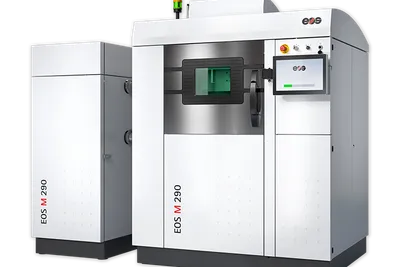
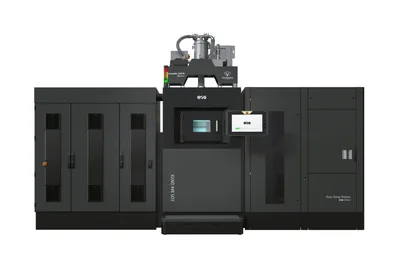
EOS M 400-4 Metal Powder Bed Fusion System
Key Specifications
build volume x y z
layer thickness
laser power
number of lasers
build rate
materials
How much does the EOS M 400-4 Metal Powder Bed Fusion System cost?
Estimated price range
Our best estimate for a metal additive manufacturing in this class — not a quote from EOS GmbH. Configuration moves it a long way.
Overview
The EOS M 400-4 Metal Powder Bed Fusion System is a four-laser machine with a listed build volume of 400 x 400 x 400 mm and 4 x 400W fiber lasers. The listed figures put the build rate at up to 100 cm³/h, material-dependent, and the layer thickness at 20 – 100 µm.
The material row is the broadest part of the table: Ti-6Al-4V, AlSi10Mg, IN625, IN718, 316L, CoCr and MS1 maraging steel. With a 100 µm upper layer limit and four beams, the machine is set up for output on large plates. The 20 µm lower limit is there for detail, at the expense of build time.
Listed accuracy is ±0.1 mm or ±0.1%, whichever is greater. On a part that spans the full 400 mm the percentage governs, so features that must hold a tight tolerance should be planned with machining stock.
Full Specifications
| Parameter | Value |
|---|---|
| Build Volume X Y Z | 400 x 400 x 400 mm |
| Layer Thickness | 20 – 100 µm |
| Laser Power | 4 x 400W fiber lasers |
| Number of Lasers | 4 |
| Build Rate | Up to 100 cm³/h (material-dependent) |
| Materials | Ti-6Al-4V, AlSi10Mg, IN625, IN718, 316L, CoCr, MS1 maraging steel |
| Accuracy | ±0.1 mm or ±0.1% (whichever is greater) |
| Machine Weight | Approx. 4,500 kg |
Specifications compiled from manufacturer literature and industry references. Not independently verified against a published spec sheet — confirm with the manufacturer or an authorised dealer before making a purchasing decision.
Strengths & Limitations
Strengths
- Four 400W fiber lasers over a listed 400 x 400 x 400 mm build volume
- Listed build rate of up to 100 cm³/h, material-dependent
- Material row spans Ti-6Al-4V, AlSi10Mg, IN625, IN718, 316L, CoCr and MS1 maraging steel
- Layer thickness range of 20 – 100 µm
Limitations
- The 100 cm³/h build rate is a material-dependent maximum, not a figure for every alloy
- Listed accuracy of ±0.1 mm or ±0.1%, whichever is greater, means tight features are likely to need finish machining
Best For
Frequently Asked Questions
01
The listed figures give a build volume of 400 x 400 x 400 mm and 4 x 400W fiber lasers, with a laser count of 4. The listed build rate is up to 100 cm³/h and depends on the material.
02
The material row names Ti-6Al-4V, AlSi10Mg, IN625, IN718, 316L, CoCr and MS1 maraging steel. Layer thickness is listed as 20 – 100 µm. Which layer applies to which alloy is not stated, so ask for the parameter set that matches your material.
03
±0.1 mm or ±0.1%, whichever is greater. Small features are therefore held to the fixed figure and long dimensions to the percentage, and anything tighter than that needs a machining allowance.
Videos
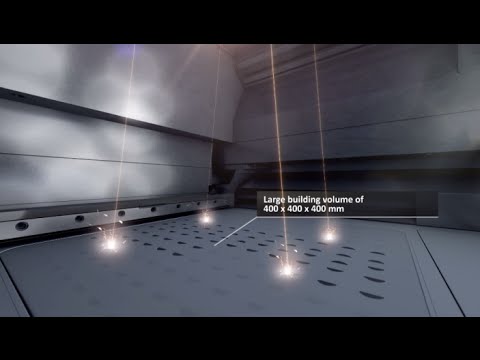
EOS 3D Printing

EOS 3D Printing

MachineToolSystems
Community Discussions
Links to community discussions. Summaries are editorial — visit the original thread for full context.