EOS M 400-4
Key Specifications
build volume
laser type
laser power
number of lasers
scan speed
focus diameter
How much does the EOS M 400-4 cost?
Estimated price range
Our best estimate for a metal additive manufacturing in this class — not a quote from EOS. Configuration moves it a long way.
Overview
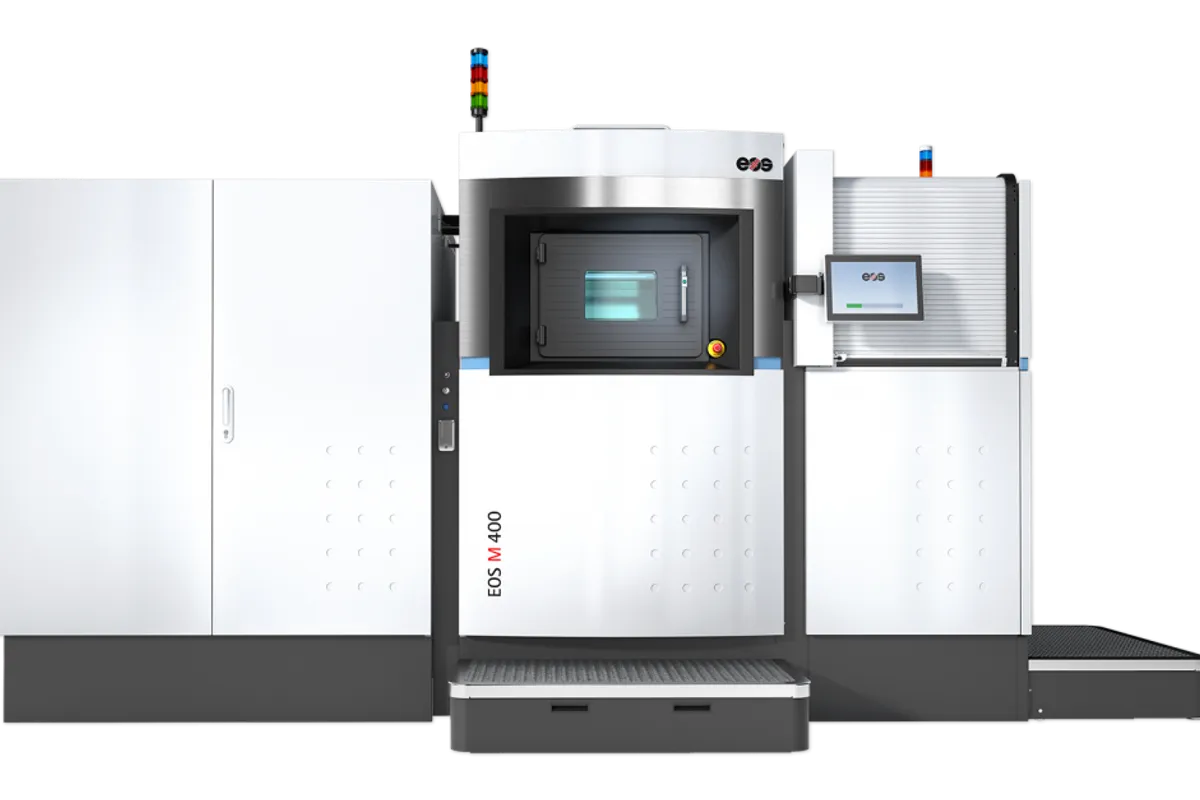
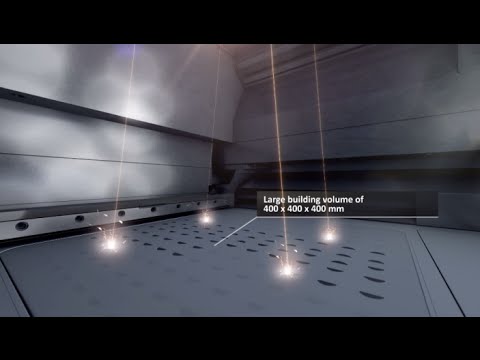
The EOS M 400-4 is a four-laser metal additive manufacturing system with a 400 x 400 x 400 mm (15.7 x 15.7 x 15.7 in) build volume and 4 x 400 W of Yb-fiber laser power. What sets it apart is how the lasers divide the plate. EOS lists the laser coverage as 4 x 250 x 250 mm quadrants with 50 mm overlap, so each laser owns one corner of the 400 x 400 mm field and shares only a band along the seams with its neighbours.
That layout suits plates filled with many parts, or four copies of one part, where each quadrant runs its own exposure at the same time. A single part that spans the plate is built by all four lasers, with the joins falling inside the overlap bands, and a part placed wholly inside one quadrant is exposed by one 400 W laser alone. The M 300-4 takes the other route: its 4 x 400 W are listed with a full-overlap architecture over 300 x 300 x 435 mm (11.8 x 11.8 x 17.1 in).
The optics are 4 F-theta lenses and 4 high-speed scanners, with a scan speed of up to 7.0 m/s (23.0 ft/s) and a focus diameter of approx. 90 µm (0.00354 in). Above it in the range, the M4 ONYX lists 6 x 400 W over 450 x 450 x 400 mm (17.7 x 17.7 x 15.7 in), so the build height is the same and the gain is in plate area and laser count.
Plan the installation around the power figures. Supply is 3 x 50 A, and consumption is listed as max. 45.0 kW and typical 22.0 kW. The machine measures 5140 x 2490 x 2625 mm (202.4 x 98.0 x 103.3 in), weighs approx. 4900 kg (10803 lbs) and has a recommended installation space of min. 7500 x 6000 x 3300 mm (295.3 x 236.2 x 129.9 in). Compressed air is 7 bar at 20 m³/h (102 psi; 706 ft³/h).
Full Specifications
| Parameter | Value |
|---|---|
| Build Volume | 400 x 400 x 400* mm (15.7 x 15.7 x 15.7 in) |
| Laser Type | Yb-fiber laser; 4 x 400 W |
| Laser Power | 4 x 400 W |
| Number of Lasers | 4 |
| Scan Speed | up to 7.0 m/s (23.0 ft/s) |
| Focus Diameter | approx. 90 µm (0.00354 in) |
| Laser Coverage | 4 x 250 x 250 mm quadrants with 50 mm overlap |
| Optics | 4 F-theta lenses, 4 high-speed scanners |
| Machine Dimensions | 5140 x 2490 x 2625 mm (202.4 x 98.0 x 103.3 in) |
| Presicion Optics | 4 F-theta-lens(es); 4 High-speed scanner(s) |
| Power Supply | 3 x 50 A |
| Power Consumption | max. 45.0 kW / typical 22.0 kW |
| Compressed Air Supply | 7 Bar; 20 m³/h (102 psi; 706 ft³/h) |
| Recommended Installation Space | min. 7500 x 6000 x 3300 mm (295.3 x 236.2 x 129.9 in) |
| Machine Weight | approx. 4900 kg (10803 lbs) |
Specifications sourced from eos.info — verified 2026-10-03
Strengths & Limitations
Strengths
- 400 x 400 x 400 mm (15.7 x 15.7 x 15.7 in) build volume, against 300 x 300 x 435 mm on the M 300-4
- Four 400 W Yb-fiber lasers, served by 4 F-theta lenses and 4 high-speed scanners
- Quadrant coverage of 4 x 250 x 250 mm lets four areas of one plate be exposed side by side
- Focus diameter of approx. 90 µm (0.00354 in) and scan speed up to 7.0 m/s (23.0 ft/s)
- At approx. 4900 kg (10803 lbs) it is lighter than the M 300-4 at approx. 5500 kg (12125 lbs), despite the larger plate
Limitations
- Each laser covers a 250 x 250 mm quadrant with 50 mm overlap, so no single laser reaches the whole 400 x 400 mm plate
- Max. power consumption of 45.0 kW, about twice the typical 22.0 kW, on a 3 x 50 A supply
- Build height of 400 mm (15.7 in) is less than the 435 mm (17.1 in) of the M 300-4
- Recommended installation space is min. 7500 x 6000 x 3300 mm (295.3 x 236.2 x 129.9 in)
- EOS's table carries no layer thickness, build rate or material rows for this model
Best For
Frequently Asked Questions
01
EOS lists the coverage as 4 x 250 x 250 mm quadrants with 50 mm overlap. Each 400 W laser works its own quadrant of the 400 x 400 mm plate, and neighbouring lasers share the overlap band where their fields meet. A part that crosses from one quadrant to the next is joined inside that band.
02
400 x 400 x 400 mm (15.7 x 15.7 x 15.7 in). The height is marked with an asterisk in EOS's table, so ask what it includes before designing to the full 400 mm.
03
The M4 ONYX lists a 450 x 450 x 400 mm (17.7 x 17.7 x 15.7 in) build volume, 6 x 400 W and approx. 5700 kg (12,566 lb). The M 400-4 lists 400 x 400 x 400 mm (15.7 x 15.7 x 15.7 in), 4 x 400 W and approx. 4900 kg (10803 lbs). Build height is the same; the M4 ONYX has the larger plate and two more lasers.
04
Both have 4 x 400 W. The M 300-4 lists 300 x 300 x 435 mm (11.8 x 11.8 x 17.1 in) with a full-overlap architecture, so it is the taller chamber with every laser covering the whole plate. The M 400-4 has the wider 400 x 400 mm plate, divided into quadrants.
05
A 3 x 50 A supply, with power consumption of max. 45.0 kW and typical 22.0 kW, and compressed air at 7 bar and 20 m³/h (102 psi; 706 ft³/h). The machine is 5140 x 2490 x 2625 mm (202.4 x 98.0 x 103.3 in), and the recommended installation space is min. 7500 x 6000 x 3300 mm (295.3 x 236.2 x 129.9 in).
Videos
EOS 3D Printing

EOS 3D Printing

MachineToolSystems
Community Discussions
Electrical and installation requirements
Options and configuration advice
Links to community discussions. Summaries are editorial — visit the original thread for full context.
More from EOS
Other Metal Additive Manufacturing
GF Machining DMP Factory 350 Dual
3D Systems DMP Factory 350 Metal 3D Printer
GF CUT AM 500
Colibrium X Line 2000R
Renishaw RenAM 500Q