EOS M 300-4
Key Specifications
build volume
laser type
laser power
number of lasers
scan speed
focus diameter
How much does the EOS M 300-4 cost?
Estimated price range
Our best estimate for a metal additive manufacturing in this class — not a quote from EOS. Configuration moves it a long way.
Overview
The EOS M 300-4 is a four-laser metal additive manufacturing system with a 300 x 300 x 435 mm (11.8 x 11.8 x 17.1 in) build volume and 4 x 400 W of Yb-fiber laser power. EOS gives the laser count as 4 with a full-overlap architecture, and that row defines the machine. Full overlap means the four scan fields lie on top of each other instead of side by side, so any laser can be put to work on any part of the plate and one large part can be shared between all of them.
Each laser has its own optical path. The table lists 4 F-theta lenses and 4 high-speed scanners, a scan speed of up to 7.0 m/s (23.0 ft/s) and a focus diameter of approx. 100 µm (0.00394 in). The focus diameter limits how thin a wall or lattice strut can be drawn, and the table gives a single figure for all four beams.
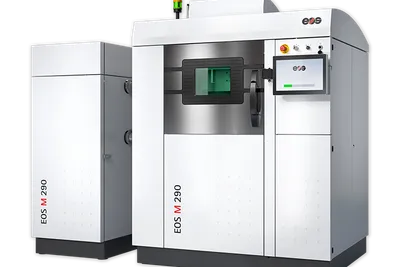
The frame is much bigger than the build chamber suggests. It measures 5221 x 2680 x 2340 mm (205.6 x 105.5 x 92.1 in) and weighs approx. 5500 kg (12125 lbs), and EOS recommends an installation space of at least 8800 x 5200 x 3500 mm (346.5 x 204.7 x 137.8 in). The 400 W M 290 lists a 250 x 250 x 325 mm (9.8 x 9.8 x 12.8 in) build volume at approx. 1350 kg (2976 lbs), so the step up to the M 300-4 is a facilities decision as much as a capacity one. Floor loading, door openings and ceiling height all need checking first.
Electrical supply is 3 x 63 A. Power consumption is listed as max. 19.6 kW and typical 16.0 kW, so the typical draw sits close to the peak and the supply should be sized for sustained load. Compressed air is 7 bar at 15 m³/h (102 psi; 530 ft³/h). Build jobs are prepared in EOSPRINT 2.
Full Specifications
| Parameter | Value |
|---|---|
| Build Volume | 300 x 300 x 435* mm (11.8 x 11.8 x 17.1 in) |
| Laser Type | Yb-fiber laser; 4 x 400 W |
| Laser Power | 4 x 400 W |
| Number of Lasers | 4 (full-overlap architecture) |
| Scan Speed | up to 7.0 m/s (23.0 ft/s) |
| Focus Diameter | approx. 100 µm (0.00394 in) |
| Machine Dimensions | 5221 x 2680 x 2340 mm (205.6 x 105.5 x 92.1 in) |
| Software | EOSPRINT 2, Siemens NX integration |
| Presicion Optics | 4 F-theta-lens(es); 4 High-speed scanner(s) |
| Power Supply | 3 x 63 A |
| Power Consumption | max. 19.6 kW / typical 16.0 kW |
| Compressed Air Supply | 7 Bar; 15 m³/h (102 psi; 530 ft³/h) |
| Recommended Installation Space | min. 8800 x 5200 x 3500 mm (346.5 x 204.7 x 137.8 in) |
| Machine Weight | approx. 5500 kg (12125 lbs) |
Specifications sourced from eos.info — verified 2026-10-03
Strengths & Limitations
Strengths
- Four 400 W Yb-fiber lasers (4 x 400 W) on a 300 x 300 mm (11.8 x 11.8 in) plate, listed with a full-overlap architecture
- 435 mm (17.1 in) of build height, against 325 mm (12.8 in) on the M 290
- 4 F-theta lenses and 4 high-speed scanners, one optical path per laser, with scan speed up to 7.0 m/s (23.0 ft/s)
- Focus diameter of approx. 100 µm (0.00394 in) for thin walls and lattice features
- Compressed air demand of 15 m³/h at 7 bar (530 ft³/h at 102 psi) is lower than the 20 m³/h (706 ft³/h) of the M 290
Limitations
- Needs a 3 x 63 A supply and draws typical 16.0 kW, max. 19.6 kW
- Weighs approx. 5500 kg (12125 lbs), and the recommended installation space of 8800 x 5200 x 3500 mm (346.5 x 204.7 x 137.8 in) includes 3500 mm of height
- X and Y are limited to 300 x 300 mm (11.8 x 11.8 in); a part with a larger footprint does not fit however tall the chamber is
- The table gives no layer thickness, build rate or material list, so throughput for a given alloy has to be confirmed with EOS
Best For
Frequently Asked Questions
01
Four. The table lists a Yb-fiber laser source at 4 x 400 W, with 4 F-theta lenses and 4 high-speed scanners, and gives the laser count as 4 with a full-overlap architecture. Full overlap means the four scan fields cover the same area, so any laser can work anywhere on the 300 x 300 mm (11.8 x 11.8 in) plate.
02
300 x 300 x 435 mm (11.8 x 11.8 x 17.1 in). EOS marks the height figure with an asterisk in its table, so ask what the 435 mm includes before designing a part to the full height. For comparison, the M 290 lists 250 x 250 x 325 mm (9.8 x 9.8 x 12.8 in).
03
The machine measures 5221 x 2680 x 2340 mm (205.6 x 105.5 x 92.1 in) and weighs approx. 5500 kg (12125 lbs). EOS recommends an installation space of min. 8800 x 5200 x 3500 mm (346.5 x 204.7 x 137.8 in). Check the floor rating and the route into the building as well as the room itself.
04
The power supply is 3 x 63 A. Power consumption is listed as max. 19.6 kW and typical 16.0 kW. Compressed air is 7 bar at 15 m³/h (102 psi; 530 ft³/h). Because the typical figure is close to the maximum, plan the electrical feed for continuous load at that level.
05
The M 290 lists a 250 x 250 x 325 mm (9.8 x 9.8 x 12.8 in) build volume, one 400 W laser and approx. 1350 kg (2976 lbs). The M 300-4 lists 300 x 300 x 435 mm (11.8 x 11.8 x 17.1 in), 4 x 400 W and approx. 5500 kg (12125 lbs), so it builds larger parts with four beams but is a far heavier installation.
Videos

EOS 3D Printing

EOS 3D Printing

AdvancedTek
Community Discussions
Troubleshooting and problem-solving
Troubleshooting and problem-solving
Links to community discussions. Summaries are editorial — visit the original thread for full context.
More from EOS
Other Metal Additive Manufacturing
Velo3D Sapphire XC 1MZ
Desktop Metal X-Series
Sodick OPM250L
Farsoon FS273M
Markforged X7