Biesse Explora Cut Up J 0
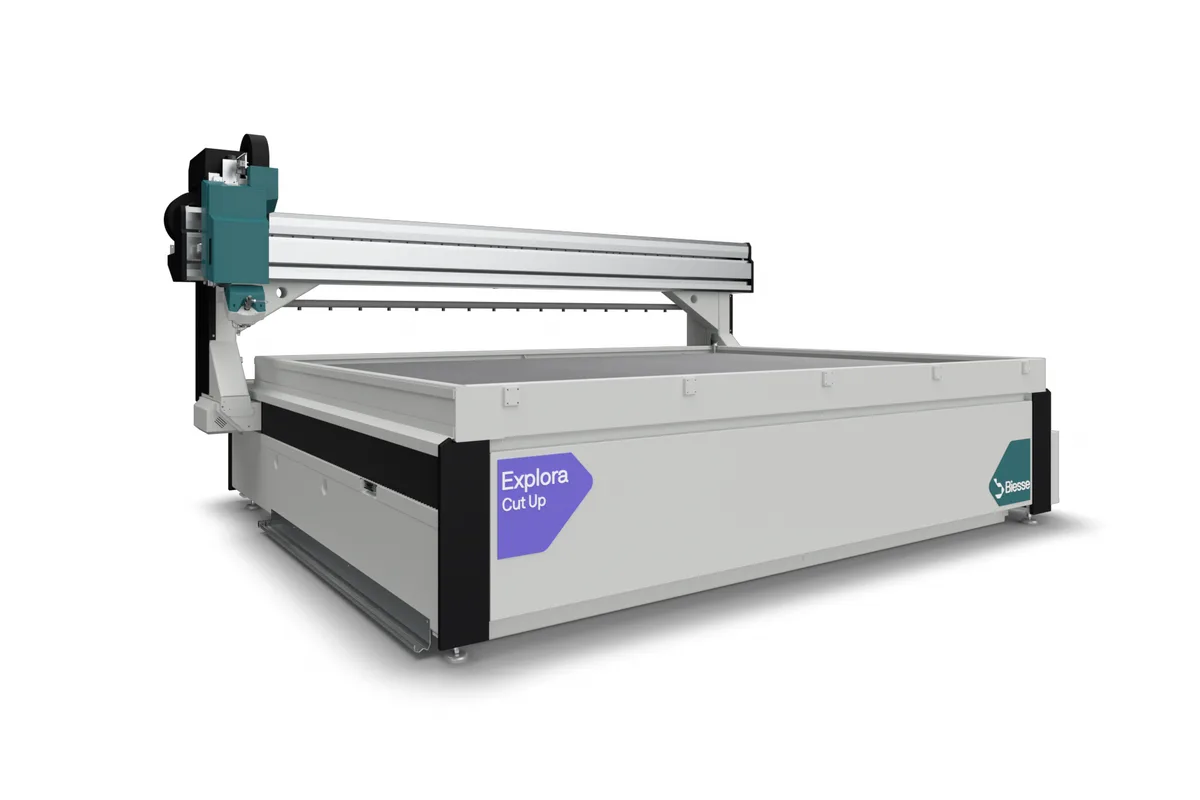
Image: biesse.com, Biesse
Key Specifications
sizes
cutting area 202
cutting area 322
cutting area 324
cutting area 326
max sheet dimensions for loading 202
How much does the Biesse Explora Cut Up J 0 cost?
Price estimate
We do not have a price for the Biesse Explora Cut Up J 0 that we can stand behind, so we show no number. Configuration, options and installation move the final price a long way: a quote is the reliable figure.
Overview
The Biesse Explora Cut Up J 0 is a waterjet cutting machine for polymeric materials, built in four sizes with cutting areas from 2,000 x 2,000 mm (78.7 x 78.7 in) to 3,210 x 6,000 mm (126.4 x 236.2 in). Operating units with 3 to 5 axes are listed, and the table covers layouts with two cutting heads.
That two-head arrangement is spelled out in figures. Minimum centre distance between heads is 280 mm (11.0 in) for a pair of 3-axis heads, 360 mm (14.2 in) for a 3-axis and a 5-axis head, and 500 mm (19.7 in) for two 5-axis heads. Those distances set the narrowest part that can be cut two-up, so a shop planning mirrored or duplicate parts should compare them with its part widths. Z stroke is 250 mm (9.8 in) with a 3-axis head and 200 mm (7.9 in) with a 5-axis head.
Sheets can be loaded larger than they are cut. Each size lists a maximum sheet dimension for loading beyond its cutting area: 2,080 x 2,250 mm (81.9 x 88.6 in) on the smallest machine and 3,300 x 6,300 mm (129.9 x 248.0 in) on the largest. The piece support table carries up to 1,000 kg/m². Axes move at up to 45 m/min in X and Y and 20 m/min in Z. These are axis maximums. Cutting speed depends on material and thickness and is not given.
Biesse's case for waterjet on polymers is the cold cut: no thermal deformation on heat-sensitive material, and no dust or fumes, so no additional extraction system. The jet is given as 1 mm, which allows sharp internal corners. An abrasive management system regulates flow automatically, with savings of up to 20% stated. The page does not publish pump data, so pressure and pump power have to be confirmed separately.
Full Specifications
| Parameter | Value |
|---|---|
| Sizes | 202, 322, 324, 326 |
| Cutting Area 202 | 2,000 x 2,000 mm (78.7 x 78.7 in) |
| Cutting Area 322 | 3,210 x 2,000 mm (126.4 x 78.7 in) |
| Cutting Area 324 | 3,210 x 4,000 mm (126.4 x 157.5 in) |
| Cutting Area 326 | 3,210 x 6,000 mm (126.4 x 236.2 in) |
| Max Sheet Dimensions for Loading 202 | 2,080 x 2,250 mm (81.9 x 88.6 in) |
| Max Sheet Dimensions for Loading 322 | 3,300 x 2,250 mm (129.9 x 88.6 in) |
| Max Sheet Dimensions for Loading 324 | 3,300 x 4,300 mm (129.9 x 169.3 in) |
| Max Sheet Dimensions for Loading 326 | 3,300 x 6,300 mm (129.9 x 248.0 in) |
| Z Axis Stroke 3 Axis | 250 mm (9.8 in) |
| Z Axis Stroke 5 Axis | 200 mm (7.9 in) |
| Max Speed Xy Axes | 45 m/min |
| Max Speed Z Axis | 20 m/min |
| Max Capacity of Piece Support Table | 1,000 kg/m² |
| Min Centre Distance Between Cutting Heads 3 plus 3 Axes | 280 mm (11.0 in) |
| Min Centre Distance Between Cutting Heads 3 plus 5 Axes | 360 mm (14.2 in) |
| Min Centre Distance Between Cutting Heads 5 plus 5 Axes | 500 mm (19.7 in) |
Specifications sourced from biesse.com — verified 2026-10-05
Strengths & Limitations
Strengths
- Four cutting areas, up to 3,210 x 6,000 mm (126.4 x 236.2 in)
- Operating units with 3 to 5 axes, with two-head layouts in the table
- Cold cutting avoids thermal deformation on heat-sensitive polymeric materials
- Dust- and fume-free operation removes the need for additional extraction systems
- Abrasive management system regulates flow automatically, with up to 20% savings stated
- Piece support table rated at 1,000 kg/m²
Limitations
- A 5-axis head shortens Z stroke from 250 mm (9.8 in) to 200 mm (7.9 in)
- Two 5-axis heads cannot work closer than 500 mm (19.7 in) centre to centre
- No pump pressure, flow or power is published for this model
- X is 3,210 mm (126.4 in) on three sizes and 2,000 mm (78.7 in) on the smallest; only Y grows
Best For
Frequently Asked Questions
01
Biesse states it processes all types of polymeric materials. The argument is cold cutting: the waterjet does not heat the material, so heat-sensitive sheet is cut without thermal deformation. Operation is described as dust- and fume-free, with no need for additional extraction systems.
02
Four sizes: 2,000 x 2,000 mm (78.7 x 78.7 in), 3,210 x 2,000 mm (126.4 x 78.7 in), 3,210 x 4,000 mm (126.4 x 157.5 in) and 3,210 x 6,000 mm (126.4 x 236.2 in). The largest sheet that can be loaded is bigger in each case, from 2,080 x 2,250 mm (81.9 x 88.6 in) to 3,300 x 6,300 mm (129.9 x 248.0 in).
03
The spec table lists minimum centre distances for three head combinations: 280 mm (11.0 in) for 3 + 3 axes, 360 mm (14.2 in) for 3 + 5 axes and 500 mm (19.7 in) for 5 + 5 axes. Two heads cut two identical parts in one pass, as long as the parts are at least that far apart centre to centre.
04
It can be. Operating units with 3 to 5 axes are listed. A 3-axis head has a Z stroke of 250 mm (9.8 in), and a 5-axis head has 200 mm (7.9 in). Biesse mentions 5-axis capability for intricate geometries. The head type is a configuration choice, so confirm it for the machine in question.
05
The product page does not say. It gives axis strokes, speeds of 45 m/min in X and Y and 20 m/min in Z, and a table capacity of 1,000 kg/m², but no pump pressure, flow or power. It does state that an abrasive management system regulates abrasive flow automatically. Ask Biesse for the pump data before comparing it with other waterjets.
More from Biesse
Other CNC Waterjet Cutting
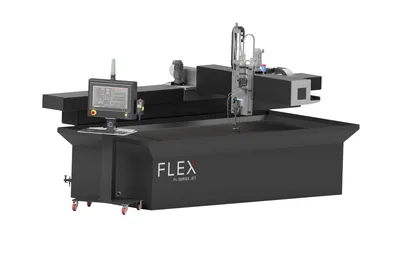
Flex Machine Tools FL-1004
WardJet X-1530