Prima Power Giga Laser Next
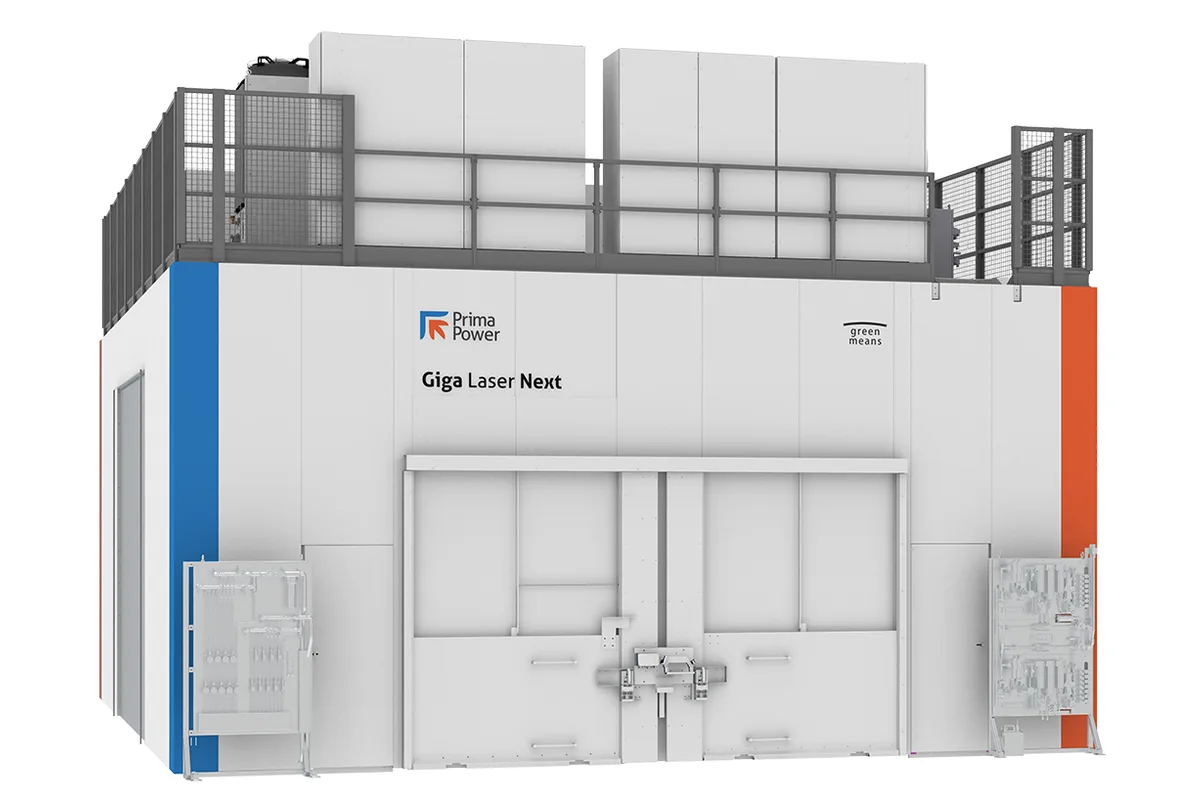
Image: primapower.com, Prima Power
Key Specifications
x axis travel
y axis travel
z axis travel
a axis range
b axis range
c axis stroke
How much does the Prima Power Giga Laser Next cost?
Price estimate
We do not have a price for the Prima Power Giga Laser Next that we can stand behind, so we show no number. Configuration, options and installation move the final price a long way: a quote is the reliable figure.
Overview
Four laser heads cut the same part at the same time on the Prima Power Giga Laser Next. It is a 3D fiber laser cell for high production volumes, such as automotive stampings and castings, and it replaces the usual row of single-head machines with one station.
Each head sits on a retractable arm, and the arms work in overlapping areas under anti-collision control that lets the heads operate as close as 40 mm from each other. Axis strokes are X 4,770 mm (187.8 in), Y 2,860 mm (112.6 in) and Z 650 mm (25.6 in). Head axes cover A 360° and B ±135°, with a C stroke of ±12 mm (±0.47 in). Linear axes move at 110 m/min, 190 m/min on trajectory, and A and B at 1.5 rev/s. Those speeds are a little below a single-head Laser Next; the output comes from four beams working in parallel.
Loading and unloading happen in covered time, with a typical idle time of 2 seconds per part. There is no turntable. Prima Power's argument is that one cutting station per part replaces the typical four of single-head machines.
Floor space is saved by going upward. The enclosure measures 10 x 10 m, and the laser sources, chillers and electrical panels stand on the roof as a mezzanine. Check building height and roof access for service accordingly. Accuracy (Pa, Ps) is 0.03 mm to VDI 3441, each source is a fiber laser of 3,000 W – 4,000 W, and the cell is commissioned with a digital twin.
Full Specifications
| Parameter | Value |
|---|---|
| X Axis Travel | 4,770 mm (187.8 in) |
| Y Axis Travel | 2,860 mm (112.6 in) |
| Z Axis Travel | 650 mm (25.6 in) |
| A Axis Range | 360° |
| B Axis Range | ±135° |
| C Axis Stroke | ±12 mm (±0.47 in) |
| Axis Speed Xyz | 110 m/min |
| Trajectory Speed | 190 m/min |
| Axis Speed Ab | 1.5 rev/s |
| Accuracy Pa Ps | 0.03 mm (VDI 3441) |
| Laser Source | Fiber, 3,000 W – 4,000 W |
Specifications sourced from primapower.com — verified 2026-10-05
Strengths & Limitations
Strengths
- Four synchronized laser heads cut the same part at the same time
- Heads can operate as close as 40 mm from each other under anti-collision control
- Typical idle time of 2 seconds for loading and unloading in covered time
- Enclosure of 10 x 10 m with ancillaries on the roof
- Embedded automation for loading/unloading, quality check and marking
Limitations
- Axis speed of 110 m/min, below the 120 m/min of the Laser Next 2141
- Laser sources, chillers and electrical panels on the roof need building height and access
- Built for high volumes; a poor fit for small mixed batches
- Z stroke of 650 mm (25.6 in)
Best For
Frequently Asked Questions
01
Four. They are synchronized and cut the same part at the same time. The retractable arms work in overlapping areas with anti-collision control, allowing the heads to operate as close as 40 mm from each other.
02
X 4,770 mm (187.8 in), Y 2,860 mm (112.6 in) and Z 650 mm (25.6 in). The head axis strokes are A 360°, B ±135° and C ±12 mm (±0.47 in).
03
The enclosure size is 10 x 10 m. The main ancillaries, meaning the laser sources, chillers and electrical panels, are located on the roof as a mezzanine to minimise the occupied floor space.
04
Part loading and unloading run in covered time with respect to laser processing, with a typical 2 seconds of idle time. Prima Power says it uses no turntables, and that embedded automation can connect the cell directly from stamping to the assembly line.
More from Prima Power
Other CNC Laser Cutting Machines
Mazak OptiPlex Champion
GF LASER P 600 U
Yawei YTF-12045
Mazak OPTIPLEX 3015 DDL
Dener FTL 12035