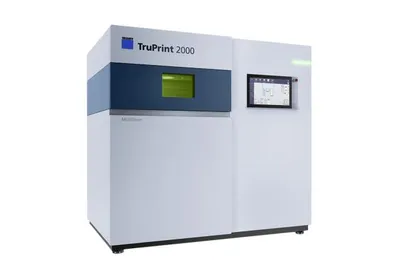
EOS M 290 1kW
Key Specifications
build volume
laser type
laser power
number of lasers
scan speed
focus diameter
How much does the EOS M 290 1kW cost?
Estimated price range
Our best estimate for a metal additive manufacturing in this class — not a quote from EOS. Configuration moves it a long way.
Overview
The EOS M 290 1kW takes the 250 x 250 x 325 mm (9.8 x 9.8 x 12.8 in) build volume of the M 290 and fits it with a single 1,000 W Yb-fiber laser in place of 400 W. The material row explains why: it starts with copper, as CuCr1Zr, followed by Aluminum, Titanium, Stainless Steel and Inconel.
Copper and aluminium alloys reflect much of a laser's energy and conduct the rest away quickly, which is the usual reason to want more power in one beam. The M 290 1kW delivers that power through 1 F-theta lens and 1 high-speed scanner, with a focus diameter of approx. 90 µm (0.00354 in) and a scan speed of up to 7.0 m/s (23.0 ft/s). The M 290 lists approx. 85 µm (0.00335 in), so the higher power comes with a slightly larger spot.
Supporting the bigger laser changes the services a little. Compressed air demand is 27.8 m³/h at 7 bar (982 ft³/h at 102 psi), against 20 m³/h (706 ft³/h) on the M 290. Power supply is 1 x 32 A, the same as the M 290.
The machine measures 2500 x 1300 x 2190 mm (98.4 x 51.2 x 86.2 in) and weighs approx. 1250 kg (2756 lbs). EOS recommends an installation space of min. 4800 x 3600 x 2900 mm (189.0 x 141.7 x 114.2 in). Software is listed as EOSPRINT 2 with the EOSTATE monitoring suite.
Full Specifications
| Parameter | Value |
|---|---|
| Build Volume | 250 x 250 x 325* mm (9.8 x 9.8 x 12.8 in) |
| Laser Type | Yb-fiber laser; 1 x 1000 W |
| Laser Power | 1,000 W |
| Number of Lasers | 1 |
| Scan Speed | up to 7.0 m/s (23.0 ft/s) |
| Focus Diameter | approx. 90 µm (0.00354 in) |
| Materials | Copper (CuCr1Zr), Aluminum, Titanium, Stainless Steel, Inconel |
| Power Consumption Max | 10 kW |
| Machine Dimensions | 2500 x 1300 x 2190 mm (98.4 x 51.2 x 86.2 in) |
| Software | EOSPRINT 2, EOSTATE monitoring suite |
| Presicion Optics | 1 F-theta-lens(es); 1 High-speed scanner(s) |
| Power Supply | 1 x 32 A |
| Power Consumption | max. 8.5 kW / typical 2.4 kW |
| Compressed Air Supply | 7 Bar; 27.8 m³/h (102 psi; 982 ft³/h) |
| Recommended Installation Space | min. 4800 x 3600 x 2900 mm (189.0 x 141.7 x 114.2 in) |
| Machine Weight | approx. 1250 kg (2756 lbs) |
Specifications sourced from eos.info — verified 2026-10-03
Strengths & Limitations
Strengths
- 1,000 W Yb-fiber laser on the 250 x 250 x 325 mm (9.8 x 9.8 x 12.8 in) build volume, against 400 W on the M 290
- Material row includes Copper (CuCr1Zr) alongside Aluminum, Titanium, Stainless Steel and Inconel
- EOSPRINT 2 and the EOSTATE monitoring suite are both in the software row
- Runs from the same 1 x 32 A supply as the 400 W M 290
- Approx. 1250 kg (2756 lbs) in a 2500 x 1300 x 2190 mm (98.4 x 51.2 x 86.2 in) cabinet
Limitations
- Focus diameter of approx. 90 µm (0.00354 in) is larger than the approx. 85 µm (0.00335 in) of the M 290
- Compressed air demand of 27.8 m³/h (982 ft³/h) is higher than the 20 m³/h (706 ft³/h) of the M 290
- Still a single laser with 1 F-theta lens and 1 high-speed scanner, so the extra power does not add a second beam
- Build volume is unchanged from the M 290 at 250 x 250 x 325 mm; larger parts need the 300 x 300 x 435 mm of the M 300-4
Best For
Frequently Asked Questions
01
Laser power. The M 290 1kW has a 1,000 W Yb-fiber laser and the M 290 has 400 W, on the same 250 x 250 x 325 mm (9.8 x 9.8 x 12.8 in) build volume. The M 290 1kW lists a focus diameter of approx. 90 µm (0.00354 in) against approx. 85 µm (0.00335 in) for the M 290, and it needs 27.8 m³/h (982 ft³/h) of compressed air against 20 m³/h (706 ft³/h).
02
Copper (CuCr1Zr), Aluminum, Titanium, Stainless Steel and Inconel. The copper alloy heads the list, and a 1,000 W laser is what a reflective, highly conductive metal calls for. The table gives no layer thickness or build rate for any of them, so ask EOS for process data on the alloy you intend to run.
03
Compressed air at 7 bar and 27.8 m³/h (102 psi; 982 ft³/h), and a 1 x 32 A power supply. The air demand is the larger change from the M 290, which lists 20 m³/h (706 ft³/h) on the same 1 x 32 A.
04
It measures 2500 x 1300 x 2190 mm (98.4 x 51.2 x 86.2 in) and weighs approx. 1250 kg (2756 lbs). The recommended installation space is min. 4800 x 3600 x 2900 mm (189.0 x 141.7 x 114.2 in).
05
The software row lists EOSPRINT 2 and the EOSTATE monitoring suite. The table does not break down which modules of the suite are in the base scope, so have that set out in the quotation.
More from EOS
Other Metal Additive Manufacturing
Concept Laser M2 Series 5 Metal 3D Printer
Colibrium M2
Renishaw AM400
SLM Solutions SLM 280 2.0
3D Systems DMP Flex 350 Dual