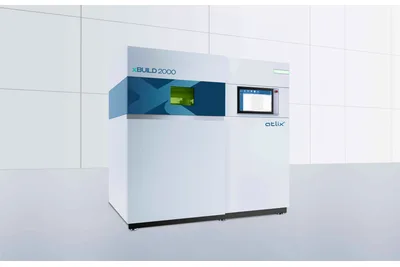
EOS M 290
Key Specifications
build volume
laser type
laser power
number of lasers
scan speed
focus diameter
How much does the EOS M 290 cost?
Estimated price range
Our best estimate for a metal additive manufacturing in this class — not a quote from EOS. Configuration moves it a long way.
Overview
The EOS M 290 is a metal additive manufacturing system with a 250 x 250 x 325 mm (9.8 x 9.8 x 12.8 in) build volume and a 400 W Yb-fiber laser, listed as 1 x 400 W. Its focus diameter of approx. 85 µm (0.00335 in) is the detail figure. The M 290 1kW lists approx. 90 µm (0.00354 in) and the M 300-4 approx. 100 µm (0.00394 in), so of the three this machine draws the finest line.
Laser power is where the range splits. The M 290 1kW keeps the same 250 x 250 x 325 mm build volume and raises the laser to 1,000 W. The M 300-4 goes to 4 x 400 W over 300 x 300 x 435 mm (11.8 x 11.8 x 17.1 in) and weighs approx. 5500 kg (12125 lbs). Next to the M 300-4, the M 290 is a much lighter installation at approx. 1350 kg (2976 lbs) on a 1 x 32 A supply.
Power consumption is listed as max. 15.0 kW and typical 5.5 kW. The gap between the two figures is wide, so the supply has to carry peaks well above the running load. Compressed air is 7 bar at 20 m³/h (102 psi; 706 ft³/h). Scan speed is up to 7.0 m/s (23.0 ft/s).
The machine measures 2680 x 2120 x 2400 mm (105.5 x 83.5 x 94.5 in). EOS recommends an installation space of min. 4800 x 3600 x 3500 mm (189.0 x 141.7 x 137.8 in), and the 3500 mm (137.8 in) height is the figure most likely to decide whether a room will do.
Full Specifications
| Parameter | Value |
|---|---|
| Build Volume | 250 x 250 x 325* mm (9.8 x 9.8 x 12.8 in) |
| Laser Type | Yb-fiber laser; 1 x 400 W |
| Laser Power | 400 W |
| Number of Lasers | 1 |
| Scan Speed | up to 7.0 m/s (23.0 ft/s) |
| Focus Diameter | approx. 85 µm (0.00335 in) |
| Machine Dimensions | 2680 x 2120 x 2400 mm (105.5 x 83.5 x 94.5 in) |
| Presicion Optics | 2 F-theta-lens(es); 2 High-speed scanner(s) |
| Power Supply | 1 x 32 A |
| Power Consumption | max. 15.0 kW / typical 5.5 kW |
| Compressed Air Supply | 7 Bar; 20 m³/h (102 psi; 706 ft³/h) |
| Recommended Installation Space | min. 4800 x 3600 x 3500 mm (189.0 x 141.7 x 137.8 in) |
| Machine Weight | approx. 1350 kg (2976 lbs) |
Specifications sourced from eos.info — verified 2026-10-03
Strengths & Limitations
Strengths
- Focus diameter of approx. 85 µm (0.00335 in), finer than the approx. 100 µm (0.00394 in) of the M 300-4
- 250 x 250 x 325 mm (9.8 x 9.8 x 12.8 in) build volume with a 400 W Yb-fiber laser
- Runs on a 1 x 32 A supply, where the M 300-4 needs 3 x 63 A
- Approx. 1350 kg (2976 lbs), about a quarter of the approx. 5500 kg (12125 lbs) of the M 300-4
- Scan speed of up to 7.0 m/s (23.0 ft/s)
Limitations
- One 400 W laser; the M 290 1kW offers 1,000 W on the same build volume
- Max. power consumption of 15.0 kW is well above the typical 5.5 kW, and the supply must cover the peak
- Recommended installation space calls for 3500 mm (137.8 in) of height
- Compressed air demand of 20 m³/h (706 ft³/h) is more than the 15 m³/h (530 ft³/h) of the much larger M 300-4
- Neither layer thickness, build rate nor materials are stated in the table
Best For
Frequently Asked Questions
01
250 x 250 x 325 mm (9.8 x 9.8 x 12.8 in). The height figure carries an asterisk in EOS's table, so ask what it includes if a part comes close to 325 mm. The next size up is the M 300-4 at 300 x 300 x 435 mm (11.8 x 11.8 x 17.1 in).
02
A Yb-fiber laser listed as 1 x 400 W, with a focus diameter of approx. 85 µm (0.00335 in) and a scan speed of up to 7.0 m/s (23.0 ft/s). The laser count in the table is 1, so the whole 250 x 250 mm plate is exposed by that one beam.
03
Both list a 250 x 250 x 325 mm (9.8 x 9.8 x 12.8 in) build volume. The M 290 has a 400 W laser and an approx. 85 µm (0.00335 in) focus diameter; the M 290 1kW has 1,000 W and approx. 90 µm (0.00354 in). The M 290 1kW also lists more compressed air, 27.8 m³/h (982 ft³/h) against 20 m³/h (706 ft³/h).
04
Power supply is 1 x 32 A. Power consumption is listed as max. 15.0 kW and typical 5.5 kW, so the peak is nearly three times the running figure. Compressed air is 7 bar at 20 m³/h (102 psi; 706 ft³/h).
05
The machine measures 2680 x 2120 x 2400 mm (105.5 x 83.5 x 94.5 in) and weighs approx. 1350 kg (2976 lbs). EOS recommends an installation space of min. 4800 x 3600 x 3500 mm (189.0 x 141.7 x 137.8 in).
Videos

Sam kh

Michael Martin
More from EOS
Other Metal Additive Manufacturing
Desktop Metal Studio System+
DMG Mori LASERTEC 30 SLM US
Farsoon FS191M
Markforged X3
Velo3D Sapphire 1MZ