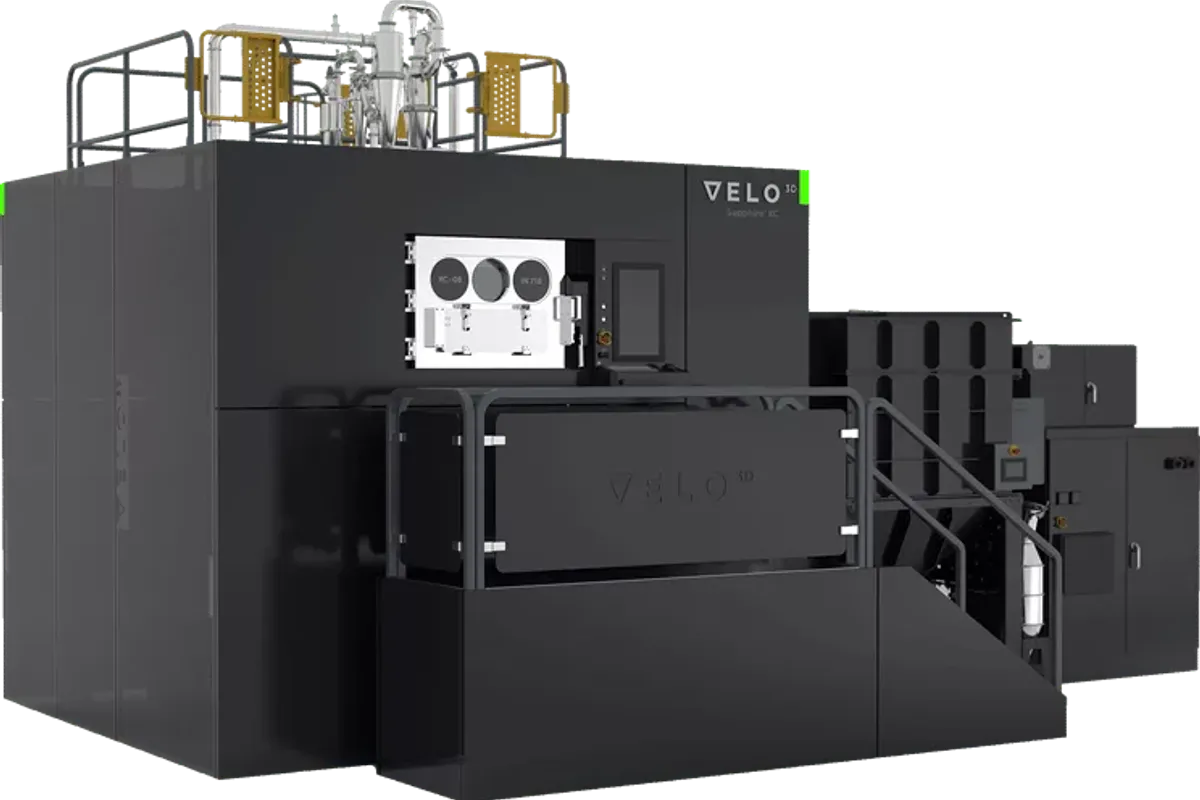
Velo3D Sapphire XC
Key Specifications
build volume
number of lasers
laser power
minimum internal channel diameter
atmosphere
process monitoring
How much does the Velo3D Sapphire XC cost?
Estimated price range
Our best estimate for a metal additive manufacturing in this class — not a quote from Velo3D. Configuration moves it a long way.
Overview
The Velo3D Sapphire XC is the large-diameter member of the Sapphire family: a metal additive manufacturing system with a Ø600 mm x 1000 mm Z build volume and eight 1 kW fiber lasers, 8 kW in total. Velo3D puts its throughput at up to 800 cc/hr.
Three rows describe how the build is controlled. The chamber runs an argon inert atmosphere with continuous O2 monitoring. Velo3D Intelligent Fusion watches the melt pool with photodiodes and a pyrometer. Build prep is done in Velo3D Flow and quality monitoring in Assure. For a buyer in a regulated supply chain these rows carry as much weight as the laser count, because melt pool monitoring and a quality package are what turn a finished part into a documented one.
The minimum internal channel diameter is 1 mm without supports. That is the row to read for manifolds, heat exchangers and injector-type parts, where passages cannot be reached afterwards to clear support material. Typical surface finish is 5–15 μm Sa.
Installation is on a different scale from the Sapphire. The size row is 8.53 x 5.00 x 4.75 m and the weight ~8,500 kg (18,740 lbs), against 3,150 kg (6,930 lbs) for the Sapphire with its Ø315 mm x 400 mm Z build and 2 x 1 kW fiber lasers. Check ceiling and crane clearance against the 4.75 m figure first.
Two neighbouring listings are worth reading alongside this one. The Sapphire XC 1MZ shows the same Ø600 mm x 1000 mm Z envelope, 8 x 1 kW and ~8,500 kg (18,740 lbs). The Sapphire XC Metal 3D Printer listing gives Ø600 mm x 550 mm Z at ~7,450 kg (16,400 lbs), so confirm with Velo3D which build height a quoted machine has.
Full Specifications
| Parameter | Value |
|---|---|
| Build Volume | Ø600 mm x 1000 mm Z |
| Number of Lasers | 8 |
| Laser Power | 8 × 1,000 W fiber lasers (8 kW total) |
| Minimum Internal Channel Diameter | 1 mm without supports |
| Atmosphere | Argon inert atmosphere, continuous O2 monitoring |
| Process Monitoring | Velo3D Intelligent Fusion — photodiode and pyrometer melt pool monitoring |
| Software | Velo3D Flow (build prep), Assure (quality monitoring) |
| Machine Weight | ~8,500 kg (18,740 lbs) |
| Size | 8.53 x 5.00 x 4.75 m |
| Lasers | Eight 1 kW |
| Throughput | Up to 800 cc/hr |
| Surface Finish | 5–15 μm Sa (typical) |
Specifications sourced from velo3d.com — verified 2026-10-03
Strengths & Limitations
Strengths
- Eight 1 kW fiber lasers (8 kW total) with throughput of up to 800 cc/hr
- Ø600 mm x 1000 mm Z build volume, against Ø315 mm x 400 mm Z on the Sapphire
- Internal channels down to 1 mm in diameter are listed as printable without supports
- Velo3D Intelligent Fusion monitors the melt pool with photodiodes and a pyrometer
- Argon inert atmosphere with continuous O2 monitoring
- Velo3D Flow for build prep and Assure for quality monitoring are the listed software
Limitations
- Occupies 8.53 x 5.00 x 4.75 m, so the building needs 4.75 m of clear height before anything else
- Weighs ~8,500 kg (18,740 lbs), against 3,150 kg (6,930 lbs) for the Sapphire
- Argon is the process gas and the table gives no consumption figure, so gas supply has to be sized with Velo3D
- The table for this model gives no layer thickness and no material list; both must be confirmed before quoting work
Best For
Frequently Asked Questions
01
Ø600 mm x 1000 mm Z. For comparison the Sapphire is listed at Ø315 mm x 400 mm Z, so the XC is close to twice the diameter and 2.5 times the height. The Sapphire XC Metal 3D Printer listing shows Ø600 mm x 550 mm Z, so confirm the build height of the machine you are quoted.
02
Eight. The laser power row reads 8 × 1,000 W fiber lasers (8 kW total), and Velo3D states throughput of up to 800 cc/hr. The Sapphire, by comparison, has 2 x 1 kW fiber lasers.
03
Velo3D Intelligent Fusion, with photodiode and pyrometer melt pool monitoring. The chamber atmosphere is argon with continuous O2 monitoring, and the listed software is Velo3D Flow for build prep and Assure for quality monitoring.
04
The size row is 8.53 x 5.00 x 4.75 m and the machine weighs ~8,500 kg (18,740 lbs). The 4.75 m height is usually the first constraint to check, followed by floor loading and the route in for an installation of this weight.
05
The table lists a minimum internal channel diameter of 1 mm without supports. That matters for cooling passages and fluid channels, because supports inside a passage of that size could not be removed after the build.
Videos

Green Stock News
Community Discussions
More from Velo3D
Other Metal Additive Manufacturing
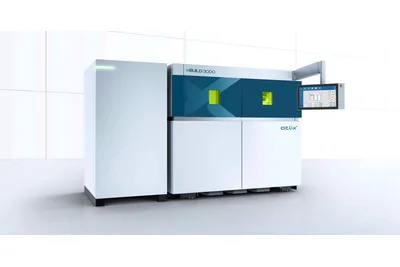
ATLIX xBUILD 3000
GE Additive M2 Series
Markforged Metal X
Desktop Metal Production System P-50
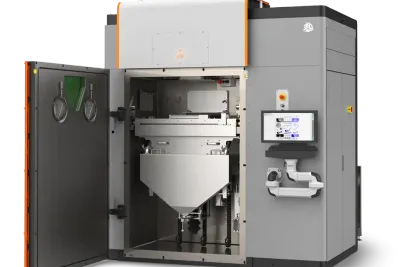
3D Systems DMP Flex 350