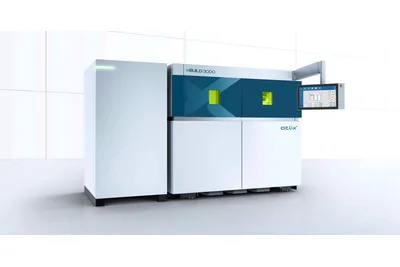
Desktop Metal X-Series
Key Specifications
technology
build rate
max part density
materials
feedstock form
debinder type
How much does the Desktop Metal X-Series cost?
Estimated price range
Our best estimate for a metal additive manufacturing in this class — not a quote from Desktop Metal. Configuration moves it a long way.
Overview
The Desktop Metal X-Series is listed as a production-scale Bound Metal Deposition (BMD) system with a build rate of up to 9,000 cm³/hr and a furnace that reaches 1,400°C. The listed figures have not been confirmed against a manufacturer document. Treat each value as a question to put to the supplier, not as a quoted specification.
Feedstock is listed as metal rod in a closed cartridge. The material row names 17-4 PH stainless steel, 316L stainless, H13 tool steel, 4140 low-alloy steel, Inconel 625 and copper, with additional production alloys. Maximum part density is given as 96 - 99% after sintering. A spread like that matters for pressure-tight or fatigue-loaded parts, where the low end may not be acceptable without test data on the actual alloy.
Three stages appear in the table: printing, a proprietary fluid debind station at production scale, and a production-grade batch furnace with multi-plate capacity. Duty cycle is described as industrial, for continuous production operation. Software is Desktop Metal Fabricate, listed with shrinkage compensation, supports and scheduling. The stated target application is MIM replacement and high-volume metal production.
What the table leaves out matters as much for planning. It gives no build envelope, layer thickness, machine dimensions, weight or power requirement, so maximum part size, floor space and utilities all have to be obtained before any comparison is possible. The Studio System 2, by contrast, is listed with a 300 x 200 x 200 mm (12 x 8 x 8 in) build envelope and a machine weight of 97 kg (214 lbs).
Full Specifications
| Parameter | Value |
|---|---|
| Technology | Bound Metal Deposition (BMD) — production scale |
| Build Rate | Up to 9,000 cm³/hr (industry-leading for BMD) |
| Max Part Density | 96 - 99% (post-sinter) |
| Materials | 17-4 PH Stainless Steel, 316L Stainless, H13 Tool Steel, 4140 Low-Alloy Steel, Inconel 625, Copper, additional production alloys |
| Feedstock Form | Metal rod (closed cartridge) |
| Debinder Type | Proprietary fluid debind station — production scale |
| Furnace Type | Production-grade batch furnace with multi-plate capacity |
| Furnace Max Temp | 1,400°C |
| Duty Cycle | Industrial — continuous production operation |
| Software | Desktop Metal Fabricate (shrinkage compensation, supports, scheduling) |
| Target Application | MIM replacement, high-volume metal AM production |
Specifications compiled from manufacturer literature and industry references. Not independently verified against a published spec sheet — confirm with the manufacturer or an authorised dealer before making a purchasing decision.
Strengths & Limitations
Strengths
- Listed build rate of up to 9,000 cm³/hr
- Material row covers 17-4 PH, 316L, H13, 4140, Inconel 625 and copper, plus additional production alloys
- Furnace listed at 1,400°C with multi-plate batch capacity
- Desktop Metal Fabricate software with shrinkage compensation, supports and scheduling
- Listed part density of 96 - 99% after sintering
Limitations
- The listed figures are unconfirmed, so build rate, density and furnace data all need verifying with the supplier
- No build envelope, layer thickness, weight or power requirement is listed
- Feedstock is metal rod in a closed cartridge, so material supply is tied to that format
- Density is given as a range of 96 - 99%, so critical parts need their own test data
Best For
Frequently Asked Questions
01
The technology row lists Bound Metal Deposition (BMD) at production scale, with metal rod feedstock in a closed cartridge. That row has not been confirmed against a manufacturer document, so ask the supplier to state the process in writing before comparing it with other systems.
02
17-4 PH stainless steel, 316L stainless, H13 tool steel, 4140 low-alloy steel, Inconel 625 and copper, with additional production alloys mentioned and not named. Maximum part density is listed as 96 - 99% after sintering.
03
The listed build rate is up to 9,000 cm³/hr. No layer thickness or build envelope accompanies it, so the figure cannot be turned into parts per shift without more data. Ask for a build-time estimate on a representative part.
04
The table lists a proprietary fluid debind station at production scale and a production-grade batch furnace with multi-plate capacity and a maximum temperature of 1,400°C. Desktop Metal Fabricate software is listed for shrinkage compensation, supports and scheduling.
More from Desktop Metal
Other Metal Additive Manufacturing
Sodick OPM250L
Farsoon FS273M
Markforged X7
Velo3D Sapphire XC