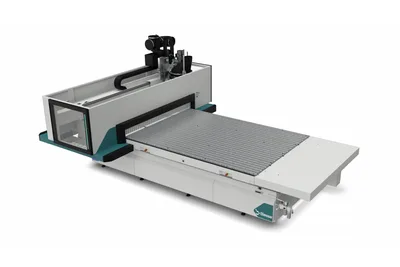
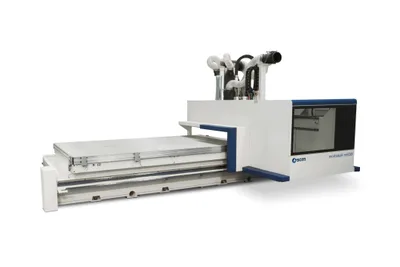
Biesse Rover Multi Up S G
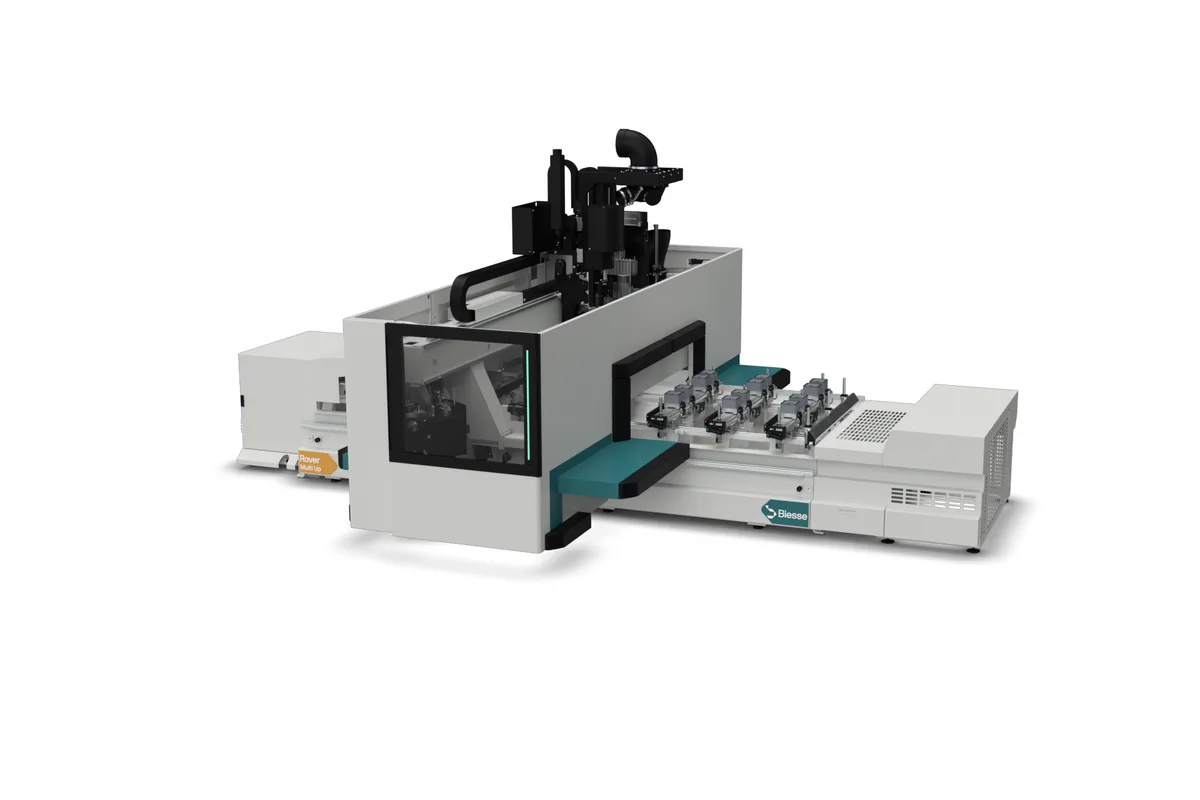
Image: biesse.com, Biesse
Key Specifications
sizes
working fields xy 1532
working fields xy 1542
working fields xy 1556
working fields xy 1842
working fields xy 1856
How much does the Biesse Rover Multi Up S G cost?
Price estimate
We do not have a price for the Biesse Rover Multi Up S G that we can stand behind, so we show no number. Configuration, options and installation move the final price a long way: a quote is the reliable figure.
Overview
The Biesse Rover Multi Up S G is a CNC machining centre that mills, drills and edgebands shaped panels in a single workflow. Five sizes are listed, with working fields from 3,140 x 1,550 mm (123.6 x 61.0 in) to 5,540 x 1,850 mm (218.1 x 72.8 in).
Edgebanding on a machining centre comes down to the gluing unit, and that is where the maker's page spends its words. Gluing systems range from EVA and PUR, applied directly to the panel, to the Ray Force System, which activates a reactive layer on the edge with infrared lamps so that no joint shows. Biesse says the unit is compact enough to edge internal pockets with a diameter of just 350 mm, and the same small size lets parts sit closer together on the table. A triple function finishing aggregate trims and scrapes edge and glue at once. Aggregates are positioned by a direct drive C axis based on linear motor technology.
Clearance in Z depends on the pods. With H=29 pods the table lists 245 mm (9.6 in), or 228 mm (9.0 in) for XPS; with H=74 pods it is 200 mm (7.9 in), or 173 mm (6.8 in) for XPS. Taller pods lift the panel further off the table and cost part height, so the pod choice should follow the thickest workpiece planned.
Speeds follow the safety layout. The full bumper configuration runs X at 25 m/min, Y at 60 m/min and Z at 20 m/min, with a 65 m/min vector speed. With bumper plus photocells and fences, X is listed as 60 - 25 m/min and the vector speed as 85-65 m/min. Acceleration is 2.5 m/s2 in X and 3 m/s2 in Y and Z. Next to the nesting machines of the family this is a long, narrow format: the Rover Multi Up N G stops at 4,300 x 2,205 mm (169.3 x 86.8 in), while this model reaches 5,540 mm (218.1 in) in X.
Full Specifications
| Parameter | Value |
|---|---|
| Sizes | 1532, 1542, 1556, 1842, 1856 |
| Working Fields Xy 1532 | 3,140 x 1,550 mm (123.6 x 61.0 in) |
| Working Fields Xy 1542 | 4,140 x 1,550 mm (163.0 x 61.0 in) |
| Working Fields Xy 1556 | 5,540 x 1,550 mm (218.1 x 61.0 in) |
| Working Fields Xy 1842 | 4,140 x 1,850 mm (163.0 x 72.8 in) |
| Working Fields Xy 1856 | 5,540 x 1,850 mm (218.1 x 72.8 in) |
| Max Workpiece Clearance Z H 29 Pods | 245 mm (9.6 in); 228 mm (9.0 in) for XPS |
| Max Workpiece Clearance Z H 74 Pods | 200 mm (7.9 in); 173 mm (6.8 in) for XPS |
| Linear Speed Full Bumper | X 25 m/min, Y 60 m/min, Z 20 m/min; vector 65 m/min |
| Linear Speed Bumper Photocells and Fences | X 60 - 25 m/min, Y 60 m/min, Z 20 m/min; vector 85-65 m/min |
| Acceleration | X 2.5 m/s2, Y 3 m/s2, Z 3 m/s2 |
Specifications sourced from biesse.com — verified 2026-10-05
Strengths & Limitations
Strengths
- Milling, drilling and shaped edgebanding in a single workflow on one machine
- Gluing by EVA, PUR or the Ray Force System, which uses infrared lamps for a no-joint edge
- Compact gluing unit edges internal pockets down to a diameter of 350 mm
- Working fields up to 5,540 x 1,850 mm (218.1 x 72.8 in)
- Direct drive C axis for aggregates, based on linear motor technology
Limitations
- Full bumper configuration limits X to 25 m/min and vector speed to 65 m/min
- XPS reduces Z clearance to 228 mm (9.0 in) on H=29 pods and 173 mm (6.8 in) on H=74 pods
- X acceleration of 2.5 m/s2 is lower than the 3 m/s2 listed for Y and Z
- Y is either 1,550 mm (61.0 in) or 1,850 mm (72.8 in); no wider table is listed
Best For
Frequently Asked Questions
01
It applies and finishes edge banding on shaped panels. Biesse describes it as a CNC machining centre that completes the whole process, from milling and drilling to edging, in a single workflow. The panel stays on the table: it is routed to shape, the gluing unit applies the edge, and a triple function aggregate trims the edge and scrapes edge and glue.
02
Biesse lists EVA and PUR systems, which apply glue directly on the panel, and the Ray Force System. Ray Force uses infrared lamps to activate a reactive layer on the edge material, which Biesse says removes any visible joint. The choice affects the edge stock as well as the machine, so settle it alongside the edge material you plan to run.
03
The page gives one figure: the gluing unit can work small internal pockets with a diameter of just 350 mm. Biesse calls it the most compact gluing unit available on the market. The compact unit also reduces the space needed between panels, so more parts fit on the working table in one cycle.
04
Five sizes. X is 3,140 mm (123.6 in), 4,140 mm (163.0 in) or 5,540 mm (218.1 in) with a Y of 1,550 mm (61.0 in), and the two longer X lengths are also offered with a Y of 1,850 mm (72.8 in). Z clearance is 245 mm (9.6 in) with H=29 pods and 200 mm (7.9 in) with H=74 pods, reduced to 228 mm (9.0 in) and 173 mm (6.8 in) for XPS.
05
In the full bumper configuration X runs at 25 m/min, Y at 60 m/min and Z at 20 m/min, with a vector speed of 65 m/min. With bumper plus photocells and fences the table lists X as 60 - 25 m/min and the vector as 85-65 m/min. Acceleration is 2.5 m/s2 in X and 3 m/s2 in Y and Z.