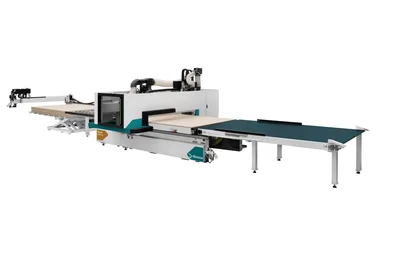
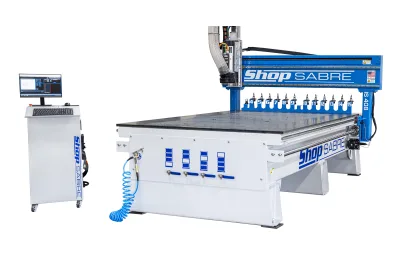
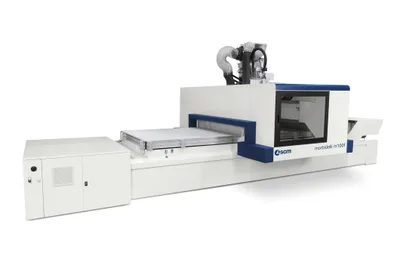
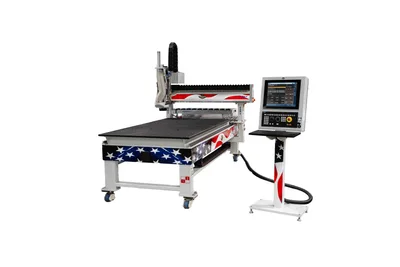
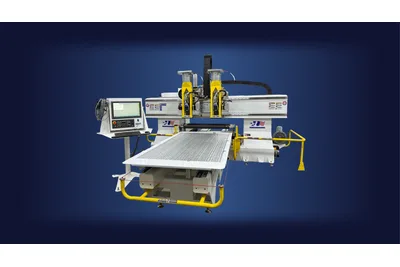
Biesse Rover A
This model was not found in Biesse's current lineup when we checked on 2026-10-03 . It may be a superseded or older model; the specifications below are as we last recorded them.
Key Specifications
Spindle Taper
Rapid Traverse
Spindle Power
machine type
x travel
y travel
How much does the Biesse Rover A cost?
Estimated price range
Our best estimate for a cnc router in this class — not a quote from Biesse. Configuration moves it a long way.
Overview
The Biesse Rover A is listed here as a 5-axis CNC machining center for composites and foam, with travels of up to 7,320 mm (288 in) in X depending on configuration, up to 1,850 mm (72.8 in) in Y and up to 600 mm (23.6 in) in Z. Biesse's current lineup has no machine under this plain name, so take the listed figures as describing an older configuration and verify them against the machine itself.
What defines it is the head. The A axis is listed at +/- 120° and the C axis at 360° continuous, so the tool can tilt past horizontal and swing all the way round without unwinding. Together with up to 600 mm (23.6 in) of Z, that lets the spindle reach the sides and undercuts of moulded shells and trimmed panels in one clamping. The long X against 1,850 mm (72.8 in) of Y makes the envelope long and narrow: right for long panels, or for several parts set end to end.
The spindle is listed at up to 22 kW (29.5 hp) and up to 24,000 RPM on an HSK-63F taper. That is more power than the 14.5 kW (19.4 HP) listed for the Rover B 7.23 at the same 24,000 RPM. In foam and laminates the cutting loads are low and speed matters more than power; the power comes into play on aluminum composite panel and thick fiberglass. Rapid traverse is up to 50 m/min (1,969 ipm).
The automatic tool changer holds 10 to 16 positions depending on the machine, which is small for 5-axis jobs that mix roughing cutters, trimming tools and drills. Workholding is listed as vacuum plus configurable pods. The control row names two alternatives, Biesse BNC or a third-party CNC, so establish which one a particular machine carries before planning post-processors and training.
Full Specifications
| Parameter | Value |
|---|---|
| Machine Type | 5-axis CNC machining center for composites and foam |
| X Travel | Up to 7,320 mm (288 in) depending on configuration |
| Y Travel | Up to 1,850 mm (72.8 in) |
| Z Travel | Up to 600 mm (23.6 in) |
| A Axis Range | +/- 120° |
| C Axis Range | 360° continuous |
| Spindle Speed | Up to 24,000 RPM |
| Spindle Motor Power | Up to 22 kW (29.5 hp) |
| Spindle Taper | HSK-63F |
| Rapid Traverse Rate | Up to 50 m/min (1,969 ipm) |
| CNC Control | Biesse BNC or Siemens Sinumerik |
| Tool Changer | Automatic, 10-16 positions |
| Worktable | Vacuum + pod-based configurable workholding |
| Primary Materials | Foam core, CFRP, fiberglass, aluminum composite panel |
Specifications compiled from manufacturer literature and industry references. Not independently verified against a published spec sheet — confirm with the manufacturer or an authorised dealer before making a purchasing decision.
Strengths & Limitations
Strengths
- A axis listed at +/- 120° and C axis at 360° continuous, for 5-axis access to the sides of a part
- Spindle of up to 22 kW (29.5 hp) at up to 24,000 RPM on an HSK-63F taper
- X travel of up to 7,320 mm (288 in), depending on configuration, for long panels or several parts in a row
- Up to 600 mm (23.6 in) of Z travel gives room for deep moulded shapes
- Vacuum plus pod-based configurable workholding is listed
Limitations
- The tool changer holds 10 to 16 positions, which fills quickly on mixed 5-axis jobs
- Y travel stops at 1,850 mm (72.8 in), so wide parts do not fit however long the X axis is
- The control row lists two alternatives, so programs, posts and training depend on which control a given machine has
- Listed materials are foam core, CFRP, fiberglass and aluminum composite panel; no metal cutting beyond that panel is listed
Best For
Frequently Asked Questions
01
The listed figures are up to 7,320 mm (288 in) in X depending on configuration, up to 1,850 mm (72.8 in) in Y and up to 600 mm (23.6 in) in Z. Each is given as a maximum, so a particular machine may be shorter in X. Measure or ask before quoting a long part.
02
The A axis range is listed as +/- 120° and the C axis as 360° continuous. A tilt beyond horizontal lets the tool reach under an overhanging edge, and continuous C rotation means the head does not have to unwind partway through a long trimming pass around a part.
03
The spindle is listed at up to 22 kW (29.5 hp) and up to 24,000 RPM, with an HSK-63F taper. The tool changer is automatic with 10 to 16 positions. On a machine with 10 positions, plan the tool list carefully for jobs that combine roughing, trimming and drilling.
04
The primary materials row lists foam core, CFRP, fiberglass and aluminum composite panel, and the machine type row describes a 5-axis CNC machining center for composites and foam. Workholding is listed as vacuum plus pod-based configurable workholding.
05
The control row lists Biesse BNC or a third-party CNC as alternatives, without saying which is standard. The two differ in programming and post-processing, so on a used machine identify the control from the machine itself before committing to software or training.
Videos

Gino Albarello - Tecnologie per il legno

Jon Stenberg AB

Eyüp Eren

Eyüp Eren
Community Discussions
Links to community discussions. Summaries are editorial — visit the original thread for full context.