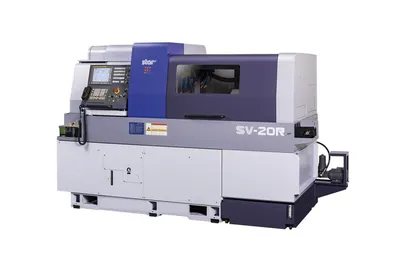
Tsugami SS32L
Key Specifications
Max Spindle
Tool Capacity
Rapid Traverse
Spindle Power
max machining diameter
sub spindle speed
How much does the Tsugami SS32L cost?
Estimated price range
Our best estimate for a swiss-type lathe in this class — not a quote from Tsugami. Configuration moves it a long way.
Overview
The Tsugami SS32L is a 32 mm (1.26 in) Swiss-type automatic lathe with 29 tools as standard and a 3,400 kg (7,496 lb) machine weight. Its main spindle runs to 8,000 rpm (rated 6,000 rpm) on a 3.7/5.5 kW motor, and the back spindle reaches the same 8,000 rpm with a rated speed of 7,000 rpm.
The two spindles are not equal in power. The back spindle is rated 2.2/3.7 kW, a step below the main, so the second operation is best kept to drilling, light turning and cut-off finishing while the main spindle takes the heavy stock removal. Parts with deep bores or large turned diameters on the back end will run better on a machine with a stronger second side.
Rapid traverse is 32 m/min on Z1, X2 and Z2 and 24 m/min on X1, Y1 and Y2. Tsugami gives the footprint as 2,020 × 1,675 × 2,020 mm (79.5 × 65.9 × 79.5 in).
The SS327-III is the larger alternative with the same 8,000 rpm main spindle and 3.7/5.5 kW rating, but 38 tools, 35 m/min on Z1, X2 and Z2 and 4,000 kg (8,818 lb). The SS32, at 3,400 kg (7,495 lb), lists a 32i-B control and live tools at 5,000 rpm, figures the SS32L's own table does not give.
Full Specifications
| Parameter | Value |
|---|---|
| Max Machining Diameter | 32 mm (1.26 in) |
| Max Spindle Speed | 8,000 rpm (rated 6,000 rpm) |
| Sub Spindle Speed | 8,000 rpm (rated 7,000 rpm) |
| Tool Capacity | 29 (standard) |
| Rapid Traverse Rate | 32 m/min (Z1, X2, Z2), 24 m/min (X1, Y1, Y2) |
| Spindle Motor Power | 3.7/5.5 kW |
| Sub Spindle Power | 2.2/3.7 kW |
| Floor Space Required | 2,020 × 1,675 × 2,020 mm (79.5 × 65.9 × 79.5 in) |
| Machine Weight | 3,400 kg (7,496 lb) |
Specifications sourced from tsugami.co.jp — verified 2026-10-03
Strengths & Limitations
Strengths
- Takes work up to 32 mm (1.26 in) in machining diameter on a 3.7/5.5 kW main spindle
- Main and back spindles both reach 8,000 rpm, with the back spindle rated for 7,000 rpm
- 29 tools as standard, with Y axes listed on both sides (Y1 and Y2)
- 3,400 kg (7,496 lb), against 4,000 kg (8,818 lb) for the 38-tool SS327-III
Limitations
- Back spindle rated 2.2/3.7 kW, below the 3.7/5.5 kW main spindle, which limits heavy back-end cuts
- 29 tools against 38 on the SS327-III, so very complex parts may run short of positions
- Rapids of 32 m/min on Z1, X2 and Z2, against 35 m/min on the SS327-III
- The table gives no machining length per chucking, live-tool speed or control model
Best For
Frequently Asked Questions
01
Both turn 32 mm bar on an 8,000 rpm main spindle rated 6,000 rpm at 3.7/5.5 kW. The SS327-III has 38 tools instead of 29, rapids at 35 m/min on Z1, X2 and Z2 instead of 32 m/min, and a 3.7/5.5 kW back spindle where the SS32L has 2.2/3.7 kW. The SS327-III also weighs 4,000 kg (8,818 lb), against 3,400 kg (7,496 lb) here.
02
The back spindle reaches 8,000 rpm (rated 7,000 rpm) on a 2.2/3.7 kW rating. That handles drilling, tapping, light turning and finishing of the cut-off face well. Heavy turning on the back end is better kept on the 3.7/5.5 kW main spindle or moved to a machine with a stronger second spindle.
03
Tsugami lists 2,020 × 1,675 × 2,020 mm (79.5 × 65.9 × 79.5 in) and 3,400 kg (7,496 lb). Check whether a bar feeder is part of that footprint and leave access for chip removal and tooling changes.
More from Tsugami
Other Swiss-Type Lathes
Muratec MW200
Mazak SYNCREX 32/9
Hanwha XD32 II
Nexturn SA38PII
Citizen Cincom A20