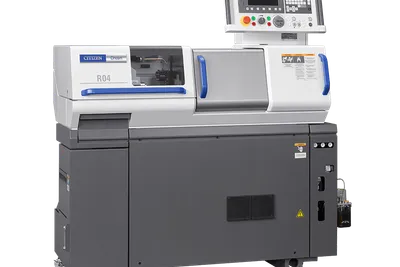
Tsugami SS207-II-5AX

Image: tsugamiamerica.com, Tsugami
Key Specifications
max bar capacity
number of axes
guide bushing
chucker mode
max machining length
tool stations
How much does the Tsugami SS207-II-5AX cost?
Estimated price range
Our best estimate for a swiss-type lathe in this class — not a quote from Tsugami. Configuration moves it a long way.
Overview
The Tsugami SS207-II-5AX is the five-axis version of the 20 mm (0.79 in) SS207-II Swiss-type lathe. Tsugami America lists it with seven axes, a FANUC 31i-B5 control, 37 tool stations as standard and 13/15 live-tool positions. Main and sub spindles both run 200 - 10,000 rpm and the main spindle is rated 2.2 / 3.7 kW (3/5 hp).
The 5AX suffix and the 31i-B5 control are what separate it from the plain SS207-II, which Tsugami's own table lists with 39 standard tools. The five-axis variant gives up two of those positions. What it offers in return is the five-axis capability its name describes, aimed at angled holes and features off the main axes that would otherwise need a second operation on another machine. For work that is all on-axis, that capability adds nothing, and the plain SS207-II with its additional stations is the more sensible 20 mm machine.
The guide bushing gives up to 210 mm of machining length per chucking. Removing it for chucker mode leaves 45 mm (1.77 in), which suits short parts from ground stock.
At 3,745 kg (8,267 lb) and 2,325 × 1,270 × 2,010 mm, the machine fits the same floor space as the SS207-II. The larger SS20MH-III-5AX goes further, with eight axes, a FANUC 31i-B5 Plus and a tool spindle listed at 25,000 rpm, but weighs 5,300 kg (11,660 lb). Tsugami America's table for the SS207-II-5AX gives no live-tool speed or rapid traverse, so ask for those along with the reach and angle range of the five-axis unit.
Full Specifications
| Parameter | Value |
|---|---|
| Max Bar Capacity | 20 mm (0.79 in) |
| Number of Axes | 7 |
| Guide Bushing | Yes |
| Chucker Mode | Yes |
| Max Machining Length | 210 mm (8.65 in) with guide bushing; 45 mm (1.77 in) without |
| Tool Stations | 37 (Standard) |
| Live Tool Stations | 13/15 |
| CNC Control | FANUC 31i-B5 |
| Main Spindle Speed | 200 - 10,000 rpm |
| Sub Spindle Speed | 200 - 10,000 rpm |
| Main Spindle Power | 2.2 / 3.7 kW (3/5 hp) |
| Machine Weight | 3,745 kg (8,267 lb) |
| Floor Space Required | 2,325 × 1,270 × 2,010 mm |
Specifications sourced from tsugamiamerica.com — verified 2026-10-03
Strengths & Limitations
Strengths
- Seven axes under a FANUC 31i-B5 control, the five-axis version of the SS207-II
- 37 tool stations as standard with 13/15 live positions
- Guide bushing and chucker mode: 210 mm per chucking with the bushing, 45 mm (1.77 in) without
- Main and sub spindles both 200 - 10,000 rpm
- Same 2,325 × 1,270 × 2,010 mm footprint as the SS207-II
Limitations
- Two fewer standard tools than the 39 of the SS207-II
- Main spindle rated 2.2 / 3.7 kW (3/5 hp), lighter than the 3.7 / 5.5 kW (5/7.4 hp) of the SS20MH-III-5AX
- No live-tool speed, rapid traverse or five-axis unit data in Tsugami America's table
- Bar capacity is limited to 20 mm (0.79 in)
Best For
Frequently Asked Questions
01
The SS207-II-5AX is the five-axis variant, listed with seven axes, a FANUC 31i-B5 control and 37 standard tool stations. The SS207-II is listed with 39 standard tools at 10,000 rpm (rated 8,000 rpm) and 2.2/3.7 kW, and Tsugami's table for it names no control. Both are 20 mm (0.79 in) machines on the same footprint.
02
Tsugami America lists 13/15 live-tool positions among the 37 standard stations. Live-tool speed and power are not in the table, so confirm them, together with the travel and angle range of the five-axis unit, against the parts you plan to run.
03
Up to 210 mm with the guide bushing. In chucker mode, with the bushing removed, it is 45 mm (1.77 in). Chucker mode avoids the bar remnant that a guide bushing leaves, which matters on short parts where every millimetre of bar counts.
04
Both take 20 mm (0.79 in) bar and carry the 5AX suffix. The SS20MH-III-5AX has eight axes, a 31i-B5 Plus, a 3.7 / 5.5 kW (5/7.4 hp) main spindle and a tool spindle listed at 25,000 rpm, and weighs 5,300 kg (11,660 lb). The SS207-II-5AX is the lighter machine at 3,745 kg (8,267 lb) with seven axes and 2.2 / 3.7 kW (3/5 hp).
Videos

Tsugami America
More from Tsugami

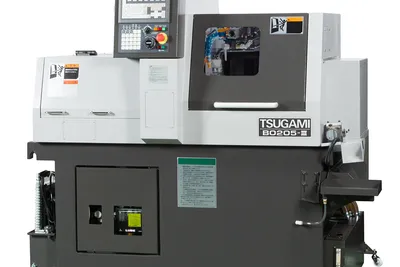

Other Swiss-Type Lathes
Star Micronics SA-20R Type B
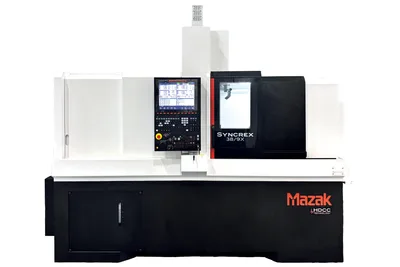
Mazak SYNCREX 20/7
Citizen Cincom F20
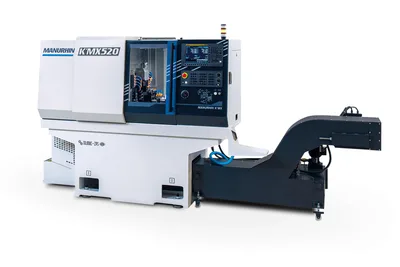
Tajmac-ZPS MANURHIN K'MX 520
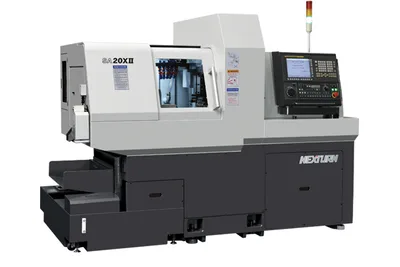
Nexturn SA20XII