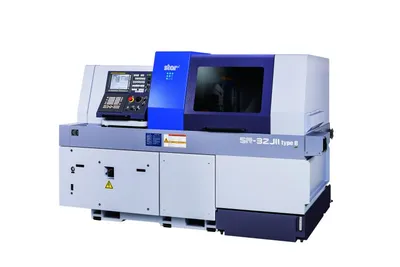
Tsugami SS207-II
Key Specifications
Max Spindle
Tool Capacity
Rapid Traverse
Spindle Power
max machining diameter
sub spindle speed
How much does the Tsugami SS207-II cost?
Estimated price range
Our best estimate for a swiss-type lathe in this class — not a quote from Tsugami. Configuration moves it a long way.
Overview
The Tsugami SS207-II is a 20 mm (0.79 in) Swiss-type lathe whose standout figure is its tooling: Tsugami lists 39 tools as standard, more than any of the SS267-III, SS327-III or SS32L in the same family. Main and sub spindles run to 10,000 rpm (rated 8,000 rpm) and both are rated 2.2/3.7 kW.
Thirty-nine positions on a 20 mm machine is a lot of tooling for the bar size. It lets complex parts, with front and back drilling, threading, slotting and milling, be machined complete without trading one tool off against another, and leaves space for duplicate tools on wear-prone operations so a long unattended run does not stop for an insert change.
Rapids are split by axis: 35 m/min on Z1, X2 and Z2 and 24 m/min on X1, Y1 and Y2. The SS267-III uses the same rapid figures and a near-identical tool count of 38, but steps up to 26 mm and 3.7/5.5 kW for larger parts, at 4,000 kg (8,818 lb). If the work stays at or under 20 mm, the SS207-II keeps the extra position and takes less floor length.
The SS207-II stands 2,325 × 1,270 × 2,010 mm (91.5 × 50.0 × 79.1 in) and weighs 3,750 kg (8,267 lb). Tsugami's table for it gives no machining length per chucking, live-tool speed, axis count or control.
Full Specifications
| Parameter | Value |
|---|---|
| Max Machining Diameter | 20 mm (0.79 in) |
| Max Spindle Speed | 10,000 rpm (rated 8,000 rpm) |
| Sub Spindle Speed | 10,000 rpm (rated 8,000 rpm) |
| Tool Capacity | 39 (standard) |
| Rapid Traverse Rate | 35 m/min (Z1, X2, Z2), 24 m/min (X1, Y1, Y2) |
| Spindle Motor Power | 2.2/3.7 kW |
| Sub Spindle Power | 2.2/3.7 kW |
| Floor Space Required | 2,325 × 1,270 × 2,010 mm (91.5 × 50.0 × 79.1 in) |
| Machine Weight | 3,750 kg (8,267 lb) |
Specifications sourced from tsugami.co.jp — verified 2026-10-03
Strengths & Limitations
Strengths
- 39 tools as standard, the most in its listed family
- Main and sub spindles both 10,000 rpm (rated 8,000 rpm) at 2.2/3.7 kW
- 35 m/min rapid on Z1, X2 and Z2
- Shorter on the floor than the SS267-III: 2,325 mm long against 2,630 mm
Limitations
- Limited to 20 mm (0.79 in) machining diameter; the SS267-III takes 26 mm
- 2.2/3.7 kW spindles, below the 3.7/5.5 kW of the SS267-III
- No machining length, live-tool data or control in Tsugami's table
Best For
Frequently Asked Questions
01
39 as standard, according to Tsugami's table. That is one more than the 38 of the SS267-III and SS327-III and ten more than the 29 of the SS32L, which makes the SS207-II the tooling-heavy choice for parts up to 20 mm (0.79 in).
02
Decide by bar size. The SS267-III machines up to 26 mm (1.02 in) with 3.7/5.5 kW spindles, 38 standard tools and 4,000 kg (8,818 lb) of machine. The SS207-II stops at 20 mm (0.79 in) with 2.2/3.7 kW but carries 39 tools, weighs 3,750 kg (8,267 lb) and is 2,325 mm long against 2,630 mm for the SS267-III.
03
The SS207-II-5AX is the five-axis variant and is listed with 37 tools as standard against 39 here, a 31i-B5 control and 3,745 kg (8,267 lb). Tsugami's table for the SS207-II gives no control, so compare the two directly with Tsugami if the five-axis work is in question.
Videos

Tsugami America
More from Tsugami
Other Swiss-Type Lathes
Star SB-38
Mazak SYNCREX 20/8
Tajmac-ZPS MANURHIN K'MX 532 TREND
Nexturn SA26PII
Citizen Cincom R04-VI