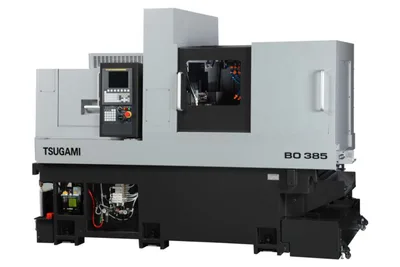
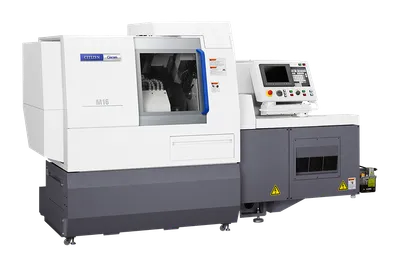
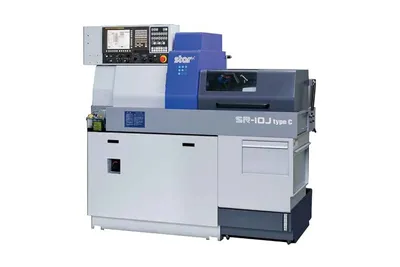
Tsugami M06
Key Specifications
Rapid Traverse
Accuracy
Repeatability
max bar capacity
main spindle speed
sub spindle speed
How much does the Tsugami M06 cost?
Estimated price range
Our best estimate for a swiss-type lathe in this class — not a quote from Tsugami. Configuration moves it a long way.
Overview
The Tsugami M06 page lists a micro Swiss-type lathe: 6 mm (0.236 in) bar capacity, a 15,000 RPM main spindle of 0.75 kW (1 hp), a 12,000 RPM sub spindle, five axes and up to 16 tools. Tsugami's current product pages do not show a machine of this description under that name, so the table could not be checked against the maker and every figure here is unconfirmed.
That matters because the same model prefix belongs to quite different machines. The M06D-II, M06DY-II and M06J-II are chucking lathes with a 6 in chuck, 51 mm (2.01 in) bar capacity and a 260 mm (10.2 in) turning diameter, weighing 3,300 kg (7,275 lb) or more. Anyone sourcing an M06 should first establish which machine the seller means.
On its own listed figures the M06 is built for very small work. Travels are 10 mm (0.39 in) on X1 and X2, 120 mm (4.72 in) on Z1 and 50 mm (1.97 in) on Z2, with 24 m/min (945 ipm) rapids. The guide bushing is described as standard and precision-ground for micro-turning. The table also states positioning accuracy of ±0.002 mm, repeatability of ±0.001 mm, a Fanuc 0i-F control and a weight of 1,200 kg (2,646 lb).
At 0.75 kW (1 hp) the main spindle is for light cuts on tiny diameters. Ask for the original specification sheet before relying on any of these numbers.
Full Specifications
| Parameter | Value |
|---|---|
| Max Bar Capacity | 6 mm (0.236 in) |
| Main Spindle Speed | 15,000 RPM |
| Sub Spindle Speed | 12,000 RPM |
| Main Spindle Power | 0.75 kW (1 hp) |
| Number of Axes | 5 axes |
| Tool Stations | Up to 16 tools |
| Guide Bushing | Standard (precision-ground for micro-turning) |
| Travel X1 | 10 mm (0.39 in) |
| Travel Z1 | 120 mm (4.72 in) |
| Travel X2 | 10 mm (0.39 in) |
| Travel Z2 | 50 mm (1.97 in) |
| Rapid Traverse Rate | 24 m/min (945 ipm) |
| Positioning Accuracy | ±0.002 mm |
| Repeatability | ±0.001 mm |
| CNC Control | Fanuc 0i-F |
| Machine Weight | 1,200 kg (2,646 lb) |
Specifications compiled from manufacturer literature and industry references. Not independently verified against a published spec sheet — confirm with the manufacturer or an authorised dealer before making a purchasing decision.
Strengths & Limitations
Strengths
- 6 mm (0.236 in) bar capacity with a 15,000 RPM main spindle for very small parts, on the listed figures
- 12,000 RPM sub spindle for back-end work
- Guide bushing listed as standard and precision-ground for micro-turning
- Up to 16 tools on five axes
Limitations
- The table could not be checked against Tsugami, so the figures are unconfirmed
- The M06 name is shared with the M06D-II and M06J-II chucking lathes, which invites confusion when buying
- 0.75 kW (1 hp) main spindle allows only light cuts
- Z2 travel of 50 mm (1.97 in) limits back-end work
Best For
Frequently Asked Questions
01
No. The M06D-II and M06J-II are chucking lathes with a 6 in chuck and 51 mm (2.01 in) bar capacity. The M06 table on this page describes a Swiss-type lathe with 6 mm (0.236 in) bar capacity. Establish which machine a seller means before comparing offers.
02
No. A machine matching this table does not appear on Tsugami's current product pages, so the figures could not be checked against the maker. Ask the seller for the original specification sheet or the machine's nameplate data.
03
The listed figures give a 15,000 RPM main spindle of 0.75 kW (1 hp) and a 12,000 RPM sub spindle. That suits light cuts on very small diameters; the table gives no sub spindle power.
04
The table lists 10 mm (0.39 in) on X1 and X2, 120 mm (4.72 in) on Z1 and 50 mm (1.97 in) on Z2, with 24 m/min (945 ipm) rapid traverse. Confirm them against the machine's own documents before planning a part.
Videos
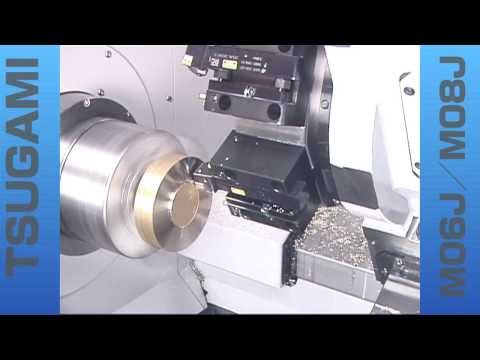
DELTA MACHINES

Weco Werkzeugmaschinen