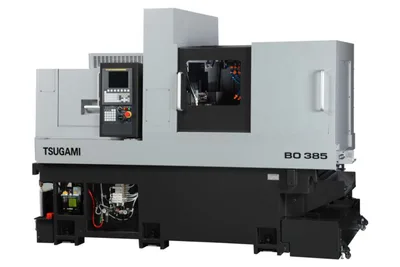
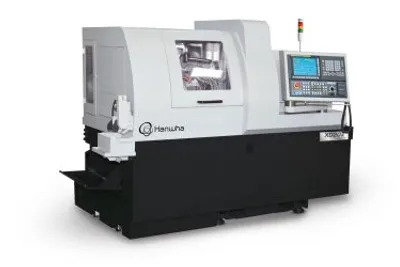
Tsugami BW208-II
Key Specifications
Max Spindle
Tool Capacity
Rapid Traverse
Spindle Power
max machining diameter
sub spindle speed
How much does the Tsugami BW208-II cost?
Estimated price range
Our best estimate for a swiss-type lathe in this class — not a quote from Tsugami. Configuration moves it a long way.
Overview
The Tsugami BW208-II pairs 20 mm (0.79 in) bar capacity with a Y2 axis and 28 standard tool positions. Among the 20 mm BW lathes it is the eight-axis choice for off-centre work: Y2 is listed at 15 m/min, and neither the BW207-II nor the BW208Z-I has it.
Power is where this machine parts company with the BW128-II, its smaller-bar counterpart. The main spindle here is rated 2.2/3.7 kW and turns up to 10,000 rpm (rated 8,000 rpm), which suits the larger diameters. The back spindle is lighter, 1.5/2.2 kW, though it runs faster at 12,000 rpm (rated 8,000 rpm). Plan heavy turning for the front and use the back for secondary operations.
With Y travel on the second tool group, flats, slots and cross holes off the centreline can be cut from that group as well as from Y1 and Y3. That is also where the four extra tool positions over the BW207-II come from, 28 against 24.
Rapids: 32 m/min on Z1, X2 and Z2, 24 m/min on Y1 and Y3, 15 m/min on Y2, 12 m/min on X1 and X3. The weight is 2,900 kg (6,393 lb) on the shared 2,010 × 1,505 × 1,750 mm (79.1 × 59.3 × 68.9 in) footprint.
Full Specifications
| Parameter | Value |
|---|---|
| Max Machining Diameter | 20 mm (0.79 in) |
| Max Spindle Speed | 10,000 rpm (rated 8,000 rpm) |
| Sub Spindle Speed | 12,000 rpm (rated 8,000 rpm) |
| Tool Capacity | 28 (standard) |
| Rapid Traverse Rate | 32 m/min (Z1, X2, Z2), 24 m/min (Y1, Y3), 15 m/min (Y2), 12 m/min (X1, X3) |
| Spindle Motor Power | 2.2/3.7 kW |
| Sub Spindle Power | 1.5/2.2 kW |
| Floor Space Required | 2,010 × 1,505 × 1,750 mm (79.1 × 59.3 × 68.9 in) |
| Machine Weight | 2,900 kg (6,393 lb) |
Specifications sourced from tsugami.co.jp — verified 2026-10-03
Strengths & Limitations
Strengths
- 20 mm (0.79 in) bar with a 2.2/3.7 kW main spindle
- Y2 axis at 15 m/min for off-centre features from the second tool group
- 28 tools as standard, four more than the BW207-II
- Back spindle reaches 12,000 rpm (rated 8,000 rpm)
Limitations
- No Z3 axis in the table; the BW209Z-I adds one with 60 mm (2.36 in) of stroke
- Back spindle power of 1.5/2.2 kW is below the main spindle's 2.2/3.7 kW
- Main spindle tops out at 10,000 rpm (rated 8,000 rpm)
Best For
Frequently Asked Questions
01
The BW208-II has a Y2 axis and 28 tools as standard. The BW208Z-I has no Y2 but adds a Z3 axis with 60 mm (2.36 in) of stroke, and carries 24 tools. It is also lighter at 2,850 kg (6,283 lb) against 2,900 kg (6,393 lb).
02
They share the Y2 axis, 28 tools and 2,900 kg (6,393 lb). The BW208-II takes 20 mm (0.79 in) bar and has a 2.2/3.7 kW main spindle to 10,000 rpm. The BW128-II takes 12 mm (0.47 in) and has a 1.5/2.2 kW main spindle to 12,000 rpm.
03
Z1, X2 and Z2 move at 32 m/min. Y1 and Y3 move at 24 m/min, Y2 at 15 m/min, and X1 and X3 at 12 m/min. The X axes are the slow ones, so short infeeds still cost time.