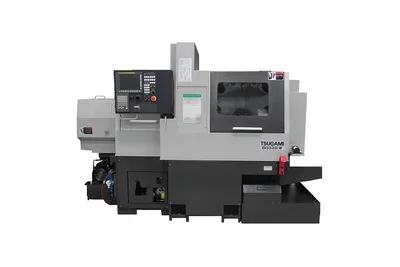
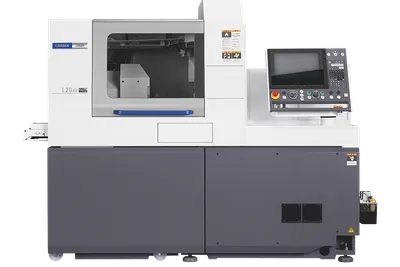
Tsugami BW207-II
Key Specifications
Max Spindle
Tool Capacity
Rapid Traverse
Spindle Power
max machining diameter
sub spindle speed
How much does the Tsugami BW207-II cost?
Estimated price range
Our best estimate for a swiss-type lathe in this class — not a quote from Tsugami. Configuration moves it a long way.
Overview
With a 20 mm (0.79 in) maximum machining diameter, the Tsugami BW207-II is the bigger-bar counterpart of the BW127-II. It keeps that model's seven axes and 24 standard tools but swaps the main spindle for a stronger, slower one: 2.2/3.7 kW and 10,000 rpm (rated 8,000 rpm), where the BW127-II has 1.5/2.2 kW and 12,000 rpm.
The back spindle does not change with it. It stays at 1.5/2.2 kW and 12,000 rpm (rated 8,000 rpm), so on this model the back spindle is the smaller motor of the two and also the faster one. For a 20 mm part that means the heaviest cuts belong on the main side, and back working is better suited to finishing, drilling and the cut-off face.
Axis motion is X1, Y1, Z1, X2, Z2, X3 and Y3, with no Y2 or Z3 in the table. Z1, X2 and Z2 rapid at 32 m/min, Y1 and Y3 at 24 m/min, and X1 and X3 at 12 m/min. The machine takes 2,010 × 1,505 × 1,750 mm (79.1 × 59.3 × 68.9 in) of floor and weighs 2,850 kg (6,283 lb), exactly as the BW127-II does.
Full Specifications
| Parameter | Value |
|---|---|
| Max Machining Diameter | 20 mm (0.79 in) |
| Max Spindle Speed | 10,000 rpm (rated 8,000 rpm) |
| Sub Spindle Speed | 12,000 rpm (rated 8,000 rpm) |
| Tool Capacity | 24 (standard) |
| Rapid Traverse Rate | 32 m/min (Z1, X2, Z2), 24 m/min (Y1, Y3), 12 m/min (X1, X3) |
| Spindle Motor Power | 2.2/3.7 kW |
| Sub Spindle Power | 1.5/2.2 kW |
| Floor Space Required | 2,010 × 1,505 × 1,750 mm (79.1 × 59.3 × 68.9 in) |
| Machine Weight | 2,850 kg (6,283 lb) |
Specifications sourced from tsugami.co.jp — verified 2026-10-03
Strengths & Limitations
Strengths
- Takes bar up to 20 mm (0.79 in), against 12 mm (0.47 in) on the BW127-II
- Main spindle rated 2.2/3.7 kW, up from 1.5/2.2 kW on the BW127-II
- Back spindle runs to 12,000 rpm (rated 8,000 rpm), faster than the main spindle's 10,000 rpm
- No more floor or weight than the BW127-II: 2,010 × 1,505 × 1,750 mm (79.1 × 59.3 × 68.9 in), 2,850 kg (6,283 lb)
Limitations
- Back spindle is rated 1.5/2.2 kW, below the 2.2/3.7 kW main spindle
- No Y2 or Z3 axis; the BW208-II adds Y2 and the BW208Z-I adds Z3
- 24 tools as standard against 28 on the BW208-II
Best For
Frequently Asked Questions
01
Same seven axes, 24 tools, rapid rates, footprint and 2,850 kg (6,283 lb) weight. The BW207-II takes 20 mm (0.79 in) bar where the BW127-II takes 12 mm (0.47 in), and its main spindle is rated 2.2/3.7 kW at up to 10,000 rpm. The BW127-II main spindle is rated 1.5/2.2 kW and runs to 12,000 rpm.
02
The main spindle is sized for 20 mm (0.79 in) bar at 2.2/3.7 kW and 10,000 rpm (rated 8,000 rpm). The back spindle is the 1.5/2.2 kW unit used across the BW range, which reaches 12,000 rpm (rated 8,000 rpm). It holds the part after cut-off, usually a smaller diameter to finish.
03
The BW208-II carries 28 tools as standard and adds a Y2 axis at 15 m/min. It weighs 2,900 kg (6,393 lb). Bar capacity and spindles are the same as on the BW207-II.