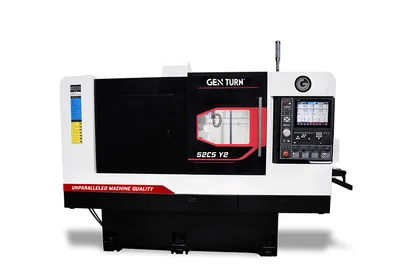
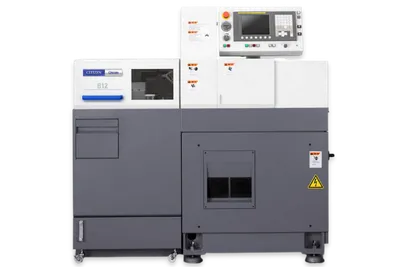
Tsugami BW128-II
Key Specifications
Max Spindle
Tool Capacity
Rapid Traverse
Spindle Power
max machining diameter
sub spindle speed
How much does the Tsugami BW128-II cost?
Estimated price range
Our best estimate for a swiss-type lathe in this class — not a quote from Tsugami. Configuration moves it a long way.
Overview
Tsugami's BW128-II handles bar to 12 mm (0.47 in) on eight axes and carries 28 tools as standard. What sets it apart in the small BW range is the Y2 axis: Tsugami lists it at 15 m/min, and the seven-axis BW127-II does not have it.
A Y stroke on the second axis gives that tool group a second direction of travel, so tools can be stacked along Y and off-centre features such as flats or cross holes become possible without relying on the first group alone. The extra positions show in the tool count, 28 here against 24 on the BW127-II and on the BW128Z-I, which trades the Y2 for a Z3 axis.
The spindles are unchanged from the rest of the 12 mm family. The main spindle reaches 12,000 rpm (rated 10,000 rpm), the back spindle 12,000 rpm (rated 8,000 rpm), and each is rated 1.5/2.2 kW. Z1, X2 and Z2 rapid at 32 m/min, Y1 and Y3 at 24 m/min, X1 and X3 at 12 m/min.
The floor space is 2,010 × 1,505 × 1,750 mm (79.1 × 59.3 × 68.9 in), the same as its siblings, and the weight rises to 2,900 kg (6,393 lb).
Full Specifications
| Parameter | Value |
|---|---|
| Max Machining Diameter | 12 mm (0.47 in) |
| Max Spindle Speed | 12,000 rpm (rated 10,000 rpm) |
| Sub Spindle Speed | 12,000 rpm (rated 8,000 rpm) |
| Tool Capacity | 28 (standard) |
| Rapid Traverse Rate | 32 m/min (Z1, X2, Z2), 24 m/min (Y1, Y3), 15 m/min (Y2), 12 m/min (X1, X3) |
| Spindle Motor Power | 1.5/2.2 kW |
| Sub Spindle Power | 1.5/2.2 kW |
| Floor Space Required | 2,010 × 1,505 × 1,750 mm (79.1 × 59.3 × 68.9 in) |
| Machine Weight | 2,900 kg (6,393 lb) |
Specifications sourced from tsugami.co.jp — verified 2026-10-03
Strengths & Limitations
Strengths
- Y2 axis at 15 m/min, which the BW127-II and BW128Z-I do not list
- 28 tools as standard against 24 on the BW127-II
- 12,000 rpm main and back spindles for 12 mm (0.47 in) work, each rated 1.5/2.2 kW
- Same 2,010 × 1,505 × 1,750 mm (79.1 × 59.3 × 68.9 in) footprint as the seven-axis model
Limitations
- No Z3 axis: the BW129Z-I has both the Y2 and a Z3 axis with 60 mm (2.36 in) of stroke
- Bar is limited to 12 mm (0.47 in)
- Y2 moves at 15 m/min against 32 m/min on Z1, X2 and Z2
Best For
Frequently Asked Questions
01
A Y2 axis, with a rapid traverse of 15 m/min, and 28 tools as standard instead of 24. It is heavier at 2,900 kg (6,393 lb) against the 2,850 kg (6,283 lb) of the BW127-II. Spindles, bar capacity and footprint are the same.
02
They add different axes to the same base. The BW128-II has a Y2 axis and 28 tools. The BW128Z-I has no Y2 but adds a Z3 axis with a 60 mm (2.36 in) stroke and carries 24 tools. Parts with off-centre features on the second tool group point to the BW128-II, axial work on the third group to the BW128Z-I.
03
Tsugami lists 2,900 kg (6,393 lb) on a footprint of 2,010 × 1,505 × 1,750 mm (79.1 × 59.3 × 68.9 in). Check the floor rating and the rigging route before delivery.
More from Tsugami
Other Swiss-Type Lathes
Tajmac-ZPS MANURHIN K'MX 620
Nexturn SA26PYII
Star Micronics SR-32JIII Type A/B
Citizen Cincom B12E-VI
Hanwha XP20