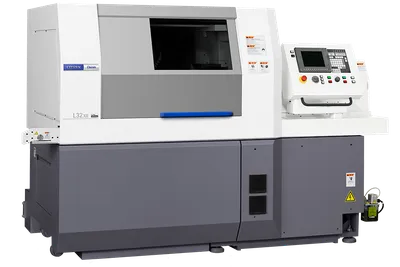
Tsugami BO325
Key Specifications
model designation
max barstock diameter
max machining length one grip
max drilling diameter
max tapping diameter
max back spindle chucking diameter
How much does the Tsugami BO325 cost?
Estimated price range
Our best estimate for a swiss-type lathe in this class — not a quote from Tsugami. Configuration moves it a long way.
Overview
The Tsugami BO325, which Tsugami's specification sheet calls the B0325-III, is a 32 mm (1.25 in) Swiss-type automatic lathe with matched 8,000 rpm main and back spindles, each on a 3.7 / 5.5 kW (5 / 7.4 hp) motor, and 31 tools in the standard specification. The figure that defines it for long work is length per grip: 330 mm (13.0 in) with the guide bushing and 70 mm (2.76 in) without.
The back spindle has the same speed and motor as the main one, and its capacities show it is meant to work. It chucks the full Ø32 mm, drills to Ø10 mm and taps M10, so heavy back-end work does not have to be moved to a second operation. On the main side the limits are Ø12 mm drilling and M10 tapping. The driven tool spindles are smaller: Ø8 mm drilling, M6 tapping and a Ø45 mm slotting cutter at position T04, at up to 6,000 min-1 with a normal speed of 4,800 min-1.
The guide bushing is rotary and driven by its own 0.75 / 1.5 kW (1 / 2 hp) motor. Five axes (X1, Y1, Z1, X2, Z2) run on 0.75 kW (1 hp) servos, with rapids of 35 m/min except X1 and Z1 at 24 m/min, and both spindles index as C1 and C2. Turning tools are 5/8 x 5/8 in (16 x 16 mm) shanks, 12 of them.
For installation, the machine measures 2,150 x 1,280 x 1,970 mm (84.64 x 50.4 x 77.5 in) and weighs 4,000 kg (8,818 lb). It needs a 22.4 kVA supply and compressed air at 0.4 MPa or more, 100 NL/min. The coolant tank holds 260 L and is fed by a 0.4 kW (0.54 hp) pump.
Full Specifications
| Parameter | Value |
|---|---|
| Model Designation | B0325-III (Swiss-type automatic lathe) |
| Max Barstock Diameter | 1.25 in (32 mm) |
| Max Machining Length One Grip | 330 mm (13.0 in) with guide bushing; 70 mm (2.76 in) without guide bushing |
| Max Drilling Diameter | Ø12 mm |
| Max Tapping Diameter | M10 |
| Max Back Spindle Chucking Diameter | Ø32 mm |
| Max Back Spindle Drilling Diameter | Ø10 mm |
| Max Back Spindle Tapping Diameter | M10 |
| Max Tool Spindle Drilling Diameter | Ø8 mm |
| Max Tool Spindle Tapping Diameter | M6 |
| Max Tool Spindle Slotting Cutter Diameter | Ø45 mm (T04) |
| Main Spindle Speed | 8,000 rpm |
| Back Spindle Speed | 8,000 rpm |
| Tool Spindle Speed | 6,000 min-1 max. (normal speed 4,800 min-1) |
| Total Tool Number | 31 (standard specification) |
| Tool Size | 5/8 x 5/8 in (16 x 16 mm), 12 pcs |
| Rapid Traverse Rate | 35 m/min (X1, Z1: 24 m/min) |
| Spindle Index | C1 axis and C2 axis |
| Main Spindle Motor | 3.7 / 5.5 kW (5 / 7.4 hp) |
| Back Spindle Motor | 3.7 / 5.5 kW (5 / 7.4 hp) |
| Rotary Guide Bushing Motor | 0.75 / 1.5 kW (1 / 2 hp) |
| Axis Motors | X1, Y1, Z1, X2, Z2: 0.75 kW (1 hp) |
| Coolant Pump | 0.4 kW (0.54 hp) |
| Compressed Air Requirement | 0.4 MPa or more, 100 NL/min |
| Power Source Requirement | 22.4 kVA |
| Coolant Tank Capacity | 260 L |
| Dimensions Wxdxh | 2,150 x 1,280 x 1,970 mm (84.64 x 50.4 x 77.5 in) |
| Machine Weight | 4,000 kg (8,818 lb) |
Specifications sourced from tsugamiamerica.com — verified 2026-09-24
Strengths & Limitations
Strengths
- 330 mm (13.0 in) machining length per grip with the guide bushing, for long shafts in one chucking
- Back spindle matches the main: 8,000 rpm on 3.7 / 5.5 kW (5 / 7.4 hp), chucking the full Ø32 mm
- Rotary guide bushing driven by its own 0.75 / 1.5 kW (1 / 2 hp) motor
- 31 tools in the standard specification, with 5/8 x 5/8 in (16 x 16 mm) turning tool shanks
- Back-end drilling to Ø10 mm and tapping to M10 without a second operation
Limitations
- Without the guide bushing, length per grip drops to 70 mm (2.76 in)
- Driven tools are limited to Ø8 mm drilling and M6 tapping, at a normal speed of 4,800 min-1
- X1 and Z1 rapids are 24 m/min, against 35 m/min on the other axes
- Needs a 22.4 kVA supply, 0.4 MPa or more of air at 100 NL/min, and floor for 4,000 kg (8,818 lb)
Best For
Frequently Asked Questions
01
330 mm (13.0 in) with the guide bushing in use, and 70 mm (2.76 in) without it. The long stroke suits shafts and pins machined complete from bar; the short guide-bushless figure is for stubby parts where a shorter remnant is worth more than reach.
02
It runs to 8,000 rpm on a 3.7 / 5.5 kW (5 / 7.4 hp) motor, the same as the main spindle. It chucks up to Ø32 mm, drills up to Ø10 mm and taps up to M10, and it indexes as the C2 axis, so most back-end features can be finished in the same cycle.
03
The tool spindles drill up to Ø8 mm, tap up to M6 and take a slotting cutter up to Ø45 mm at position T04. They run to 6,000 min-1, with a normal speed of 4,800 min-1. Larger cross holes or heavy milling are beyond them, so check the part's largest driven-tool feature first.
04
A 22.4 kVA electrical supply and compressed air at 0.4 MPa or more with 100 NL/min of flow. The coolant tank holds 260 L. The machine measures 2,150 x 1,280 x 1,970 mm (84.64 x 50.4 x 77.5 in) and weighs 4,000 kg (8,818 lb), so check floor loading and access for rigging.
05
Yes. Tsugami's specification for this page names the model B0325-III and describes it as a Swiss-type automatic lathe. Use that designation when asking for quotations or documentation, since the model is listed under the B0325 name in Tsugami's literature.
Videos

Machinery Resources International
Community Discussions
Troubleshooting and problem-solving
Links to community discussions. Summaries are editorial — visit the original thread for full context.
More from Tsugami

Other Swiss-Type Lathes
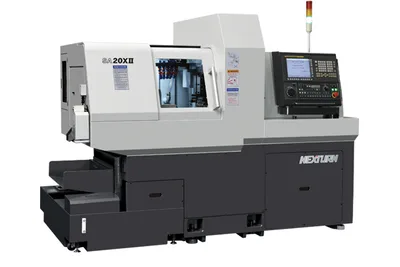
Nexturn SA45XII
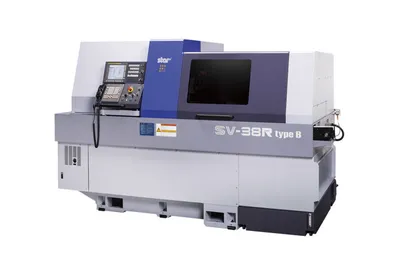
Star SV-38R
Schaublin 42 CNC
Tornos Delta 38