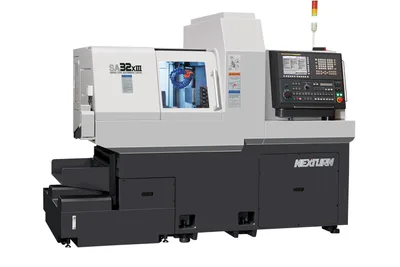
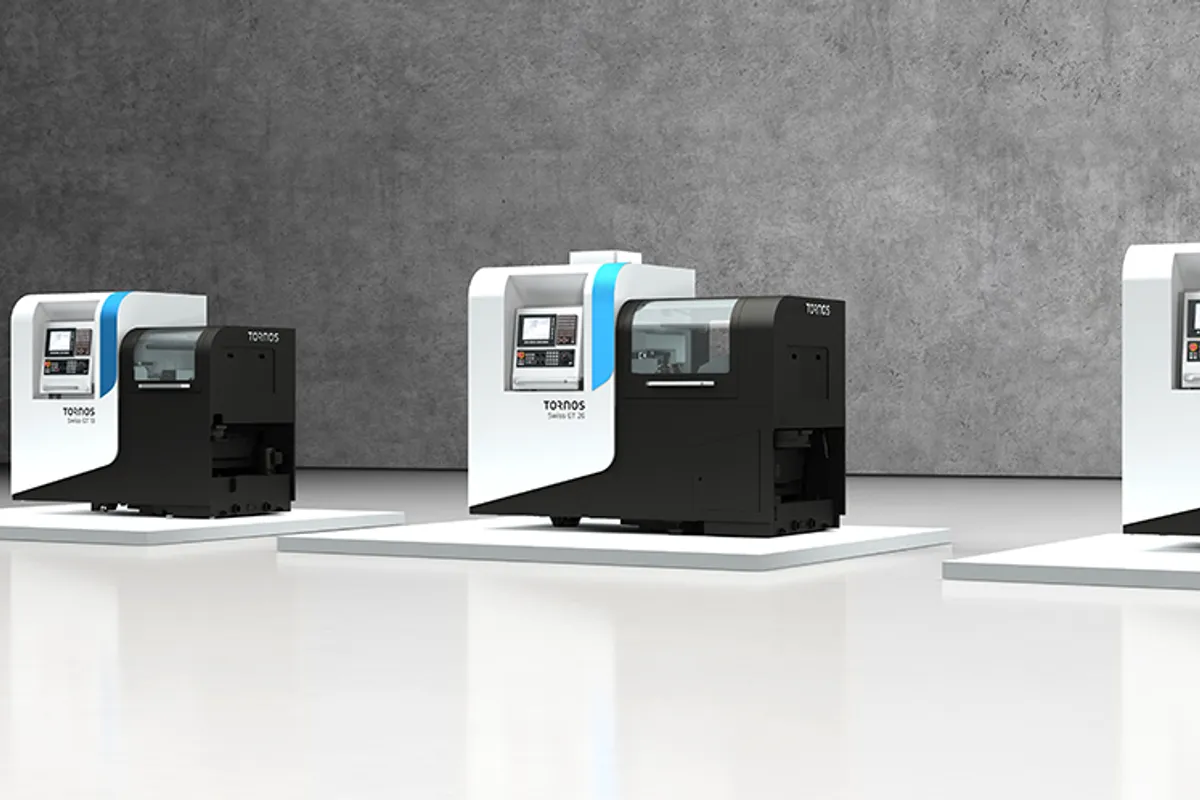
Tornos Swiss GT 26
Key Specifications
Max Spindle
Tool Capacity
Spindle Power
axes
number of independent tool systems
bar capacity
How much does the Tornos Swiss GT 26 cost?
Estimated price range
Our best estimate for a swiss-type lathe in this class — not a quote from Tornos. Configuration moves it a long way.
Overview
The Tornos Swiss GT 26 is a sliding-headstock bar lathe with 6 linear axes, 2 C-axes and 2 independent tool systems, and a bar capacity listed as 23 (25.4) mm. Main spindle and counter spindle carry the same rating: 0-10,000 rpm, 8.2 (10.5) kW and 26 Nm. That symmetry is the defining feature. Work passed to the counter spindle can be cut as hard as work on the main side, so operations can be divided to balance the cycle instead of being pushed to the front because the back is weaker.
Tornos lists a total tool capacity of 40. Of these, up to 10 are turning tools of 16 x 16 section, and there are 5 frontal tools for main operations with (5) more shown in brackets for counter-operations. Rotating tools have 4 positions on S11, run at 5000 rpm, and are rated 0.75 / 1 kW for S11 / S21. Counter-operation rotating tools also run at 5000 rpm, with 0.75 kW.
The rotating tool power deserves attention. At 0.75 kW to 1 kW and 5000 rpm, these drives are sized for cross-drilling, small slots and flats, not for heavy milling; a part that needs substantial milled stock removal will spend most of its cycle there. The maximum standard output length of the workpiece is 120 mm, and the counter spindle accepts up to 25.4 mm.
The machine is at most 2710 mm long and 1270 mm wide, stands 1990 mm high and weighs 3550 kg. The cutting oil tray holds 200 l and the coolant pump is rated 0.44 kW, so anyone who needs high-pressure coolant for deep drilling should raise it with Tornos. The control is a Fanuc 31iB.
Full Specifications
| Parameter | Value |
|---|---|
| Axes | 6 linear axes + 2 C-axis |
| Number of Independent Tool Systems | 2 |
| Bar Capacity | 23 (25.4) mm |
| Max Spindle Speed | 0-10,000 rpm |
| Spindle Motor Power | 8.2 (10.5) kW |
| Spindle Torque | 26 Nm |
| Max Number of Turning Tools | 10 |
| Turning Tool Section | 16 x 16 |
| Number of Frontal Tools Op Cop | 5 / (5) |
| Positions for Rotating Tools S11 | 4 |
| Rotating Tool Speed | 5000 rpm |
| Rotating Tool Power S11 S21 | 0.75 / 1 kW |
| Counter Spindle Max Bar Capacity | 25.4 mm |
| Max Standard Output Length of Workpiece | 120 mm |
| Counter Spindle Speed | 0-10,000 rpm |
| Counter Spindle Power | 8.2 (10.5) kW |
| Counter Spindle Torque | 26 Nm |
| Counter Operation Rotating Tool Speed | 5000 rpm |
| Counter Operation Rotating Tool Power | 0.75 kW |
| Tool Capacity | 40 |
| CNC Control | Fanuc 31iB |
| Max Length | 2710 mm |
| Max Width | 1270 mm |
| Height | 1990 mm |
| Machine Weight | 3550 kg |
| Cutting Oil Tray Capacity | 200 l |
| Coolant Pump Power | 0.44 kW |
Specifications sourced from tornos.com — verified 2026-10-03
Strengths & Limitations
Strengths
- Main and counter spindle share one rating: 0-10,000 rpm, 8.2 (10.5) kW and 26 Nm
- Total tool capacity of 40, including up to 10 turning tools of 16 x 16 section
- 6 linear axes and 2 C-axes across 2 independent tool systems, so main and counter operations can overlap
- Rotating tools at 5000 rpm for main operations (4 positions on S11) and for counter-operations
- 200 l cutting oil tray, and a 3550 kg machine inside a maximum outline of 2710 mm by 1270 mm
Limitations
- Rotating tool power is 0.75 / 1 kW (S11 / S21) and 0.75 kW in counter-operation, which keeps milling to light cuts
- Rotating tools stop at 5000 rpm, half the 10,000 rpm of the spindles, so very small drills and mills run slow
- Maximum standard output length of the workpiece is 120 mm
- The coolant pump is listed at 0.44 kW, and the table shows no high-pressure coolant figure
Best For
Frequently Asked Questions
01
Tornos lists the bar capacity as 23 (25.4) mm, and the counter spindle's maximum bar capacity as 25.4 mm. The maximum standard output length of the workpiece is 120 mm.
02
By the listed figures, yes. Each runs 0-10,000 rpm with 8.2 (10.5) kW and 26 Nm of torque. The practical effect is that roughing and threading can be planned on either side without derating the cut for the counter spindle.
03
Total tool capacity is 40. That includes up to 10 turning tools of 16 x 16 section, 5 frontal tools for main operations with (5) for counter-operations, and 4 positions for rotating tools on S11.
04
Rotating tools run at 5000 rpm in both main and counter-operation. Power is listed as 0.75 / 1 kW for S11 / S21 and 0.75 kW for counter-operation rotating tools, which suits cross-drilling, tapping and light milling more than heavy stock removal.
05
Maximum length is 2710 mm, maximum width 1270 mm and height 1990 mm, and the machine weighs 3550 kg. The cutting oil tray holds 200 l, which adds to the floor load once filled.
Videos

MTDCNC
Comparisons
More from Tornos
Other Swiss-Type Lathes
DMG Mori SPRINT 32|10
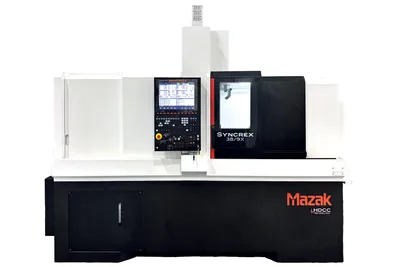
Mazak SYNCREX 38/7
Tsugami BW209Z-I
Hanwha XD42H
Tsugami BE208