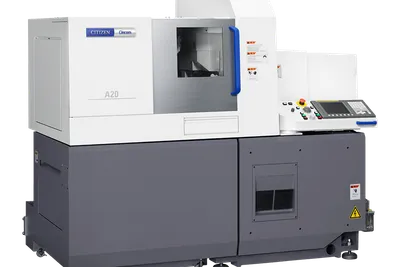
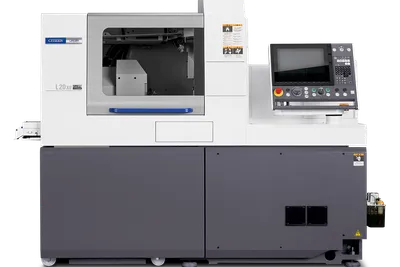
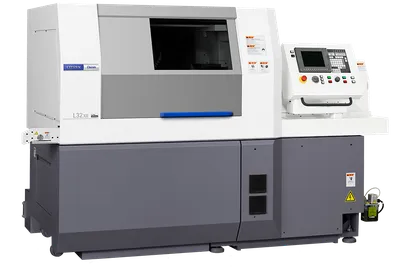
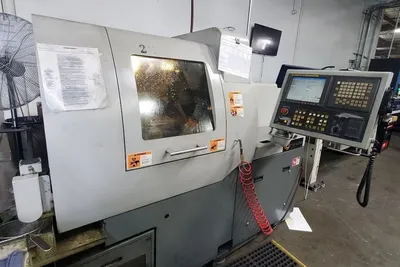
Tornos Deco 2000
Key Specifications
max bar capacity
min bar capacity
max machining length
spindle speed range
number of cross slides
longitudinal slides
Overview
The Tornos Deco 2000 is a cam-driven Swiss-type automatic lathe designed for high-volume production of small precision parts in the 1–20mm diameter range. As a mechanical cam machine rather than a fully CNC-controlled platform, the Deco 2000 represents Tornos' continuation of the traditional Swiss screw machine philosophy: fixed-cycle kinematics driven by precision-ground cams produce exceptional surface finish and dimensional consistency at production rates that CNC machines struggle to match for simple, high-volume parts. The Deco 2000 is the workhorse of watch component, micro-fastener, and connector pin production where cycle times under 5 seconds and annual volumes in the millions justify the cam changeover investment.
The cam-driven architecture of the Deco 2000 means that once set up and running, the machine requires minimal operator attention and delivers cycle-to-cycle consistency that is mechanically enforced rather than software-controlled. Cam profiles are precision-ground to produce each motion sequence—longitudinal slide advance, cross-slide infeed, and tool retract—with the same trajectory on every cycle. This mechanical repeatability produces Cpk values and surface finishes that are difficult to replicate on a servo-driven machine with equivalent simplicity of setup.
The Deco 2000 accommodates bar stock from 1 to 20mm in diameter and uses a collet-type spindle headstock with Tornos's proven precision spindle bearing arrangement. The machine features five cross-slide tool positions plus a longitudinal tool slide, accommodating a comprehensive layout for turned, threaded, and formed parts. Threading is accomplished via cam-driven threading attachment, and form tools for complex profile generation are a standard application. The machine is designed to be configured by a skilled cam-change specialist and then run unattended for extended production runs.
For shops producing millions of identical small precision parts annually—watch components, textile machine needles, medical micro-parts, electrical contact pins—the Deco 2000 offers an operating cost per part that CNC Swiss automatics cannot approach. The absence of servo drives, complex software, and ball screws means maintenance costs are low and the machine's mechanical precision is retained over decades of service with proper cam and collet maintenance. Tornos maintains a broad cam library and application engineering support for Deco 2000 users.
Full Specifications
| Parameter | Value |
|---|---|
| Max Bar Capacity | 20 mm (0.787 in) |
| Min Bar Capacity | 1 mm (0.039 in) |
| Max Machining Length | 50 mm (1.97 in) |
| Spindle Speed Range | 500 – 10,000 RPM |
| Number Of Cross Slides | 5 |
| Longitudinal Slides | 1 |
| Drive System | Cam-driven mechanical |
| Threading | Cam-driven threading attachment |
| Guide Bushing | Yes, precision Swiss-type |
| Bar Feed | Magazine-type, gravity or pneumatic assist |
| Machine Dimensions | 1,600 x 900 x 1,600 mm (63 x 35.4 x 63 in) |
| Machine Weight | Approx. 900 kg (1,984 lbs) |
| CNC Control | Mechanical cam (no CNC control) |
Specifications compiled from manufacturer literature and industry references. Not independently verified against a published spec sheet — confirm with the manufacturer or an authorised dealer before making a purchasing decision.
Strengths & Limitations
Strengths
- [object Object]
- [object Object]
- [object Object]
- [object Object]
Limitations
- [object Object]
- [object Object]
- [object Object]
Best For
Frequently Asked Questions
01
The Tornos Deco 2000 is a cam-driven mechanical Swiss-type automatic lathe, not a CNC machine. Instead of servo motors and software controlling axis motion, precision-ground cams physically drive each slide through its programmed motion sequence. This produces faster cycle times and superior mechanical repeatability for simple parts, but lacks the geometric flexibility of CNC platforms.
02
The Deco 2000 accepts bar stock from 1mm to 20mm in diameter, covering the full range of watch components, micro-fasteners, connector pins, and medical micro-parts that are its primary applications. Different collet sets are required for different diameter ranges.
03
Programming on the Deco 2000 is accomplished by specifying cam profiles that produce each axis motion sequence. This is done by a skilled cam Swiss setup technician using Tornos cam calculation tools, typically resulting in a set of ground cams specific to each part. Tornos maintains a library of existing cam profiles for common part families.
04
Tornos has largely transitioned its product line to the CNC-based Deco series (Deco 10, Deco 13, etc.) and the Sigma series. The cam-driven Deco 2000 is no longer in active production as a new machine, but a substantial installed base remains in operation globally, and Tornos maintains aftermarket support, cams, and spare parts for existing machines.
05
For simple turned parts such as a plain-turned pin or small screw blank, cycle times of 2–8 seconds are typical. More complex parts with multiple cross-slide operations, thread cutting, and chamfering may require 10–20 seconds. These rates translate to 180–1,800 parts per hour, making the Deco 2000 extremely competitive for high-volume simple part production.
Videos

RDMO Second-Hand Machine Tools

Winternitz Industrial Auctioneers & Appraisers

decolletageTV

decolletageTV
Community Discussions
Comparison and buying advice — TornosVs Citizen
Community discussion — Fanuc/Deco2000PNC Cable Details | Practical...
Community discussion — PreDecoTornos?
Troubleshooting and problem-solving — Picking up on hex stock
Community discussion about this machine.
Community discussion — Microsoft Word - 8025TG manual.doc | Forum
Community discussion — Microsoft Word - Polygon Turning Guide.doc | Forum
Community discussion — Microsoft Word - Polar coord 2.doc | Forum
Community discussion — Tornos Deco 2000 20/26mm Manual : r/Machinists - Reddit
Community discussion — Tornos Swiss lineup : r/Machinists - Reddit
Community discussion — What do you guys think of this machine? : r/machining - Reddit
Pricing and buying discussion — What’s a good CNC mill to buy as a hobbyist? :
Links to community discussions. Summaries are editorial — visit the original thread for full context.