Industrial CNC Machine Directory

Starrag SIP 5000

$900,000 - $1,400,000 Updated 2026-03-15
01

Key Specifications

X Travel

700 mm (27.6 in)

Y Travel

530 mm (20.9 in)

Z Travel

500 mm (19.7 in)

Max Spindle

20,000 RPM

Spindle Taper

HSK-A63

Tool Capacity

40 tools standard (up to 120 optional)

02

Overview

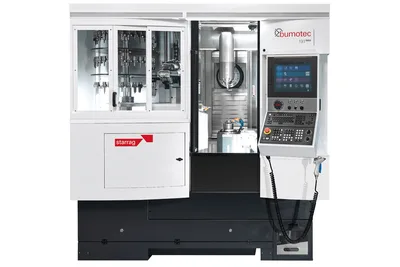
The Starrag SIP 5000 is an ultra-precision 5-axis machining center from Starrag's legendary SIP brand, which has been synonymous with jig boring accuracy since the 1930s in Geneva, Switzerland. The SIP 5000 carries that heritage forward into modern 5-axis simultaneous machining, targeting applications where positional accuracy in the single-micron range is non-negotiable. This is the machine aerospace OEMs and precision instrument makers reach for when tolerances on a DMG Mori or Makino simply are not tight enough.

The SIP 5000 features X/Y/Z travels of 700 x 530 x 500 mm (27.6 x 20.9 x 19.7 in) with a rotary tilting table providing A-axis (+30/-120 degrees) and C-axis (360-degree continuous) for full 5-axis simultaneous capability. The motorized spindle delivers up to 20,000 RPM with an HSK-A63 taper and 28 kW of power. What sets the SIP 5000 apart is its volumetric accuracy: Starrag quotes positioning accuracy of 0.002 mm (2 microns) and repeatability of 0.001 mm (1 micron). These figures are verified under loaded cutting conditions, not just as static measurements with a laser interferometer.

The machine uses hydrostatic guideways on all linear axes, which eliminate stick-slip at very low feed rates and provide vibration damping that ball-bearing linear guides cannot match. This is critical for mirror-finish surface quality on hardened steels and aerospace alloys. The bed is made from natural granite for thermal stability, a hallmark of the SIP tradition. Temperature-controlled oil circulates through the spindle, column, and bed to maintain geometric accuracy over long machining cycles.

The SIP 5000 runs on Heidenhain TNC 640 control, the gold standard for 5-axis contouring applications. Tool capacity is 40 tools standard, expandable to 120. At $900,000 to $1,400,000 for a new unit, the SIP 5000 commands a significant premium over mainstream 5-axis machines, but for shops where micron-level accuracy defines their competitive edge, there is no substitute. Direct competitors include the Yasda YBM Vi40, Kern Micro HD, and Mitsui Seiki PJ 303X5.

03

Full Specifications

Parameter Value
X-Axis Travel 700 mm (27.6 in)
Y-Axis Travel 530 mm (20.9 in)
Z-Axis Travel 500 mm (19.7 in)
A Axis Range +30° / -120° tilting
C Axis Range 360° continuous
Max Spindle Speed 20,000 RPM
Spindle Taper HSK-A63
Spindle Motor Power 28 kW (37.5 hp)
Table Size 630 x 500 mm (24.8 x 19.7 in)
Max Workpiece Weight 500 kg (1,102 lb)
Tool Capacity 40 tools standard (up to 120 optional)
Guideway Type Hydrostatic on all linear axes
Bed Material Natural granite
Positioning Accuracy 0.002 mm (0.00008 in)
Repeatability 0.001 mm (0.00004 in)
CNC Control Heidenhain TNC 640
Machine Weight 14,000 kg (30,865 lb)

Specifications sourced from starrag.com — verified 2026-03-28

04

Strengths & Limitations

Strengths

  • Hydrostatic guideways on all linear axes eliminate stick-slip and provide superior vibration damping, enabling mirror-finish surfaces on hardened steels and difficult aerospace alloys
  • Positioning accuracy of 0.002 mm and repeatability of 0.001 mm place the SIP 5000 in the ultra-precision category, exceeding most mainstream 5-axis machining centers by a factor of 3-5x
  • Natural granite bed provides exceptional thermal stability and vibration absorption, maintaining geometric accuracy over multi-hour machining cycles in temperature-variable shop environments
  • SIP heritage dating to the 1930s means over 90 years of continuous precision engineering refinement — this is not a repurposed high-speed machine, it is purpose-built for accuracy
  • Heidenhain TNC 640 control with advanced 5-axis kinematic compensation provides best-in-class contouring accuracy for complex freeform surfaces
  • Temperature-controlled oil circulation through spindle, column, and bed actively compensates for thermal growth, critical for maintaining micron-level tolerances during extended production runs

Limitations

  • At $900,000-$1,400,000 the SIP 5000 costs 2-3x more than capable 5-axis machines from DMG Mori or Makino, a premium justified only when micron-level accuracy is truly required
  • 500 kg maximum workpiece weight and 700 mm X-travel limit the machine to small-to-medium parts — shops machining large structural aerospace components need a bigger platform
  • Starrag's service network is considerably smaller than major Japanese and German builders in North America, with longer lead times for emergency service calls
  • Hydrostatic guideways require a dedicated hydraulic system and regular oil maintenance, adding operational complexity compared to linear guide machines
05

Best For

Aerospace OEMs machining flight-critical turbine engine components, fuel system housings, and hydraulic manifolds requiring micron-level positional accuracy and bore relationships Precision optics and instrument manufacturers producing mirror-finish surfaces on hardened tool steels and exotic alloys where surface finish and form accuracy are paramount Defense and space industry contractors machining guidance system components, gyroscope housings, and inertial navigation parts with ultra-tight tolerance callouts Medical device manufacturers producing high-precision titanium and cobalt-chrome implant components where regulatory quality requirements demand documented single-micron accuracy High-end die and mold shops producing injection mold cores and cavities for optical-quality plastic parts requiring mirror-polished surfaces directly off the machine
06

Frequently Asked Questions

01 What does a new Starrag SIP 5000 cost?

New SIP 5000 machines typically price between $900,000 and $1,400,000 depending on configuration. Key options that drive price include spindle variants (high-speed vs. high-torque), expanded tool magazine (up to 120 tools), through-spindle coolant, probing systems, and pallet changers. Used SIP 5000 units are rare on the secondary market but when available trade between $400,000 and $700,000 depending on vintage and condition.

02 Why are hydrostatic guideways better than linear guides for precision work?

Hydrostatic guideways float the carriage on a thin film of pressurized oil, eliminating metal-to-metal contact. This provides zero stick-slip at any feed rate (critical for fine finishing passes at very low feeds), superior vibration damping compared to rolling-element guides, and essentially infinite service life since there is no mechanical wear. The trade-off is a dedicated hydraulic system and higher maintenance complexity, but for micron-level work, hydrostatic guides are the gold standard.

03 How does the SIP 5000 compare to a Yasda YBM Vi40?

Both are ultra-precision 5-axis machines targeting similar applications. The SIP 5000 uses hydrostatic guideways and natural granite for its precision approach, while Yasda relies on hand-scraped cast iron ways and proprietary thermal compensation. The SIP 5000 offers slightly larger travels (700 vs 560 mm X) and a higher standard spindle speed. Yasda has a stronger service presence in Asia. Both machines deliver sub-5-micron volumetric accuracy in practice.

04 What industries use the Starrag SIP 5000?

The SIP 5000 is found primarily in aerospace (turbine engine components, fuel systems, hydraulic manifolds), defense (guidance systems, weapons platforms), precision optics, and high-end medical device manufacturing. These industries share the common requirement for documented micron-level accuracy and surface finish quality that cannot be achieved reliably on mainstream machining centers. Some premium watchmaking and scientific instrument companies also use SIP machines.

05 Does the SIP 5000 use a granite or cast iron bed?

The SIP 5000 uses a natural granite bed, continuing a tradition established by SIP Geneva decades ago. Granite provides superior thermal stability compared to cast iron — its coefficient of thermal expansion is roughly half that of cast iron, and granite does not develop internal stresses over time the way cast iron can. Combined with temperature-controlled oil circulation, the granite bed helps maintain geometric accuracy across temperature variations in the shop environment.

06 Can the SIP 5000 be automated for unattended production?

Yes, the SIP 5000 can be equipped with pallet changers and expanded tool magazines (up to 120 tools) for unattended multi-part production. However, given the machine's focus on ultra-precision work, most users run attended operations where an operator monitors cutting conditions and verifies tolerances between parts. Automated loading is more common in medium-batch precision production than in one-off prototype work.

07

Videos

Titanium machining of aerospace parts on Starrag BTP 5000

Titanium machining of aerospace parts on Starrag BTP 5000

Starrag TV

SPC 7120 SIP - Super Precision Machining Center

SPC 7120 SIP - Super Precision Machining Center

Starrag TV

SIP SPC 7140 - Horizontal spindle for highest accuracy

SIP SPC 7140 - Horizontal spindle for highest accuracy

Starrag TV

Starrag offers state-of-the-art production solutions for aerospace turbine casings

Starrag offers state-of-the-art production solutions for aerospace turbine casings

Starrag TV

Efficient finishing of XXL blades on Starrag LX 451

Efficient finishing of XXL blades on Starrag LX 451

Starrag TV

08

Community Discussions

09

Comparisons

10

Related Machines