DMG Mori DMU 50
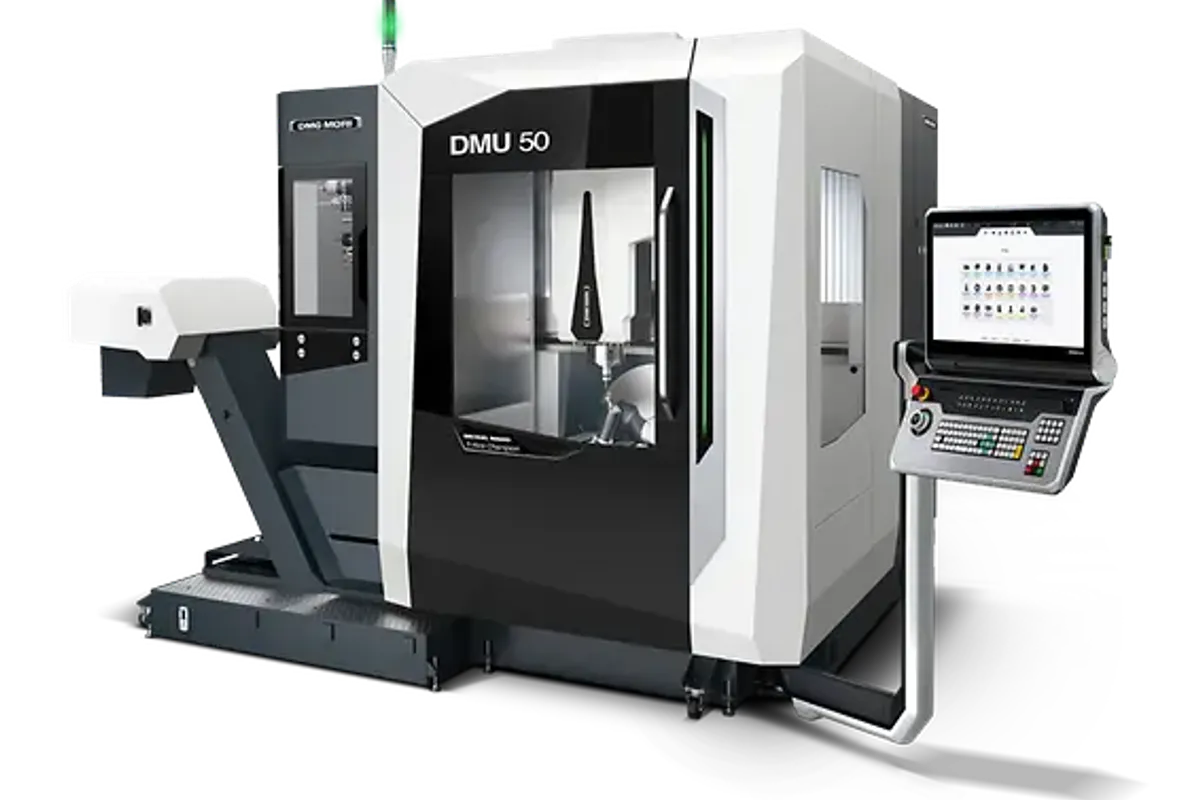
Image: dmgmori.com, DMG Mori
Key Specifications
X Travel
Y Travel
Z Travel
Max Spindle
Tool Capacity
Spindle Power
How much does the DMG Mori DMU 50 cost?
Estimated price range
Our best estimate for a 5-axis machining center in this class — not a quote from DMG Mori. Configuration moves it a long way.
Overview
The DMG MORI DMU 50 3rd Generation is a compact 5-axis machining center built around a swivel rotary table, with 650 × 520 × 475 mm (25.6 × 20.5 × 18.7 in) of X/Y/Z travel. It takes a workpiece up to 630 mm (24.8 in) in diameter and 600 mm (23.6 in) tall, but only up to 300 kg (661.4 lb). For most shops the weight limit, not the travels, is the figure that decides whether a job fits.
The table swivels on its B-axis from -35° to +110°. Going beyond a right angle on the positive side lets the spindle reach slightly undercut faces without a second setup. The 35° on the negative side is enough for clearance moves and shallow angles, not for full access from both directions. DMG MORI also lists cooled table bearings, direct path measuring systems in all axes, direct driven ball screw drives and a one-piece machine bed.
Three speedMASTER spindles are offered. The basic version runs to 15,000 rpm with 28.2 hp and 81.9 ft lb. The first option keeps 15,000 rpm and raises the rating to 61.7 hp and 147.5 ft lb, about 80% more torque, which makes it the one to pick for steel and larger cutters. The second option trades some of that torque for speed: 20,000 rpm with 46.9 hp and 95.9 ft lb, suited to small tools and light alloys.
The basic tool magazine has 30 pockets and is loaded from the front, even while the machine is cutting. Magazines with 60, 120 or 180 pockets are optional, so five-sided work with a long tool list should be quoted with one of those. Further up the range, the DMU 65 FD monoBLOCK 2nd Generation is the next step in envelope at 735 × 650 × 560 mm (28.9 × 25.6 × 22 in) of travel.
Full Specifications
| Parameter | Value |
|---|---|
| Max Workpiece Diameter | 630 mm (24.8 in) |
| Max Workpiece Height | 600 mm (23.6 in) |
| Max Workpiece Weight | 300 kg (661.4 lb) |
| X-Axis Travel | 650 mm (25.6 in) |
| Y-Axis Travel | 520 mm (20.5 in) |
| Z-Axis Travel | 475 mm (18.7 in) |
| Max Spindle Speed | 15,000 rpm (basic version); 20,000 rpm optionally available |
| Spindle Motor Power | 28.2 hp (15,000 rpm, basic version); 61.7 hp (15,000 rpm, optional); 46.9 hp (20,000 rpm, optional) |
| Spindle Torque | 81.9 ft lb (15,000 rpm, basic version); 147.5 ft lb (15,000 rpm, optional); 95.9 ft lb (20,000 rpm, optional) |
| Tool Capacity | 30 pockets (basic version); 60, 120 or 180 pockets optionally available |
| B Axis Swivel | -35° / +110° |
Specifications sourced from dmgmori.com — verified 2026-10-02
Strengths & Limitations
Strengths
- Swivel rotary table with a B-axis range of -35° to +110° for 5-axis simultaneous machining
- Three speedMASTER spindles to choose from: 15,000 rpm with 28.2 hp and 81.9 ft lb in the basic version, a 61.7 hp and 147.5 ft lb option at the same speed, or a 20,000 rpm option
- The 30-pocket magazine of the basic version is loaded from the front, even during machining
- Direct path measuring systems in all axes and direct driven ball screw drives
- Cooled table bearings, a one-piece machine bed and a cooling concept that DMG MORI aims at long-term precision
Limitations
- Workpiece weight tops out at 300 kg (661.4 lb), so a solid steel block that fills the 630 mm (24.8 in) diameter is far too heavy for the table
- Z travel is 475 mm (18.7 in) against a 600 mm (23.6 in) maximum workpiece height, so long tools on tall parts need a clearance check
- The swivel range is lopsided: +110° one way but only -35° the other, so undercut faces have to be presented on the positive side
- The 61.7 hp spindle, the 20,000 rpm spindle and the larger tool magazines are all options; the basic machine has 28.2 hp and 30 pockets
Best For
Frequently Asked Questions
01
Up to 630 mm (24.8 in) in diameter, 600 mm (23.6 in) in height and 300 kg (661.4 lb). The axis travels are 650 mm (25.6 in) in X, 520 mm (20.5 in) in Y and 475 mm (18.7 in) in Z. Weight is usually the first limit reached: add up the part, the vise or fixture and any clamping before committing a job.
02
Three speedMASTER spindles. The basic version is 15,000 rpm with 28.2 hp and 81.9 ft lb. Optionally available are a 15,000 rpm spindle with 61.7 hp and 147.5 ft lb, and a 20,000 rpm spindle with 46.9 hp and 95.9 ft lb. The stronger 15,000 rpm option suits steel and larger cutters; the 20,000 rpm option suits small tools.
03
The B-axis swivels from -35° to +110°. The positive side goes beyond a right angle, which gives access to slightly undercut features. The negative side stops at 35°, so parts that need steep angles from both directions have to be set up with those faces toward the positive side, or rotated with the rotary axis.
04
The basic version has a tool magazine with 30 pockets. It is loaded from the front and can be loaded during machining. Larger magazines with 60, 120 or 180 pockets are optionally available; they are not part of the basic machine, so they need to be on the quotation.
05
The DMU 60 FD eVo is the larger machine, with 750 × 550 × 550 mm (29.5 × 21.7 × 21.7 in) of travel against 650 × 520 × 475 mm (25.6 × 20.5 × 18.7 in) here. The DMU 50 3rd Generation is limited to workpieces of 630 mm (24.8 in) in diameter and 300 kg (661.4 lb), so parts beyond those limits are the reason to look at the larger model.
Videos

DMG MORI

TITANS of CNC MACHINING

Element Engineering Australia

MTD eBusiness
Community Discussions
Comparisons
More from DMG Mori
Other 5-Axis Machining Centers
Quaser MF700 (Flex)
AWEA MVP-7032
Mazak FF-5000/40
TOS Kuřim FRF 350
GF Machining MIKRON MILL P 800 U