Industrial CNC Machine Directory

Hanwha XE26 II

$150,000 - $200,000 Updated 2026-03-16
01

Key Specifications

Rapid Traverse

28 m/min (1,102 ipm)

Accuracy

±0.005 mm

Repeatability

±0.003 mm

max bar capacity

26 mm (1.024 in)

main spindle speed

10,000 RPM

sub spindle speed

8,000 RPM

02

Overview

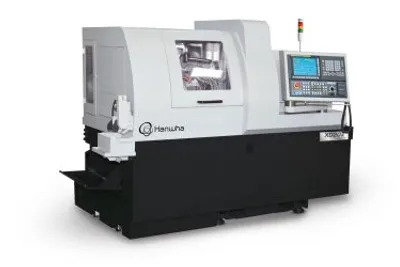
The Hanwha XE26 II is an economy-class 26 mm Swiss-type automatic lathe in Hanwha's XE-series lineup, providing reliable Swiss-type precision in the 26 mm diameter class at a capital cost below the flagship XD26 II. The XE26 II addresses the large segment of the precision turned parts market where 26 mm bar capacity is needed — covering medical screws, automotive shafts, pneumatic fittings, and electronics connector bodies — but where the full 9-axis, 40-tool complexity of the XD26 II exceeds what the part mix actually demands.

The main spindle on the XE26 II runs to 10,000 RPM with 3.7 kW (5 hp) of power, matching the core spindle specification of the XD26 II on the main axis. Sub-spindle speed is 8,000 RPM. The XE26 II operates on a 6-axis configuration — X1, Z1, X2, Z2, and two transverse axes — providing front turning, back turning, cross-drilling, and basic transverse milling without the Y-axis and B-axis capability of the XD-series. Tool count is 24 to 28 stations, configured with front and back turning tools and driven tool positions for the transverse operations.

The guide bushing system and removable guide bushing option follow the Hanwha standard architecture across the XE-series. Positioning accuracy is ±0.005 mm, which is adequate for the majority of 26 mm precision part production outside the tightest medical and aerospace tolerance classes.

Fanuc 0i-F control is standard, providing straightforward programming and operation for the XE-series application range. Pricing for the XE26 II is typically $150,000 to $200,000, representing a meaningful cost reduction compared to the XD26 II at $195,000-$270,000. Competitive alternatives include the Tsugami B0266 and the Hanwha XD26 II for shops deciding between economy and flagship capability.

03

Full Specifications

Parameter Value
Max Bar Capacity 26 mm (1.024 in)
Main Spindle Speed 10,000 RPM
Sub Spindle Speed 8,000 RPM
Main Spindle Power 3.7 kW (5 hp)
Number Of Axes 6 axes
Tool Stations Up to 28 tools
Guide Bushing Standard (removable for non-guide bushing mode)
Travel X1 30 mm (1.18 in)
Travel Z1 200 mm (7.87 in)
Travel X2 30 mm (1.18 in)
Travel Z2 90 mm (3.54 in)
Rapid Traverse Rate 28 m/min (1,102 ipm)
Positioning Accuracy ±0.005 mm
Repeatability ±0.003 mm
CNC Control Fanuc 0i-F
Machine Weight 2,100 kg (4,630 lb)
04

Strengths & Limitations

Strengths

  • 26 mm bar capacity at $150K-$200K is among the most cost-effective entry points for 26 mm Swiss-type production from a established manufacturer
  • 10,000 RPM main spindle and 3.7 kW power match the flagship XD26 II on core spindle specs, providing equivalent cutting performance for the 6-axis application range
  • 6-axis configuration covers the majority of 26 mm Swiss-type production needs including front turning, back turning, cross-drilling, and transverse milling
  • Fanuc 0i-F control is operator-friendly and straightforward to program, reducing the training investment for shops new to Hanwha or Swiss-type production
  • Hanwha US technical support in Elmhurst, IL provides reliable parts and service without the international shipping delays common with smaller import brands
  • Removable guide bushing reduces remnant material waste for shorter part programs in expensive materials

Limitations

  • 6-axis without Y-axis limits off-center milling — parts requiring true Y-axis features or B-axis angular drilling need the XD26 II
  • ±0.005 mm positioning accuracy is lower than XD-series; the tightest medical and aerospace work (requiring ±0.003 mm or better) should use the XD26 II
  • 28-tool maximum may be limiting for complex part families needing extensive tooling; shops should audit tool requirements before committing to XE-series
  • Fanuc 0i-F lacks high-speed look-ahead and advanced macro capability of the 32i-B used on XD-series machines
  • 8,000 RPM sub-spindle (vs 10,000 RPM main) creates a speed mismatch that can limit back-work surface finish on high-RPM back-facing operations
05

Best For

Automotive and industrial manufacturing shops running 26 mm shafts, pins, fittings, and valve bodies where feature complexity is moderate and 6-axis capability is sufficient Medical device contract shops producing standard bone screws and threaded implant components where ±0.005 mm dimensional accuracy meets drawing requirements Mid-size contract shops looking for a cost-effective 26 mm Swiss-type platform to complement a flagship XD-series machine for overflow or secondary part family capacity Shops transitioning from cam-type screw machines at 26 mm who want a straightforward CNC Swiss-type learning curve without maximum-axis complexity
06

Frequently Asked Questions

01 How does the XE26 II compare to the XD26 II for a typical automotive parts shop?

For automotive shafts, pins, and connector bodies with standard turned features and cross-holes, the XE26 II handles 80-90% of the typical automotive Swiss-type part mix at a $45K-$70K lower machine cost. The XD26 II adds Y-axis milling, higher tool count, and tighter positioning accuracy for the remainder of the part mix requiring off-center milling or tighter tolerances. Shops with a defined and relatively simple automotive part family are often better served by two XE26 II machines than one XD26 II at equivalent total investment.

02 Can the XE26 II machine Inconel or titanium?

Titanium and Inconel can technically be machined on the XE26 II, but the 3.7 kW power and absence of high-pressure coolant as standard make these materials challenging at any significant production rate. For shops whose part mix includes titanium or Inconel at 26 mm, the XD26 II with high-pressure coolant option is the appropriate choice. The XE26 II is optimized for free-machining steels, stainless 303, brass, and aluminum.

03 What is the tool change arrangement on the XE26 II?

The XE26 II uses a gang tooling arrangement on X1-Z1 axis rails — tools are preset in fixed positions on the tooling plate and do not rotate or index. Tool selection is achieved by moving the Z1 and X1 axes to bring the appropriate tool into position. This arrangement is simpler and faster than turret-based tool changes, but requires careful tool interference planning during programming.

04 Does the XE26 II support thread whirling?

Thread whirling attachments can be mounted in the live tooling positions on the XE26 II. The 6-axis configuration supports thread whirling for standard bone screw thread forms. Shops requiring thread whirling should specify the appropriate driven tool mounting configuration when ordering. Thread whirling is a proven cycle time reducer for high-volume screw production even on economy-tier Swiss-type machines.

05 What is the realistic cycle time for a simple 26 mm pin on the XE26 II?

A simple turned pin (26 mm diameter, 50 mm length, OD turned, faced both ends via sub-spindle) typically runs in 15-25 seconds on the XE26 II depending on material and surface finish requirements. Adding cross-holes and chamfers extends this to 30-45 seconds. Complex parts with extensive milling, threading, and multiple diameter changes may run 60-120 seconds. These cycle times are broadly comparable to the XD26 II for the 6-axis operations both machines share.

07

Videos

Hanwha XD 20/26II Sliding Head CNC Lathe

Hanwha XD 20/26II Sliding Head CNC Lathe

Dugard

Hanwha XD20/26III Sliding Head CNC Lathe Available at Dugard UK

Hanwha XD20/26III Sliding Head CNC Lathe Available at Dugard UK

Dugard

Hanwha XE  Series Sliding Head CNC Lathe

Hanwha XE Series Sliding Head CNC Lathe

Dugard

New stock machine just landed - Hanwha sliding head lathe

New stock machine just landed - Hanwha sliding head lathe

MTDCNC

Hanwha XV20/26 Sliding Head CNC Lathe Available at Dugard UK

Hanwha XV20/26 Sliding Head CNC Lathe Available at Dugard UK

Dugard

08

Community Discussions

Practical Machinist

CNC Machining | experience with Hanwha swiss lathe ...

Owner experience and review — experience with Hanwha swiss lathe ...

Practical Machinist

General | OT - Looking for a part for a Hanwha SL26HP ...

Pricing and buying discussion — OT - Looking for a part for a Hanwha SL26HP ...

Practical Machinist

CNC Machining | Hanwha XP32S - Practical Machinist

Community discussion — Hanwha XP32S - Practical Machinist

Practical Machinist

Hanwha XD42 swiss long part re-chucking - Practical Machinist

Owner experience and review — Hanwha XD42 swiss long part re-chucking - Practical Machinist

CNCZone

Offering help with Emmegi CamPlus, Drill, and Shape - CNCzone

Community discussion — Offering help with Emmegi CamPlus, Drill, and Shape - CNCzone

CNCZone

CamWorks - CNCzone

Community discussion — CamWorks - CNCzone

CNCZone

Need Help! Changing S/N setting 26 to cancel alarm 144 - CNCzone

Pricing and buying discussion — Need Help! Changing S/N setting 26 to cancel alarm 144 - CNCzone

CNCZone

Help with emmegi software - CNCzone

Troubleshooting and problem-solving — Help with emmegi software - CNCzone

Reddit

Vise recommendations? Best for the money : r/Machinists - Reddit

Community discussion — Vise recommendations? Best for the money : r/Machinists - Reddit

Reddit

Milling machine advice : r/Machinists - Reddit

Community discussion — Milling machine advice : r/Machinists - Reddit

Reddit

benchtop lathe/mill recommendations? : r/Machinists - Reddit

Options and configuration advice — benchtop lathe/mill recommendations? : r/Machinists - Reddit

Reddit

experience with Xometry? : r/Machinists - Reddit

Pricing and buying discussion — experience with Xometry? : r/Machinists - Reddit

Links to community discussions. Summaries are editorial — visit the original thread for full context.

09

Related Machines