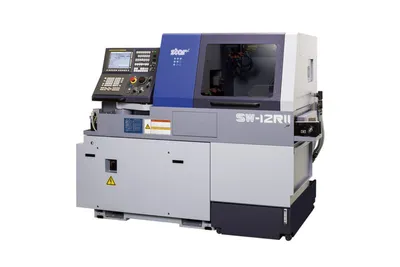
Hanwha XE20 II
Key Specifications
Max Spindle
Spindle Power
sub spindle speed
number of axes
travel z1
control
How much does the Hanwha XE20 II cost?
Estimated price range
Our best estimate for a swiss-type lathe in this class — not a quote from Hanwha Precision Machinery. Configuration moves it a long way.
Overview
The Hanwha XE20 II is a 6-axis Swiss-type lathe for stock up to 20 mm (0.79 in), with a 10,000 rpm main spindle, an 8,000 rpm sub spindle and the Hanwha Fanuc-i control. Hanwha lists it in five types, H, N, NH, J and Ne, and the Z1 travel is different for most of them.
The H and J types have 210 mm of Z1 travel. The N and Ne types have 60 mm. The NH type is listed with two figures, 160 mm (H) and 50 mm (N). That spread, from 50 mm to 210 mm, is the widest variable on the machine, so part length should pick the type before anything else is compared.
Spindle power is 2.2/3.7 kW on the main and 1.5/2.2 kW on the sub. The tool layout is 6 OD tools on □12 mm shanks, 5 front tools (ER16M, Ø25) and 4 cross drill tools in ER16, with live tools at up to 6,000 rpm and 1.0 kW. The back tool block holds 4 ER16 tools in one of two forms: 2 fixed + 2 driven, or 4 fixed. A machine with the all-fixed block cannot mill or cross-drill the back of the part, which is worth checking on a stock machine.
Compared with the XD20 II, which shares the 20 mm capacity, 10,000 rpm speed and tool counts, the XE20 II is lighter at 2,500 kg (5,512 lb) against 2,700 kg (5,952 lb), and the XD20 II adds the option of a Siemens 828D control. The XE20 II measures 2,260 × 1,240 × 1,670 mm (89.0 × 48.8 × 65.7 in) and is listed at 15 kVA, 10 kW.
Full Specifications
| Parameter | Value |
|---|---|
| Sub Spindle Speed | 8,000 rpm |
| Number of Axes | 6 axes |
| Travel Z1 | 210 mm (H type) / 60 mm (N type) / 160 mm (H), 50 mm (N) (NH type) / 210 mm (J type) / 60 mm (Ne type) |
| CNC Control | Hanwha Fanuc-i |
| Machine Weight | 2,500 kg (5,512 lb) |
| Max Machining Diameter | 20 mm (0.79 in) |
| Max Spindle Speed | 10,000 rpm |
| Spindle Motor Power | 2.2/3.7 kW |
| OD Tools | 6 (□12 mm) |
| Front Tools | 5 (ER16M, Ø25) |
| Cross Drill Tools | 4 (ER16) |
| Live Tool Speed | 6,000 rpm |
| Live Tool Power | 1.0 kW |
| Sub Spindle Power | 1.5/2.2 kW |
| Back Tools | 4 (ER16) (2 fixed + 2 driven) / 4 (ER16) (4 fixed) |
| Floor Space Required | 2,260 × 1,240 × 1,670 mm (89.0 × 48.8 × 65.7 in) |
| Power Consumption | 15 kVA, 10 kW |
Specifications sourced from hanwhamachinery.com — verified 2026-10-03
Strengths & Limitations
Strengths
- Five types (H, N, NH, J, Ne) covering Z1 travel from 50 mm to 210 mm
- 10,000 rpm main spindle and 8,000 rpm sub spindle
- 6 OD tools on □12 mm shanks, 5 front tools (ER16M, Ø25) and 4 ER16 cross drill tools
- Lighter than the XD20 II: 2,500 kg (5,512 lb) against 2,700 kg (5,952 lb)
- Listed at 15 kVA, 10 kW on a 2,260 × 1,240 × 1,670 mm (89.0 × 48.8 × 65.7 in) footprint
Limitations
- Live tool power is 1.0 kW, so driven work is limited to small drills and light milling
- One back tool configuration is 4 fixed tools with no driven positions
- N and Ne types have only 60 mm of Z1 travel
- Only the Hanwha Fanuc-i control is listed; the XD20 II also offers a Siemens 828D
Best For
Frequently Asked Questions
01
Hanwha lists five, set apart in the table by Z1 travel: H type 210 mm, N type 60 mm, NH type 160 mm (H) and 50 mm (N), J type 210 mm and Ne type 60 mm. The table gives no other description of the letters, so ask what else changes between types when requesting a quotation.
02
The XE26 II takes 26 mm (1.02 in) stock, runs its main spindle to 8,000 rpm with 2.2/5.5 kW and has 5 OD tools on □16 mm shanks. The XE20 II takes 20 mm (0.79 in), runs to 10,000 rpm with 2.2/3.7 kW and has 6 OD tools on □12 mm shanks. Weight, footprint and the remaining tooling are listed the same.
03
Only with the right back tool block. Hanwha lists two: 4 ER16 tools as 2 fixed + 2 driven, or 4 ER16 tools all fixed. The sub spindle itself runs to 8,000 rpm with 1.5/2.2 kW.
04
The footprint is 2,260 × 1,240 × 1,670 mm (89.0 × 48.8 × 65.7 in), the weight 2,500 kg (5,512 lb) and the listed power consumption 15 kVA, 10 kW.
Videos

MTDCNC

Surplex
CNC Exchange
Dugard
More from Hanwha Precision Machinery
Other Swiss-Type Lathes
DMG Mori SPRINT 32|8
Tsugami BO326
Nexturn SA45XIII
Tsugami P036W