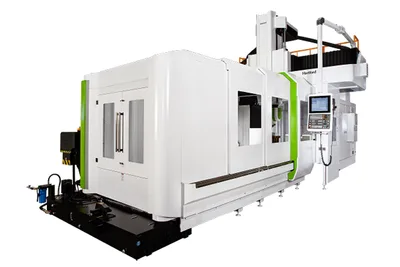
GF Machining Liechti Turbomill 800g
Key Specifications
Max Spindle
Spindle Taper
Tool Capacity
Weight
Rapid Traverse
Spindle Power
How much does the GF Machining Liechti Turbomill 800g cost?
Estimated price range
Our best estimate for a 5-axis machining center in this class — not a quote from GF Machining Solutions. Configuration moves it a long way.
Overview
The Liechti Turbomill 800g is a single-spindle 5-axis simultaneous machine listed with an 800 mm work zone and a 450 mm maximum part diameter. Unlike most Turbomill entries on this site, its table also lists turning limits, 450 mm in diameter and 800 mm in length, matching the milling envelope. The figures are listed values only; they have not been checked against a current Liechti or GF Machining Solutions specification.
The spindle runs to 20,000 rpm on HSK-A63 and is rated 50 kW (67 hp) and 150 Nm. The magazine holds 40 tools. That is a torque-oriented spindle by the standards of these listings, suited to parts where roughing and finishing happen in the same setup.
The closest sibling, the Liechti Turbomill 800i, shares the 800 mm work zone, the 50 kW, 150 Nm spindle, the 40 tools and the 20,000 kg weight, but is listed for 400 mm parts and has no turning rows. On paper, then, the 800g offers the larger diameter and the turning capability for the same footprint weight. Ask the supplier to confirm both points, since the table does not explain the g and i suffixes.
The listed weight is 20,000 kg (44,092 lb). Rapids are 30 m/min, positioning is given as 0.004 mm, coolant runs through the spindle at 80 bar, and the control is a Siemens Sinumerik 840D sl with Liechti Turbosoft+ CAM.
Full Specifications
| Parameter | Value |
|---|---|
| Workzone Length | 800 mm |
| Max Part Diameter | 450 mm (17.7 in) |
| Number of Axes | 5-axis simultaneous |
| Max Spindle Speed | 20,000 RPM |
| Spindle Taper | HSK-A63 |
| Spindle Motor Power | 50 kW (67 hp) |
| Spindle Torque | 150 Nm |
| Spindle Configuration | Single spindle |
| Tool Capacity | 40 |
| Rapid Traverse Rate | 30 m/min (1,181 ipm) |
| Positioning Accuracy | 0.004 mm (4 µm) |
| CAM Software | Liechti Turbosoft+ |
| CNC Control | Siemens Sinumerik 840D sl |
| Coolant System | High-pressure through-spindle (80 bar) |
| Machine Weight | 20,000 kg (44,092 lb) |
| Max Turning Diameter | 450 mm |
| Max Turning Length | 800 mm |
Specifications compiled from manufacturer literature and industry references. Not independently verified against a published spec sheet — confirm with the manufacturer or an authorised dealer before making a purchasing decision.
Strengths & Limitations
Strengths
- Turning limits of 450 mm diameter and 800 mm length are listed alongside 5-axis milling
- 450 mm part diameter, against 400 mm on the Liechti Turbomill 800i
- 20,000 rpm HSK-A63 spindle with 50 kW and 150 Nm
- 40-tool magazine and 80 bar through-spindle coolant
Limitations
- 800 mm work zone length limits part length; longer parts need the Liechti Turbomill 1400g at 1400 mm
- Rapid traverse of 30 m/min is modest for long toolpaths
- The table is unconfirmed and does not explain the turning capability, so verify it in writing
- 20,000 kg (44,092 lb) needs a foundation check
Best For
Frequently Asked Questions
01
Its table lists a maximum turning diameter of 450 mm and a maximum turning length of 800 mm, which indicates turning capability. The table is not confirmed against a current manufacturer sheet, so ask the supplier to state the turning speed and the workholding before relying on it.
02
On the listed figures, the Liechti Turbomill 800i takes parts up to 400 mm in diameter and has no turning rows. The Turbomill 800g takes 450 mm and lists turning limits. Both have an 800 mm work zone, a 50 kW, 150 Nm spindle at 20,000 rpm, 40 tools and 20,000 kg of machine.
03
The Liechti Turbomill 800g Twin is listed with two independent spindles of 50 kW each, 60 tools split 30 per spindle and 28,000 kg of machine. The Liechti Turbomill 800g Twin's maximum part diameter is 300 mm, against 450 mm on this single-spindle machine.
04
Positioning accuracy is listed as 0.004 mm (4 µm). The table gives no repeatability, test standard or thermal conditions, so request the acceptance test protocol before planning tight tolerances around that figure.
More from GF Machining Solutions
GF Machining MIKRON MILL P 800 U ST
GF Machining Liechti g-Mill 850
GF Machining Liechti Turbomill 2000gx
GF Machining Mikron MILL E 1400 U
GF Mikron MILL S 200 U
GF Machining MIKRON MILL S 600 U
Other 5-Axis Machining Centers
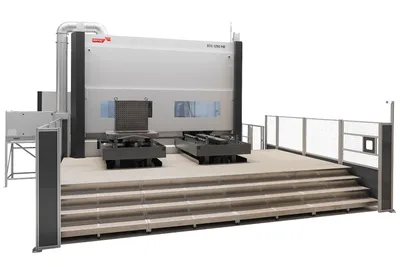
Starrag S1250 HD
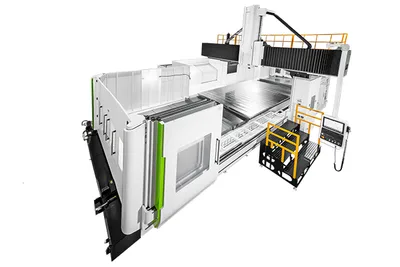
Hartford HSA-546AAC
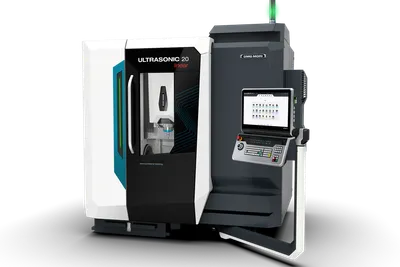
DMG Mori ULTRASONIC 20 linear 3rd Generation
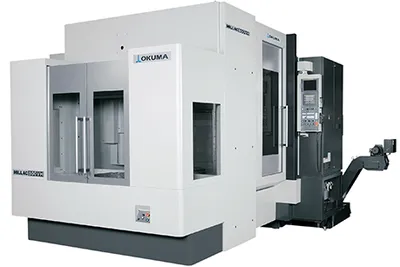
Okuma MILLAC 800VH
AWEA LP-4025YZF