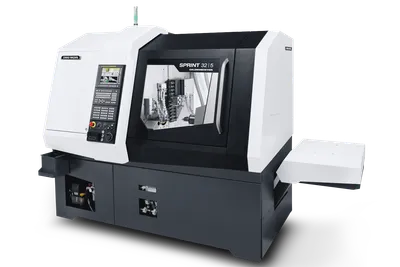
DMG Mori SPRINT 32|9
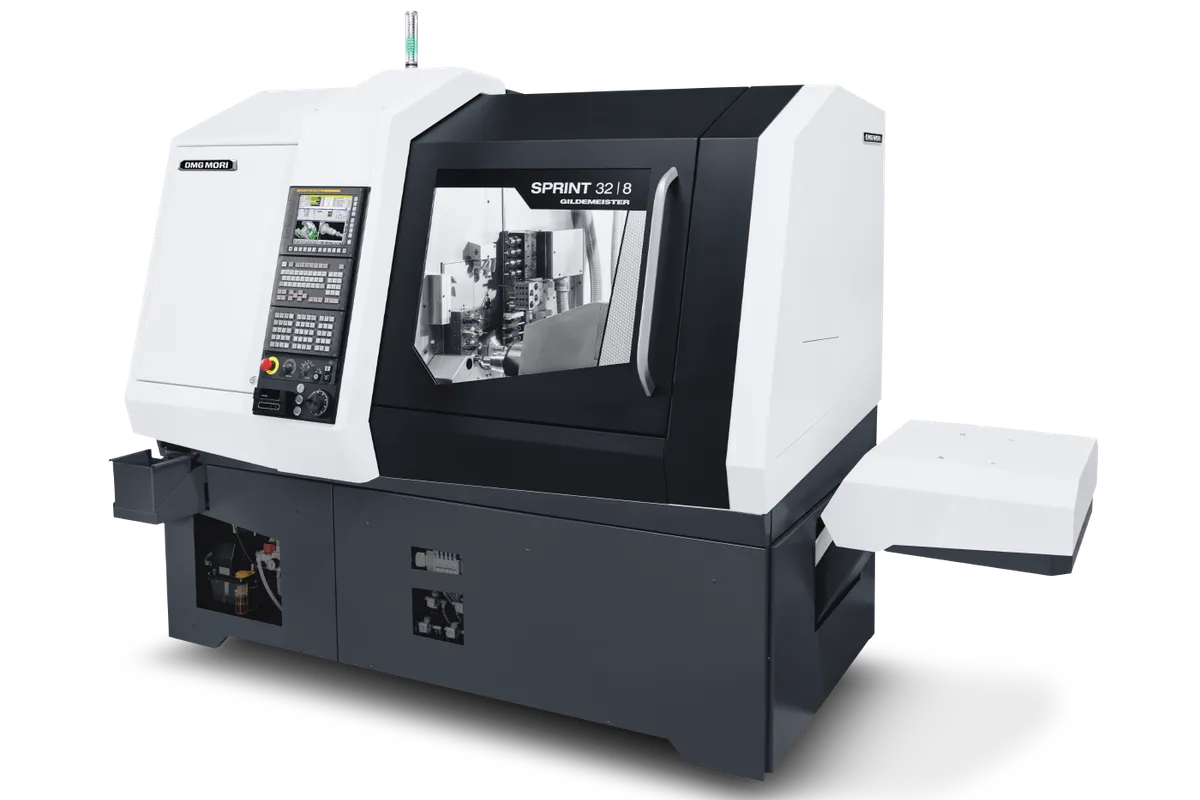
Image: dmgmori.com, DMG Mori
Key Specifications
X Travel
Y Travel
Z Travel
Max Spindle
Tool Capacity
Spindle Power
How much does the DMG Mori SPRINT 32|9 cost?
Estimated price range
Our best estimate for a swiss-type lathe in this class — not a quote from DMG Mori. Configuration moves it a long way.
Overview
A B axis is what the DMG MORI SPRINT 32|9 adds to a 32 mm (1.3 in) bar automatic. DMG MORI describes the machine as 6 linear axes, 2 C-axes and 1 B axis, run from a FANUC 31i-B5 Plus control, with a main and a counter spindle that both reach 8,500 rpm.
On a bar machine a B axis earns its place on features that are neither axial nor radial: inclined holes, angled flats, chamfers on cross-bores. A tool is swung to the angle of the feature, where a lathe without the axis needs an angled holder for every angle on the drawing. The Highlights do not give the swivel range, so ask for it if a part has steep angles.
Whatever the angle, the cut is made by the driven tools, and those are small: 6,000 rpm, 3 Nm and 1 kW. Of the 41 tool stations in total, 8 are driven as standard. Plan angled features around small drills and end mills.
Turning power sits mostly on the main spindle, at 40.4 Nm and 5.5 kW. The counter spindle is rated 14 Nm and 2.2 kW. Both have integrated motors and direct measuring systems, and the control's 2 channels let up to 2 tools cut simultaneously.
Parts can be up to 240 mm (9.4 in) long. The SWISSTYPEkit, which allows short and long part turning on one machine, is optional. Travels of 70 mm (2.8 in), 405 mm (15.9 in) and 100 mm (3.9 in) in X, Y and Z are the same as on the SPRINT 32|8, so the choice between the two does not turn on envelope.
Full Specifications
| Parameter | Value |
|---|---|
| X-Axis Travel | 70 mm (2.8 in) |
| Y-Axis Travel | 405 mm (15.9 in) |
| Z-Axis Travel | 100 mm (3.9 in) |
| Max Workpiece Diameter | 32 mm (1.3 in) |
| Max Workpiece Length | 240 mm (9.4 in) |
| Max Bar Capacity | 32 mm (1.3 in) |
| Driven Tool Stations | 8 driven tool stations as standard |
| CNC Control | FANUC 31i-B5 Plus |
| Driven Tool Speed | 6,000 rpm, 3 Nm, 1 kW |
| Max Spindle Speed | 8,500 rpm (main spindle) |
| Spindle Motor Power | 5.5 kW (main spindle) |
| Spindle Torque | 40.4 Nm (main spindle) |
| Sub Spindle Speed | 8,500 rpm, 14 Nm, 2.2 kW (counter spindle) |
| Tool Capacity | Total of 41 tool stations |
| Controlled Axes | 6 linear axes, 2 C-axis and 1 B axes |
Specifications sourced from dmgmori.com — verified 2026-10-02
Strengths & Limitations
Strengths
- 1 B axis in addition to 6 linear axes and 2 C-axes, for angled drilling and milling without special holders
- Main spindle with 8,500 rpm, 40.4 Nm and 5.5 kW
- 41 tool stations in total, with 8 driven tool stations as standard
- FANUC 31i-B5 Plus with 2 control channels; up to 2 tools working simultaneously
- Counter spindle also reaches 8,500 rpm, with an integrated motor and direct measuring system
Limitations
- Driven tool spindles give 3 Nm and 1 kW at 6,000 rpm, which limits the size of angled features
- Counter spindle is rated 14 Nm and 2.2 kW against 40.4 Nm and 5.5 kW on the main spindle
- DMG MORI's Highlights do not state the B axis swivel range
- SWISSTYPEkit and the Tool Monitoring System with graphical tool load display are both options
Best For
Frequently Asked Questions
01
It lets a tool be set at an angle to the part, so inclined holes and angled surfaces can be machined in the same cycle as the turning. DMG MORI lists the machine with 6 linear axes, 2 C-axes and 1 B axis. The swivel range is not given in the Highlights, and the driven tools that do the cutting are rated 6,000 rpm, 3 Nm and 1 kW.
02
The main spindle runs at 8,500 rpm with 40.4 Nm and 5.5 kW. The counter spindle runs at 8,500 rpm with 14 Nm and 2.2 kW. Both are integrated spindle motors with direct measuring systems. Bar capacity is 32 mm (1.3 in).
03
DMG MORI presents it as an automatic turning machine. The SWISSTYPEkit, described as allowing short and long part turning on one machine, is an option, so whether a given machine can run long parts that way depends on how it was ordered. Maximum workpiece length is 240 mm (9.4 in).
04
A total of 41 tool stations. 8 driven tool stations are standard, with driven tool spindles at 6,000 rpm, 3 Nm and 1 kW. Up to 2 tools can work simultaneously.
05
A FANUC 31i-B5 Plus, with a 10.4 in colour display on the control panel. It manages 2 control channels, 6 linear axes, 2 C-axes and a B axis. Tool monitoring with a graphical tool load display can be added as an option.
Videos

Machinery Marketing International

MachineryValues Inc
More from DMG Mori
Other Swiss-Type Lathes
Citizen Cincom B12E-II