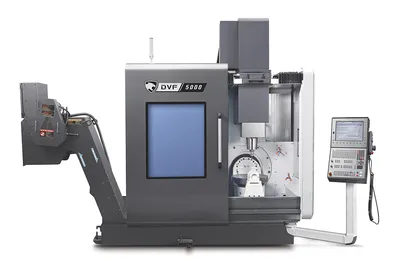
Victor Vcenter-A5
Key Specifications
X Travel
Y Travel
Z Travel
Max Spindle
Spindle Taper
Tool Capacity
Overview
The Victor Vcenter-A5 is a 5-axis vertical machining center from Victor Taichung Machinery Works, one of Taiwan's heritage machine tool manufacturers with over six decades of production experience. The Vcenter-A5 represents Victor's entry into simultaneous 5-axis machining — a significant step up in capability from the company's 3-axis VMC lines — targeting Taiwanese and export customers who need simultaneous 5-axis capability at a price substantially below European 5-axis machining centers from DMG Mori, Hermle, or Chiron.
The Vcenter-A5 uses a trunnion-style 5-axis configuration with a tilting rotary table (A+C axes) mounted on the standard X/Y/Z VMC platform. This arrangement is common among Taiwanese 5-axis VMC builders and provides a practical, cost-effective path to simultaneous 5-axis capability for parts that fit within the trunnion table's working envelope. The trunnion design is mechanically simpler than swivel-head configurations and delivers good thermal stability, making it suitable for production machining of aerospace and medical components where 5-axis interpolation is needed for complex sculptured surfaces and undercut features.
The spindle is a 15,000 RPM BT 40 or HSK-A63 unit producing 18.5 kW — appropriate for the aluminum aerospace and precision medical work that represents the primary application for 5-axis machining at this price tier. X/Y/Z travels of 560 x 500 x 450 mm define the 3-axis envelope before the A and C axis rotations expand access to part features. The A axis tilts ±110 degrees and the C axis rotates 360 degrees, providing full access to five-sided and complex sculptured geometries in a single setup. A 24-tool ATC completes the standard configuration.
Control options include Fanuc 30i-B5 as standard, with Heidenhain TNC 640 as an option for die-mold and aerospace buyers who prefer the Heidenhain programming environment for 5-axis surface programs. Victor's Vcenter-A5 is positioned at approximately $180,000–$280,000 depending on spindle, control, and options — well below DMG Mori DMU 50 or Hermle C 400 territory while delivering credible simultaneous 5-axis capability for Taiwanese-manufactured machines.
Full Specifications
| Parameter | Value |
|---|---|
| X-Axis Travel | 560 mm (22.0 in) |
| Y-Axis Travel | 500 mm (19.7 in) |
| Z-Axis Travel | 450 mm (17.7 in) |
| A Axis Tilt | ±110° |
| C Axis Rotation | 360° (continuous) |
| Max Spindle Speed | 15,000 RPM |
| Spindle Taper | BT 40 (HSK-A63 option) |
| Spindle Motor Power | 18.5 kW (24.8 hp) |
| Table Size | Trunnion table 500 mm dia. (19.7 in) |
| Max Workpiece Weight | 200 kg (441 lb) on trunnion |
| Tool Capacity | 24 (arm-type ATC) |
| Tool Change Time | 2.0 sec (tool-to-tool) |
| Rapid Traverse Rate | 36 m/min (X/Y/Z); 30 rpm (A); 60 rpm (C) |
| Guideway Type | Linear roller guideways |
| Positioning Accuracy | ±0.005 mm (linear); ±5 arcsec (rotary) |
| Repeatability | ±0.003 mm (linear); ±3 arcsec (rotary) |
| CNC Control | Fanuc 30i-B5 (Heidenhain TNC 640 option) |
| Machine Weight | 8,500 kg (18,739 lb) approx. |
| Manufacturer | Victor |
| Spindle Bore | 152.91 mm |
| Model | 1640S |
Specifications sourced from machinio.com — verified 2026-03-28
Strengths & Limitations
Strengths
- Simultaneous 5-axis capability at $180,000–$280,000 is significantly below DMG Mori DMU 50 (~$350,000+) or Hermle C 400 (~$500,000+), providing genuine 5-axis interpolation for manufacturers that cannot justify European-brand capital investment
- Trunnion A+C axis design delivers good thermal and mechanical stability for 5-axis production machining — thermally stable relative to swivel-head designs because the spindle remains in a fixed orientation relative to the machine column
- Fanuc 30i-B5 control provides full 5-axis simultaneous interpolation, RTCP (rotary tool center point compensation), and tool-axis vector control required for production 5-axis programs generated by CAM systems
- Victor's 60+ years of machine tool manufacturing in Taiwan provides a meaningful production experience base that newer 5-axis entrants lack — the Vcenter-A5 benefits from Victor's established spindle and linear axis supply chain
Limitations
- 200 kg trunnion table load limit constrains workpiece size and weight — aerospace structural parts and large mold cores that are heavy for their size may exceed this limit, requiring careful fixture weight management
- Victor's 5-axis service capability and application engineering support is less mature than the company's 3-axis VMC expertise — buyers should verify that their regional Victor dealer has qualified 5-axis application support before purchase
- ±5 arcsec rotary positioning accuracy is adequate for many aerospace applications but less precise than the ±2–3 arcsec achieved by premium 5-axis machines from Hermle, DMG Mori NTX, and Grob — shops with the most demanding 5-axis angular accuracy requirements should evaluate higher-specification machines
Best For
Frequently Asked Questions
01
3+2 machining uses the A and C rotary axes to position the workpiece at a fixed angle, then executes the cutting program in 3-axis linear motion at that fixed orientation. Simultaneous 5-axis interpolates all five axes (X, Y, Z, A, C) continuously during cutting, enabling the tool to follow complex curved surfaces while maintaining a consistent tool-to-surface angle. The Vcenter-A5 supports both: 3+2 is available on any 5-axis machine as a positioning mode, while simultaneous 5-axis interpolation requires the Fanuc 30i-B5 or Heidenhain TNC 640 with the appropriate 5-axis software options active.
02
The Vcenter-A5 is compatible with all major CAM systems that output 5-axis G-code or direct Fanuc/Heidenhain post-processors, including Mastercam, Hypermill, PowerMill, NX CAM, Fusion 360, and SolidCAM. For production 5-axis work, a purpose-built 5-axis post-processor verified on the specific machine is essential — Victor's application team or the dealer can provide or recommend tested post-processors for major CAM platforms. Post-processor verification with a known test part is strongly recommended before committing the machine to production programs.
03
Trunnion table (A+C) 5-axis places the rotary motion in the table rather than the spindle head. This keeps the spindle in a fixed vertical orientation, which simplifies thermal stability and spindle speed management. The limitation is that workpiece size is constrained by the trunnion table diameter and weight capacity. Swivel-head (B+C or A+B) 5-axis keeps the table fixed and tilts the spindle, allowing larger, heavier workpieces. For smaller precision components (medical, small aerospace), trunnion is generally preferred; for large structural parts, swivel-head or gantry 5-axis is more appropriate.
04
RTCP (Rotary Tool Center Point, also called TCPC or TCP) is a control function that automatically compensates for the offset between the tool tip and the rotary axis center as the A and C axes move. Without RTCP, a 5-axis program would need to manually calculate and compensate for this geometry in every line of G-code, making CAM programming prohibitively complex. With RTCP active on the Fanuc 30i-B5, the CAM system programs in part coordinates and the control automatically handles the kinematic transformation. RTCP is essential for practical simultaneous 5-axis machining and is standard on the Vcenter-A5.
05
Victor Taichung sells through authorized dealers in North America, Europe, and Asia. North American buyers should contact Victor's North American importer for current dealer listings and demo availability. Victor's 5-axis machines have been exhibited at IMTS and other North American trade shows, providing exposure to the US market. As with most Taiwanese brands, service coverage in North America depends on regional dealer quality — thorough dealer evaluation before purchase is particularly important for 5-axis machines where application support and programming assistance are frequently needed.
Videos

Bowland Trading Ltd supplying Used Machine Tools
JS PRECISION CO

OKK USA Corporation

Apex Auctions

Guangzhou Haozhi Industrial Co.,Ltd.
Related Machines
DMG Mori DMU 50
Haas UMC-750
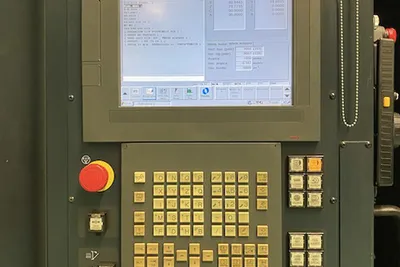
Makino D500
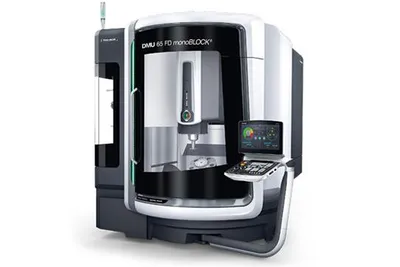
DMG Mori DMU 65 monoBlock
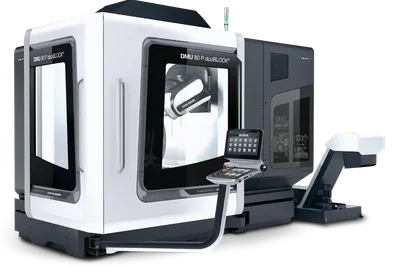
DMG Mori DMU 80P duoBLOCK