Trumpf TruLaser Weld 5000
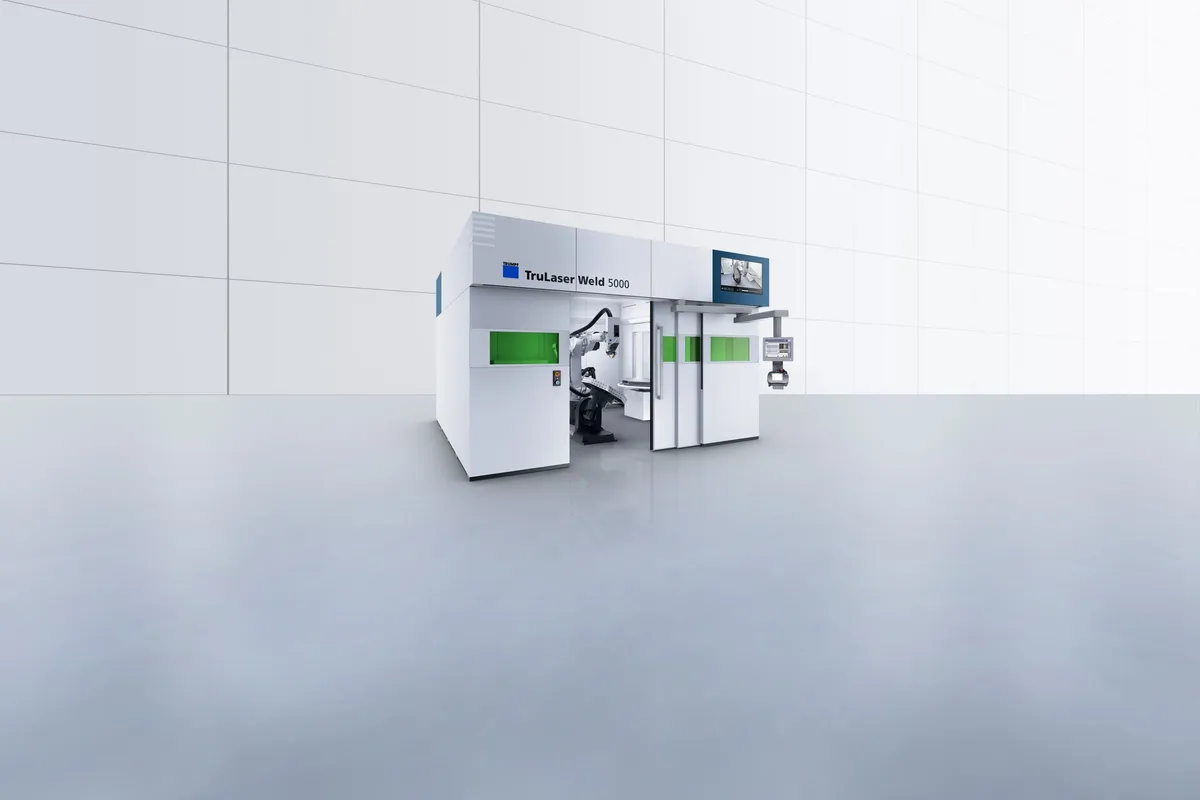
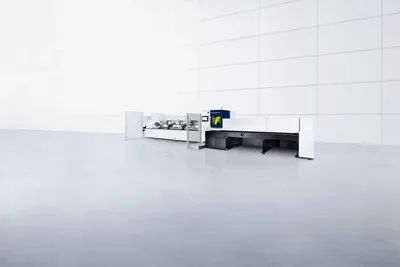
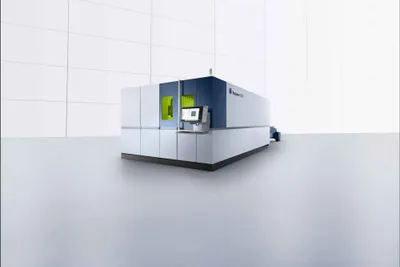
Image: trumpf.com, TRUMPF
Key Specifications
Repeatability
robot type
robot carrying capacity
robot repeatability
brightline scan frequency
gap bridging
How much does the Trumpf TruLaser Weld 5000 cost?
Estimated price range
Our best estimate for a cnc laser cutting machine in this class — not a quote from TRUMPF. Configuration moves it a long way.
Overview
The Trumpf TruLaser Weld 5000 is a robot laser welding cell: a high accuracy robot with six axes, a nominal carrying capacity of 70 kg (154 lb) and a repeatability of +/- 0.05 mm, working inside a cabin with a TruFiber 3,001 or TruFiber 6,001 laser. Heat conduction welding, deep penetration welding and FusionLine are all available on the one machine.
FusionLine is the process to look at if your parts do not fit up perfectly, since gap bridging is listed at up to 1 mm. That figure tells you how much the upstream cutting and bending may vary before a joint has to be reworked. Beam oscillation of up to 2,000 Hz is listed under BrightLine.
Two positioner layouts are described. With rotate-and-tilt positioning the work area is 2,000 x 1,000 x 1,200 mm (78.7 × 39.4 × 47.2 in). With the rotary table it is 2,600 mm in length by 1,200 mm in diameter, and the table carries 750 kg per side. A per-side rating and a rotation of ± 180 ° in 3.7 s describe a table with two stations, where one side is loaded at the 885 mm insertion height while the other is in the beam. The vertical rotary axes cover ± 190 ° in 2.5 s.
Two further load figures appear without saying which positioner they belong to: a maximum loading of 600 kg and a maximum workpiece weight of 400 kg (882 lb). Settle with Trumpf which applies to the configuration you intend to order. The cabin ranges from 4,800 x 3,650 x 3,215 mm to 9,400 x 5,950 x 3,215 mm, so floor space depends heavily on that choice too. Programming is done offline in TruTops Weld, in parallel with production.
Full Specifications
| Parameter | Value |
|---|---|
| Robot Type | High accuracy robot |
| Robot Carrying Capacity | 70 kg nominal |
| Robot Repeatability | +/-0.05 mm |
| Brightline Scan Frequency | Up to 2,000 Hz beam oscillation |
| Gap Bridging | Up to 1 mm (FusionLine) |
| Work Area Rotate Tilt | 2,000 x 1,000 x 1,200 mm |
| Work Area Rotary Table | 2,600 mm length x 1,200 mm diameter |
| Rotary Table Load | 750 kg per side |
| Cabin Dimensions Range | 4,800 x 3,650 x 3,215 mm to 9,400 x 5,950 x 3,215 mm |
| Num Axes | 6 |
| Nominal Carrying Capacity | 70 kg |
| Repeatability | +/- 0.05 mm |
| Maximum Work Area | 2000 mm x 1000 mm x 1200 mm |
| Maximum Loading | 600 kg |
| Max Work Area | 2,000 × 1,000 × 1,200 mm (78.7 × 39.4 × 47.2 in) |
| Maximum Load Mass Moment of Inertia | 600 kg*m² |
| Rotation Area of Rotary Table | ± 180 ° |
| Rotation Time of Rotary Table | 3.7 s |
| Insertion Height | 885 mm |
| Rotation Area of Vertical Rotary Axes | ± 190 ° |
| Rotation Time of Rotary Axes | 2.5 s |
| Parallel Programming | With the simple TruTops Weld offline programming system |
| Number of Axes | 6 |
| Robot Payload | 70 kg (154 lb) |
| Laser Type | TruFiber 3,001 / 6,001 |
| Max Workpiece Weight | 400 kg (882 lb) |
Specifications sourced from trumpf.com — verified 2026-10-03
Strengths & Limitations
Strengths
- Heat conduction welding, deep penetration welding and FusionLine on one machine
- Gap bridging of up to 1 mm with FusionLine
- Robot with six axes, 70 kg (154 lb) nominal carrying capacity and +/- 0.05 mm repeatability
- Rotary table carries 750 kg per side and turns ± 180 ° in 3.7 s
- Offline programming with TruTops Weld runs in parallel with production
- A rotary module for shield gas guidance improves access to the part
Limitations
- The cabin starts at 4,800 x 3,650 x 3,215 mm and reaches 9,400 x 5,950 x 3,215 mm
- Workpiece weight is listed at 400 kg (882 lb) and maximum loading at 600 kg, without saying which positioner each applies to
- The work area with rotate-and-tilt positioning is limited to 2,000 x 1,000 x 1,200 mm (78.7 × 39.4 × 47.2 in)
- The lasers are named, TruFiber 3,001 / 6,001, but no welding depth or seam speed is listed
Best For
Frequently Asked Questions
01
Heat conduction welding, deep penetration welding and FusionLine, all on one machine. FusionLine is listed with gap bridging of up to 1 mm, and beam oscillation of up to 2,000 Hz is listed under BrightLine. The lasers named are the TruFiber 3,001 and TruFiber 6,001.
02
With rotate-and-tilt positioning the work area is 2,000 x 1,000 x 1,200 mm (78.7 × 39.4 × 47.2 in). With the rotary table it is 2,600 mm in length and 1,200 mm in diameter. Insertion height is 885 mm.
03
The rotary table is rated at 750 kg per side. The table also lists a maximum loading of 600 kg, a load mass moment of inertia of 600 kg*m² and a maximum workpiece weight of 400 kg (882 lb), without stating which positioner each belongs to. Confirm the rating for your configuration.
04
A high accuracy robot with six axes, a nominal carrying capacity of 70 kg (154 lb) and a repeatability of +/- 0.05 mm. Welding programs are prepared offline in TruTops Weld, so the cell keeps welding while the next job is programmed.
05
Cabin dimensions range from 4,800 x 3,650 x 3,215 mm to 9,400 x 5,950 x 3,215 mm. Height is the same across the range; length and width grow with the positioner layout chosen, so fix the layout before planning the floor.
Videos

TRUMPF Inc.

TRUMPF Inc.

TRUMPF Inc.

OPIE Manufacturing Group
More from TRUMPF
Other CNC Laser Cutting Machines
Dener E-FTL 6025
Han's Laser W4025D
Amada ORSUS 3015 AJe
Durma HD-FO
Bystronic BySmart Fiber 3015